

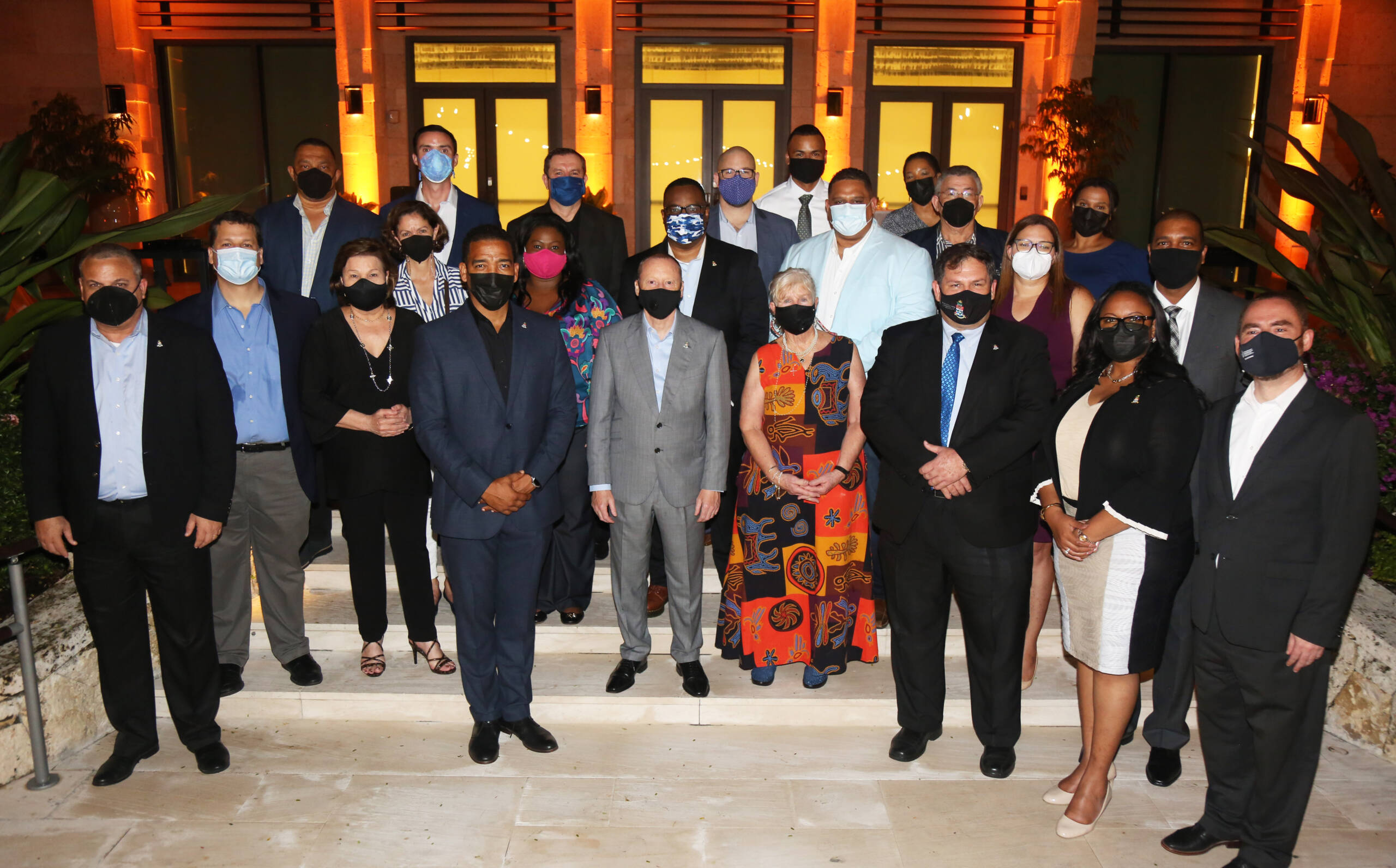
Government officials have completed a day of meetings with cruise line chiefs, in a bid to work out details of how Cayman can begin safely receiving cruise ship tourists again.
Eight representatives from various cruise lines and the Florida-Caribbean Cruise Association took part in meetings on 2 Feb., which culminated that night with a networking event at the Kimpton Seafire resort, at which business owners from the private sector also had a chance to meet with the cruise line bosses.
Representatives from Royal Caribbean, Carnival, Disney, Celebrity and Holland America cruise lines were among the delegates.
No announcement was made at Wednesday’s event regarding when cruise lines might return to Cayman. However, according to a summary of Cabinet minutes from its 25 Jan. meeting, the government extended the temporary ban on cruise ships only until 28 Feb. 2022, though that date can be extended further, if necessary.
Tourism Minister Kenneth Bryan, speaking at the networking gathering following the day’s meetings, said, “At the very top of the list are our health and safety protocols that will allow cruise shops to return while keeping our community safe, because, right now, due to the pandemic, we have no cruise tourism at all, and that’s a sad day for our country. So, our immediate priority has been to discuss a way forward that will allow cruise ships to return while keeping our communities safe.”
He said he was optimistic a “satisfactory outcome will be reached in due course”, and that the Ministry of Tourism would be releasing more information regarding the discussions.
In 2019, 1.83 million cruise passengers passed through the Cayman Islands.
Pre-disembarkation LFT ‘not practical’
Michele Paige, president of the FCCA, told the Compass that at least one of the conditions the government had hoped to place on the cruise ships before allowing them to make stops in Cayman – to ensure passengers underwent lateral flow tests before disembarking – could not happen, as it would not be practical.
Bryan, speaking on Radio Cayman’s ‘For the Record with Orrett Connor’ the day before the cruise delegation arrived on island, had said that government would request that all passengers arriving in Cayman should be tested before getting off the ships here.
Paige said testing people on board the ship before they got off would not work as it would require too many technicians to test thousands of passengers, or to observe and verify those results. Testing the passengers at the port after disembarking would also be impractical, she said.
“Could you imagine having 3,000 or 4,000 passengers do testing?” she asked. “They already had to take a tender into port which took about half an hour or 45 minutes, maybe even an hour if they had to queue up. Now they have to stand in line to do a test.”
First port of call
During the meetings, making Cayman the port of first call for all ships stopping here, so that the passengers would not have visited other islands before landing, was another topic of discussion.
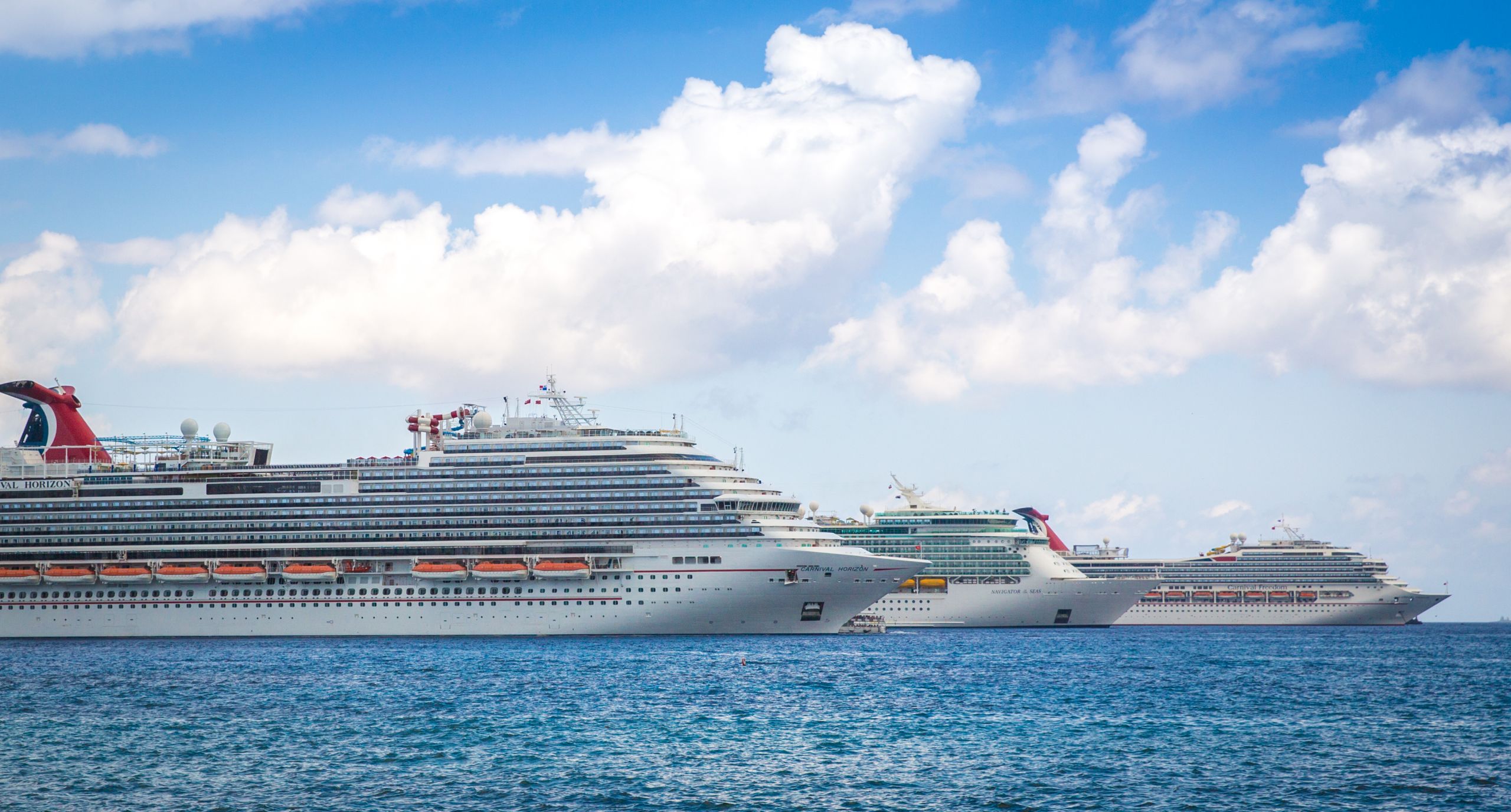
Speaking with reporters on 2 Feb., Paige said government officials had asked how many ships would be willing or able to make Cayman the first port of call. Cruise lines would have to look into the financial impact this would have on the cruises, she said.
“Recognising that there is a need, while we want to make sure that the safety and security of everybody in Cayman is taken care of, but there is an economic impact [on the cruise lines] here,” she said. “So, how do we prepare the private sector for the ships coming back, and how do we also look at what is possible within the cruise industry?”
Bigger cut of revenue for Cayman operators?
Another topic of discussion at Wednesday’s meetings was how local tour and water-sports operators on Cayman could get a higher percentage of revenue from the on-island tours and experiences booked by passengers on board the ships.
Bryan said there was a “compelling need” for government, FCCA representatives and all cruise sector tourism stakeholders to work collaboratively “to find ways to rebalance the distribution of income derived from the cruise tourism industry so that Caymanian business owners have the opportunity to increase the earnings in return for the hard work they put into consistently delivering a high-quality tourism product.”
Asked how talks on this subject went, Paige said the issue was not about the cruise lines taking a smaller percentage of the revenue, leaving more for local businesses, but “it is about elevating the product to create a higher price”.
She said higher-spending cruise passengers would be willing to pay more, so long as they’re offered an exclusive, high-quality experience, perhaps ones that would show them a side of the Cayman Islands that they would not have seen pre-pandemic.
She gave the example of quick trips to Cayman Brac, where the passengers could fly to the sister island and spend a few hours there, before returning to Grand Cayman and re-boarding the ship, or providing very local cuisine offerings and more interactive experiences with local Caymanians.
Jobs for Caymanians on board the cruise ships was also discussed, Paige said.
Cayman ready for new guests
The Cayman Islands will be ready to receive cruise visitors as soon as protocols and arrangements can be worked out, Bryan said.
The minister explained that the Port Authority and all the major tourism attractions, as well the tour operators and service providers, already had COVID-19 protocols in place, and some entities, such as the Cayman Turtle Conservation and Education Centre and the Tourism Attraction Board, had new tours in place “ready to receive new guests”.
“So, yes, we are certainly ready from a preparation perspective,” he said. “And that’s why we’re keen to get to the point where we can safely welcome cruise ships back to our shores so people can get back to work doing the jobs they love, promoting our islands and our people to the rest of the world.”
Paige, addressing the gathering on 2 Feb., said the cruise industry was looking forward to “renewing one of the best relationships we’ve ever had in the world, with the Cayman Islands”.
She said, “The Cayman Islands, because of the private sector, has always delivered a phenomenal experience. You’ve always been at the highlight of every single cruise passenger’s experience. So, it is only fitting, that with the work that is being put in place, to make sure that we elevate the product and elevate the expenditure that the passengers and crew spend in the Cayman Islands, that it is going to be a very rewarding time for all Caymanians.”
Paige described the meetings as being “very rewarding”, and the cruise lines had listened to officials on what was required to bring the ships back to Cayman and “how to respond to all the health requirements”.
She said she hoped the cruise industry would soon be allowed to return to Cayman, adding that she was prepared to return here for talks “as many times as it will take… to be able to make it happen”.
Paige said the cruise ship trips to Cayman may not resemble those that took place before the pandemic, and that the industry was looking to the future, and not to replicate exact experiences that passengers have had in the past.
“The cruise industry has to respect what the Cayman Islands wants in terms of the cruise industry product,” she said. “So, it’s a respect back-and-forth, and that’s where we are right now, is discussing that respect. It’s almost like when you’re painting a picture, it’s like a blank canvas, and you can do whatever you want. There are no preconceived notions.”
Related Videos








Sorry but what about the environment and sustainability? Pollution, dumping, etc. Are we back to turning a blind-eye on all of that?
The requirements for disembarking cruise passengers must be the same for visitors arriving by air. I completely understand and support the stance of the cruise representatives that testing every person on board by an observed LFT before allowing passengers to disembark is not practical. If Cayman is the first port-of-call will those ships arrive here 1 day after leaving their home port? If not, even if they are delayed due to weather, or other unforeseen events then the passengers should not be eligible to disembark without a verified LFT. Exceptions should not be granted to cruise passengers. If I am arriving via air and my flight is delayed or canceled and I end up on a flight arriving one day after my original scheduled arrival I am required to get another certified LFT dated one day before my new arrival date. Without that test, I can’t board the flight to GCM.
Do I want multiple cruise ships with 3000+ passengers in port on a daily basis? NO! But I believe it is inevitable and I believe CIG will continue to press forward with bringing cruise tourism back. Cruise tourism should not be placed above air arrivals. Many have said it before but I’ll say it again, we should be focusing on stay-over tourism, but until all of the testing requirements during the stay are eliminated stay-over tourism will not return. Emphasis should not be on cruise ships until we’ve seen a true effort to reestablish stay-over tourism.
I imagine they will have to have a lateral flow test for the cruisers on hours 2, 4 and 6 along with a PCR to exit the island. Maybe they can set up a testing station at the turtle farm and keep people quarantined there if they don’t pass the tests.
I would assume stingray city will be set up in the same fashion. Maybe a floating test station out there for everyone.
I’m sure the Jolly at the Kimpton was enjoyed by all, but little will change. No covid tests on arrival, continued price gouging share of the land based trips and our roads swamped with cruise sheep traffic made even worse by the closure of Cardinal Ave. What MUST change is numbers, we can’t put off our main revenue source, and our standing as an upmarket destination for stayover visitors, so cruise arrivals should be limited to 50% of the 2019 total.