

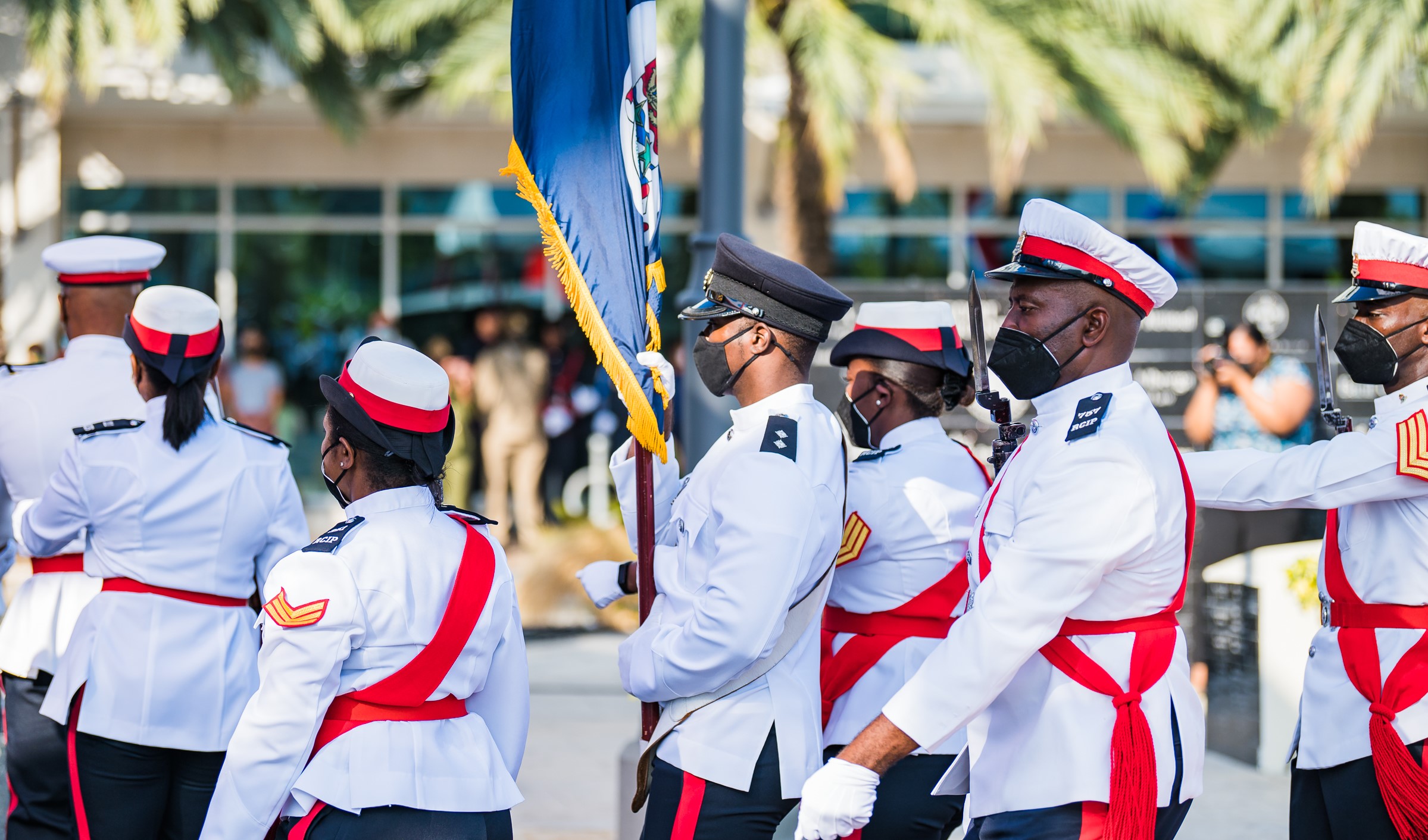
A judge has ruled that changes to shift times for Royal Cayman Islands Police Service uniformed officers were unlawful and should be reversed.
The Royal Cayman Islands Police Association, along with two constables, had challenged the shift changes in court on the basis that they had led to fewer vacation days for officers.
Prior to the new shift policy for uniformed officers being officially introduced on 1 Jan. 2021, officers had been working shifts of seven-and-a-half-hours per day, with six days on and four days off. Under the new policy implemented by Commissioner Derek Byrne, officers are currently required to work 12-hour shifts, which include an hour off for lunch, with four days on and four days off.

Grand Court Judge Kirsty-Ann Gunn delivered her decision on a judicial review in early December but the written ruling on the case was not published until this week.
The police commissioner, when asked by the Compass for a response to the court’s ruling, said he could not comment as the case was being appealed. A representative from the police association also declined to comment on the case, pending the appeal.
The one-day hearing into the judicial review – filed by the Royal Cayman Islands Police Association and the two officers against the police commissioner and the attorney general – was heard on 23 Sept.
The police association’s attorney Guy Dilliway-Parry had argued that the altered work hours effectively meant that the allotted vacation time for some officers was reduced from 22 days to 15.
The court had heard that under the Public Service General Orders, police constables are guaranteed a minimum of 165 hours of leave each year. To comply with this, Dilliway-Parry argued in his submission to the court, for decades, the RCIPS had calculated vacation time by dividing 165 hours by 7.5, resulting in 22 days of vacation. With the new calculation of shift times, the 165 hours was divided by 11 hours, resulting in 15 days of vacation.
“While officers did receive more days off as rest time as a result of the new shift, this is not a question of balancing and compensation, it is a matter of the statute and there is no ambiguity in what officers are entitled to,” Dilliway-Parry told the court in September. “By reducing the vacation days, the new policy breached the statute and, in doing so, became illegal.”
Shifts extended during lockdown
The 12-hour shifts were first introduced in March 2020, in response to a need for increased policing during the COVID-19 lockdown, Byrne explained in an affidavit submitted during the court hearing. From March to December that year, constables worked 12-hour shifts, while retaining their 22 days of annual leave.
In surveys of officers carried out by the RCIPS, the “vast majority” said they preferred those work hours, the commissioner said.
He added that, to ensure that uniformed officers were on par with non-frontline staff who worked 7.5 hours a day, five days a week and received 30 days of annual leave, constables on shift received an additional 15 days off, as well as the 15 days of leave under the new calculations.
Attorney Jevon Alcock, representing the commissioner, had accepted during the hearing that the practice of granting additional time off to uniformed officers was not documented in the Uniform Shift Policy nor in any employment contracts or elsewhere, and therefore was not guaranteed.
Gunn noted the commissioner’s argument that while the amount of calculated vacation time under the new policy was less “on paper”, officers were getting an additional 15 rest days a year, and the commissioner had the discretion to grant one rest day off for every vacation day lost under the new policy.
Inadequate compensation
But the judge said that by acting on a discretionary basis, the commissioner had not guaranteed the additional time off.
“By proceeding on a discretionary basis,” she wrote, “the Commissioner has, in practice, reduced the officers’ actual entitlement by seven days without adequately compensating for the shortfall.”
She added, “The decision to change the formula, thereby reducing leave entitlement is, therefore, an abuse of power and in breach of Article 19 [of the Cayman Islands Constitution] in respect of all officers employed prior to 1 January 2021.”
Article 19 states, “All decisions and acts of public officials must be lawful, rational, proportionate and procedurally fair.”
The judge ordered that the new Uniform Shift Policy be revoked for all officers who had been hired by the RCIPS prior to 1 Jan. 2021, and that the previous policy of seven-and-a-half-hour shifts be reinstated.
She said determining whether this would apply to officers hired after that date was beyond the scope of the court as it had not been addressed by either party in the judicial review.
Pending the appeal, it appears that the 12-hour shift policy, with four days on and four days off, remains in place.
Related Videos













Do civil servants work 7.5 hours a day, 5 days a week and receive 30 days of annual leave (6 weeks), that seems pretty generous.