


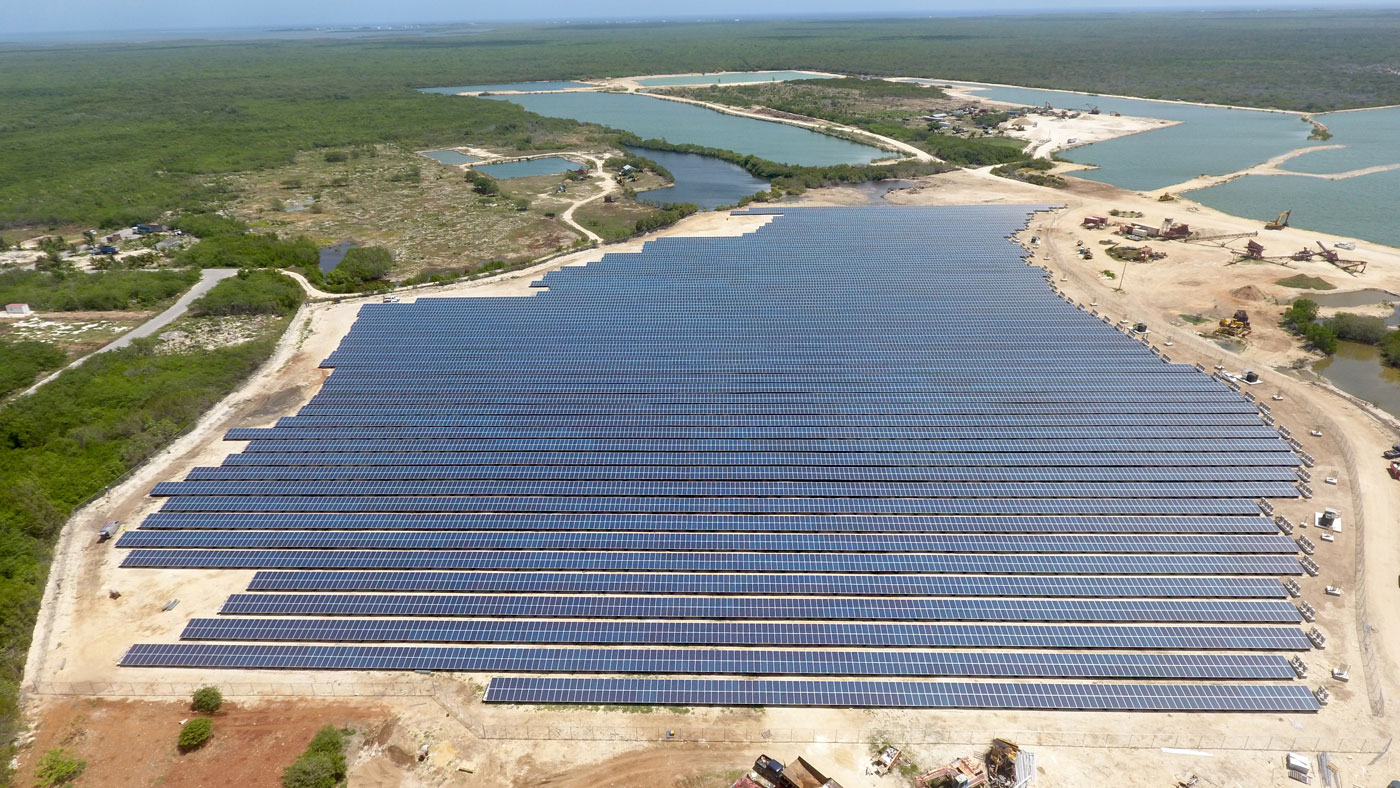
Caribbean Utilities Company hopes to build as many as six major solar farms in an effort to slash Cayman’s carbon emissions, meet renewable energy targets and cut the cost of electricity.
CUC vice-president Sacha Tibbetts said it was time to “press go” on the island’s energy transition, arguing it will save millions of dollars.
There has been some scepticism about Cayman’s ability to meet ambitious goals of deriving 70% of its power from renewable sources within 15 years. But Tibbetts said those goals are realistic and argues that large-scale solar can make the biggest, swiftest gains without negatively impacting the environment.

Utilities regulator OfReg is about to begin rolling out a series of auctions for renewable power projects and CUC plans to be heavily involved in the bidding process.
Tibbetts said the company is eager to get started.
“If we could have just gone ahead and done it, we would have reached the national energy goals by now,” he said, referring to the national target that 70% of the island’s power supply should come from renewable sources.
The current ratio is less than 5% but Tibbetts said a single project could move the needle significantly.
OfReg has been debating the best means to procure energy supply contracts for some time, ultimately deciding on a competitive auction process that allows qualified bidders to vie for projects.
Tibbetts said CUC, in its Integrated Resource Management Plan, had indicated 140 MW of renewable energy would be needed by 2037. Cayman currently has one 5MW solar farm.
He hopes the bidding process will begin this year and that work can start soon after, on what is likely to be the first of several $100 million projects.
Tibbetts acknowledged CUC would likely have competition for power supply contracts but said the company aims to be a big part of the island’s energy transition.
If successful in its bid, he said the company had a long-term vision that could include as many as six 150-acre solar farms, each supplying somewhere between 20MW and 40MW of power.
Environmental impact not a concern
Addressing concerns that utility-scale solar projects eat up valuable land, he said six solar farms would take up less total area than the airport.
Citing a Department of Environment survey that indicated there are around 1,500 acres of undeveloped land across Grand Cayman that are not considered environmentally sensitive, Tibbetts said this was more than double what would be needed.
He said all solar farms would be subject to the usual planning process and insisted CUC would not do anything to impact important ecological land.
He added that the company had been running a mangrove education programme for schoolchildren for two decades and would not do anything that negatively affected important habitat.
Tibbetts insisted there was room for expansion of both solar farms and smaller scale rooftop solar, known as distributed energy. He said CUC was currently increasing its battery storage capacity, which will grow further as utility-scale solar farms, with on-site batteries, are developed.
That should provide more capacity for schemes like the CORE programme, which facilitates homeowners putting solar panels on their roofs.
While wind and other forms of renewable energy are in the mix, CUC is firmly focussed on solar, believing it has the best potential for the quickest gains, said Tibbetts.
“One project could be significant enough to reduce our fuel usage by 10%, which would reduce our CO2 emissions by 10%.
“It is just a matter of saying go and we are ready to go.”
He reiterated CUC’s analysis that solar is now significantly cheaper than fossil fuel-generated energy.
“If you can generate 50% of your energy from a source that is 30 or 40% cheaper than diesel, that is potentially millions of dollars in savings.
“Every day we don’t press go, that is thousands of dollars we are losing in potential savings.”
Related Videos












This is a good idea but the sun doesn’t shine at night. How will the power be stored for nighttime use?
That hardly seems aggressive enough in regards to the timeline.
I find it hard to believe that solar farms would not be an eyesore on our beautiful island. Put them on as many rooftops as you can, but please not on the land!
Ideally, every rooftop on island should have solar panels. Let’s work towards that!