Deputy Premier Chris Saunders has said government is moving to end the tourism stipend by April and transition displaced workers, who are not fully employed, to a grant programme at a smaller sum in some cases.
Speaking to the Cayman Compass Saturday at the Dart-organised hospitality industry job fair, Saunders said getting tourism workers on the job was key to relieving government of the stipend payments.
Government cannot continue the stipend long term, the finance minister said, as the payments total $5 million monthly.
“That in the present is unsustainable and I think no one can [disagree] with that … spending over $60 million a year on the stipend,” he said, especially as government already spent tens of millions of dollars to promote the Cayman Islands to attract businesses to local shores.
“That is being done on behalf of Caymanians and Caymanian businesses,” he said, which is why he stressed the need for displaced workers to get every job opportunity available.
“People need to understand, just as the government is making investment to bring people here, we also need to make sure that when they do come in that it is Caymanians that are benefitting,” he added.
“We are not doing this for anyone else to benefit but our people.”
From April, Saunders said his proposal will be to continue paying a stipend only to people who are not fully employed.
He said this is because gratuity is a large part of income earned in the tourism industry, and with stayover tourism still rebuilding and the cruise industry remobilizing, the gratuity earnings for workers will continue to be low.
The deputy premier, Tourism Minister Kenneth Bryan, Premier Wayne Panton and other government officials were on hand for the employment fair, which saw some 290 jobseekers register for opportunities at the three hotels under the Dart portfolio.
New assistance scheme
Speaking about plans for the stipend, Saunders said the proposal will see “top up” payments for employed tourism workers.
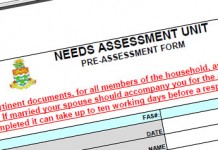
“Government will continue paying for those within the tourism industry that are already employed… making some level of income. We will continue to pay them something to, at least, offset what they would have lost from gratuity. Those in the cruise [industry] and watersports, we will continue to pay the full $1,500, and then after that, now people can basically start applying to Needs Assessment Unit,” Saunders said.
Those payments will continue until June, he suggested.
He pointed out that April will mark almost two years since government has been paying the tourism stipend, which is well now over $100 million out of the public purse.
“So at some point, now we need to start moving those funds into other areas in government that actually need assistance. We have a lot of plans for education, we have mental health that we need to be looking at and also the other things that we want to get to,” Saunders explained.
Some 625 recipients who are now fully employed, as announced last month, have started receiving reduced payments – $1,000 in February and $750 this month.
A total of 2,400 individuals are receiving the $1,500 monthly stipend. However, payments are contingent on the completion of a survey outlining the recipient’s employment status.
Saunders said those surveys will continue as the stipend programme transitions to a grant programme.
He said the main concern is ensuring the country continues to have the cash flows to keep the economy going.
He said transitioning away from the stipend is important for the public purse, as government had a small surplus target of $19 million upon taking office, and now the forecasted deficit is $58 million.
“Nineteen million dollars is one hurricane, one emergency away from basically being wiped out. So we need to make sure that government finances are on a very solid footing. We have literally been tracking even cash collections almost on a daily basis from financial services and everything else just to see exactly where we are. I mean we have borrowings included in the budget for this year. The government position is if we don’t need to borrow or worse case if we do it is only going to be for what it is that we need,” he said.
He said three more months of the stipend, even past June, would mean the $19 million surplus is gone.
“We are really tightening up where we really do not have to spend, watching our cash very closely,” he said, adding that does not change the government’s commitment to take care of Caymanians who may need assistance.
However, he said what is needed is getting people back to work to ease the strain on government resources.
“It starts with at least making sure that one, our people are fully employed, as whoever is willing or able to work can actually give that opportunity to work. And then we can start focusing on other priorities of the government, taking care of our elderly, and other priorities that we want. But it starts with making sure that our people are given opportunity to live their best life,” he said.
He said the end date for the stipend is not a hard and fast target, and there will be assessments along the way.
“At the end of the day, first and foremost, it is about taking care of our people. So if the [tourism] volumes aren’t there, then we’ll assess as we go, and all it directly means is that some things that we like to get done in other areas, we just have to delay that because taking care of people is first and foremost, making sure our people have a roof over their head and food on a table,” Saunders added.
Related Videos