For financial institutions and service providers the unprecedented and expanding sanctions against Russia present exceptional compliance challenges.
The response to Russia’s war in Ukraine is unique both in scope and in terms of the interconnectedness with Western economies of those targeted by sanctions.
At the same time, the sanctions landscape across the various countries is fluid with new individuals and companies added on an almost daily basis.
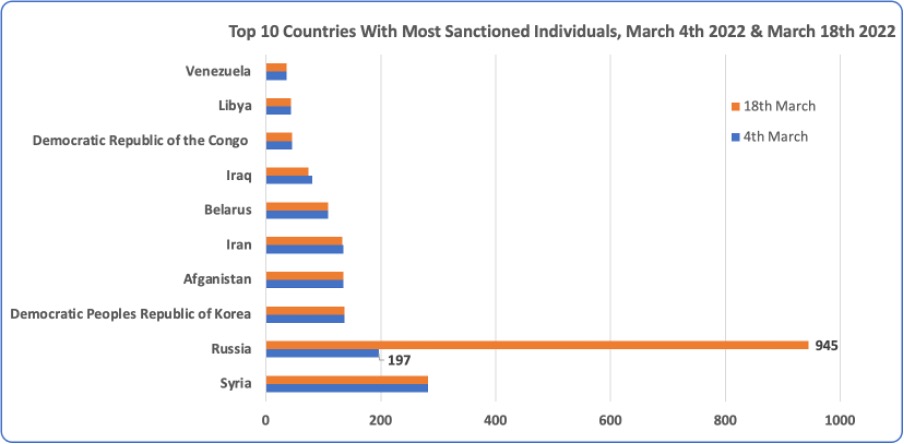
An analysis by local consulting firm FTS shows a 380% increase in Russian individual sanctions on a global consolidated list over a two-week period.
The number of listed Russians jumped from 197 on 4 March to 945 on 18 March, while none of the remaining top 10 countries with the most sanctioned individuals have experienced any material changes over the same period.
 “Everyone is well aware that sanctions have increased since the conflict began but we thought it might be interesting to monitor the extent of the changes to this global consolidated list over time,” explained FTS director Paul Byles.

Although companies in the financial industry must apply sanctions all the time, the pace of change and the rapid expansion of sanctions as a foreign policy tool is unmatched.
Aside from Russia, sanctions are imposed in connection with other war and conflict zones from Syria, Afghanistan and Iraq to Libya. The Democratic Republic of Congo finds itself on sanctions lists for systematic violence against individuals and human rights abuses.
This week, the US sanctioned a Belgian businessman over allegations of illicit gold trading in Congo.
Sanctions are also applied against North Korea over its nuclear weapons programme and against Iran for its nuclear enrichment activities. Meanwhile, Belarus and Venezuelan leaders are facing asset freezes and travel bans over the illegitimacy of their presidencies.
While there is no publicly available data on the number of suspicious activity reports filed in the Cayman Islands since the war in Ukraine began, Byles believes there are likely many such reports.
“Every international financial services jurisdiction will be having a similar experience right now in relation to the significant increase in sanctions reporting and I wouldn’t expect the Cayman Islands to be any different,” he said.
“I would imagine that local authorities are a bit overwhelmed right now with the increase in reporting. That’s not a bad thing. It simply means that as a jurisdiction this aspect of our regulatory framework is working.”
Complexity calls for sophisticated technology
Sanctions screening can quickly become complicated.
While the UK and EU sanctions lists have become more harmonised, there are still differences between the two as well as the US list of sanctioned individuals and companies.
There are software solutions available to check on individuals, businesses and entities on various sanctions lists and running these applications across client databases is straightforward.
But monitoring individuals and entities that are connected to those sanctioned make this process more difficult. These politically exposed persons (PEPs) may not be sanctioned directly but nevertheless can pose a significant risk and mean more extensive due diligence and closer monitoring.
For instance, The Guardian reported this week that billions of dollars associated with sanctioned oligarch Alisher Usmanov may be held in bank accounts controlled by his family members.
Usmanov’s sister Saodat Narzieva, who works as a gynaecologist and obstetrician in a hospital in Uzbekistan’s capital Tashkent, appears to be the beneficial owner of 27 corporate accounts at Credit Suisse, the newspaper said. One of the accounts held almost 1.9 billion Swiss francs.
The implications of the sanctions also go more broadly beyond those who are listed. Two months ago, Russia may have been considered a medium-risk country. Now that it is classed high risk, all transactions, clients and counterparties have to re-evaluated.

For Bob Taylor, head of corporate business development at Global Risk and Data Authority Ltd., a compliance solutions provider, the only way to deal with the issue is technology.
“In a world of one-sanction-a-month type of activity, people could do these things manually,” he said. “But if you look at the rapidity of changes and the complexity of these structures, organisations can’t have static databases.”
Those who do not want to use technology would have to double or triple their staff.
But the job of a good compliance officer is not to manually check official sanctions lists and make updates but to make decisions based on the available information, Taylor said.
“Do we want this person as a client? Do we want to allow this transaction to go through? Is this something of concern? Rather than performing tasks that can be automated.”
Given the widespread use of complex offshore structures by Russian billionaires, Taylor said the Russia sanctions illustrate the need for sophisticated compliance technology.
“The minimum [use of technology] that was acceptable is no longer appropriate for the level of sophistication of Russian oligarchs.”
Related Videos