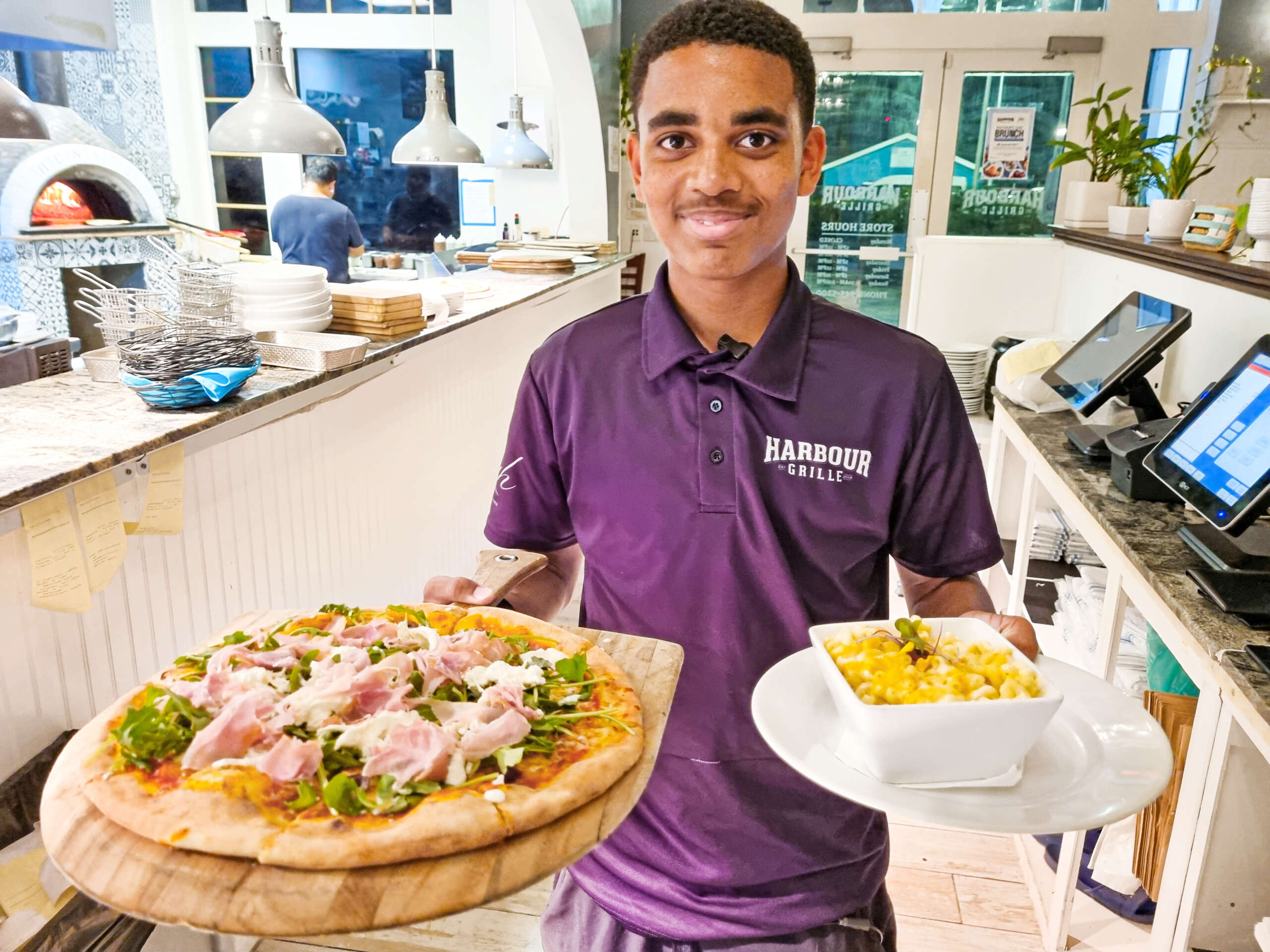
Nimbly balancing a large pizza on a wooden slab in one hand, while holding an assortment of entrées in the other, Seaford Russell Jr.* navigates the restaurant floor on a busy Friday afternoon at Harbour Grille as if it was second nature.
However, at 15 years old, it is still a novel experience for him and a handful of his John Gray High School classmates, who are getting their first appreciation of a fair day’s wage for a fair day’s work.
“It all started when I said to the whole year group of 210 students, ‘There are six places available and, if you are interested, come and see me at lunchtime’,” said Glen Hewell, the school’s Student Progress Leader. “At lunchtime… 82 turned up and I thought to myself, this is an amazing, wonderful problem to have.”
In light of the high demand, Hewell went back to the employers and was able to double the entry-level job openings. After a string of initial meetings, the group was reduced to 32 students, each of whom was given 30 seconds to state in a nutshell why they deserved the job.
“In the interview… they were saying ‘I need to get money to help my parents’, ‘I need the money to buy things’, ‘I need the experience’,” said Hewell. “All successful people worked when they were younger… we learned to handle money, we learned to be on time, we learned to handle pressure. It can only be a good thing.”
Russell was one of the standout students. He told the Cayman Compass, “When I heard about the jobs, I thought about my mom and my two sisters, and I wanted to help out with the bills and get some experience.”
Young people want to work
In previous years, John Gray High School had a thriving student internship programme which placed dozens of high school seniors in entry-level jobs across numerous industries on a temporary basis.
However, the programme had collapsed, and students seeking jobs and work experience were forced to join the line and compete with Cayman’s wider employment market.
In his new role as progress leader, Hewell said it was clear the students wanted to work, not just during a two-week stint, but as interns during summer holidays.
Now, the fledgling programme is getting a reboot and is seeking to place students aged 14 and 15 in extended part-time employment.
“Young people want to work. They want to work at weekends, they wanted to work for obvious reasons,” Hewell said.
“We started to contact local companies, and there were three in particular – [the] fantastic Alan Simpson from Sharkeez and Hard Rock Café, Matthew Clubbe from Salty’s, and Ms Una [Flanagan] from Eats and Legendz – … [who] said we would like to employ John Gray kids on the weekends.”
Collectively, these restaurants are employing 12 of the teens, but with several dozen students still hopeful of securing employment, Hewell said they need more companies to come on board if the budding programme is to be successful.
Clubbe, general manager of the Harbour Grille group of restaurants which includes Salty’s, believes that while summer internships are a great way to introduce students to employment, he believes meaningful experience and exposure can only be gained through long-term employment. “With this, they are given some responsibility and they rise to the occasion,” he said.
He added, “Monday to Friday 9 to 5 is great but we need them to be able to work weekends and public holidays and at different times.”
But with the new employment prospects, there must be a balance, says Flanagan, a manager at Eats Cafe and Legendz Bar and Grill.
“Before the students begin to work, we meet with them and their parents and clearly outline what is expected of them, and what the role entails,” she said. “Our student employees are treated no different from our regular employees, in that they are paid and expected to work a set amount of hours.”
She added, “But we make sure to schedule them so that they can get their hours in on Friday and Saturday night or even a Sunday morning and then be able to get home do their school work and rest for the Monday morning start.”
Shifting mindsets to employment
Hewell said since his arrival at John Gray, more than a decade ago, there has been a fundamental shift in stigmas which once would have dissuaded students from working in the service industry.
“Back in the day, a lot of people, not everybody, but a lot wouldn’t be seen dead working in the fast-food industry. They said that it just wasn’t their thing,” said Hewell. “But now, the young people want to work, they are prepared to get their hands dirty, they are prepared to turn up. Obviously, they want the money and the experience and it’s a different culture.”
Aijulon Thomas, 15, is a Year 10 student who represents that shift in mindset. She still remembers her first day on the job.
“I was so nervous, I kept walking around the place asking people what to do, because this was my first job,” said Thomas. She said she spent her first-day polishing silverware and setting tables at the Hard Rock Café.
Through its Life Skills class, John Gray High provides students with a chance to prepare their resumes and practise interviewing skills. However, Thomas notes that even with prior preparation, the job market is extremely competitive, which could leave students at a disadvantage.
The most recent snapshot of Cayman’s employment market, the 2020 Fall Labour Force Survey released in March 2021, showed there were at least 1,759 unemployed Caymanians.
With the country still reeling from the economic hardships brought on by the COVID-19 pandemic, John Gray Students must now compete with adult Caymanian job-hunters.
“I think other business owners should help to provide part-time jobs for us, because a lot of my friends want to work as well, but there are enough spaces,” said Ariana Chambers, 14, who works in the Hard Rock clothing store.
Russell, who intends to keep his job for some time, is also calling on his classmates to join the search.
“Look online, look in the papers, reach out and do your part,” he said. “There are jobs out there, some of them you just have to search a little harder for.”
But, with at least another 60 students hoping to secure work, Hewell said there must also be greater community participation.
*Editors Note: The Seaford Russell Jr. featured in this article is not the same Seaford Russell Jr. who is employed as a journalist with Cayman Compass.
Related Videos