

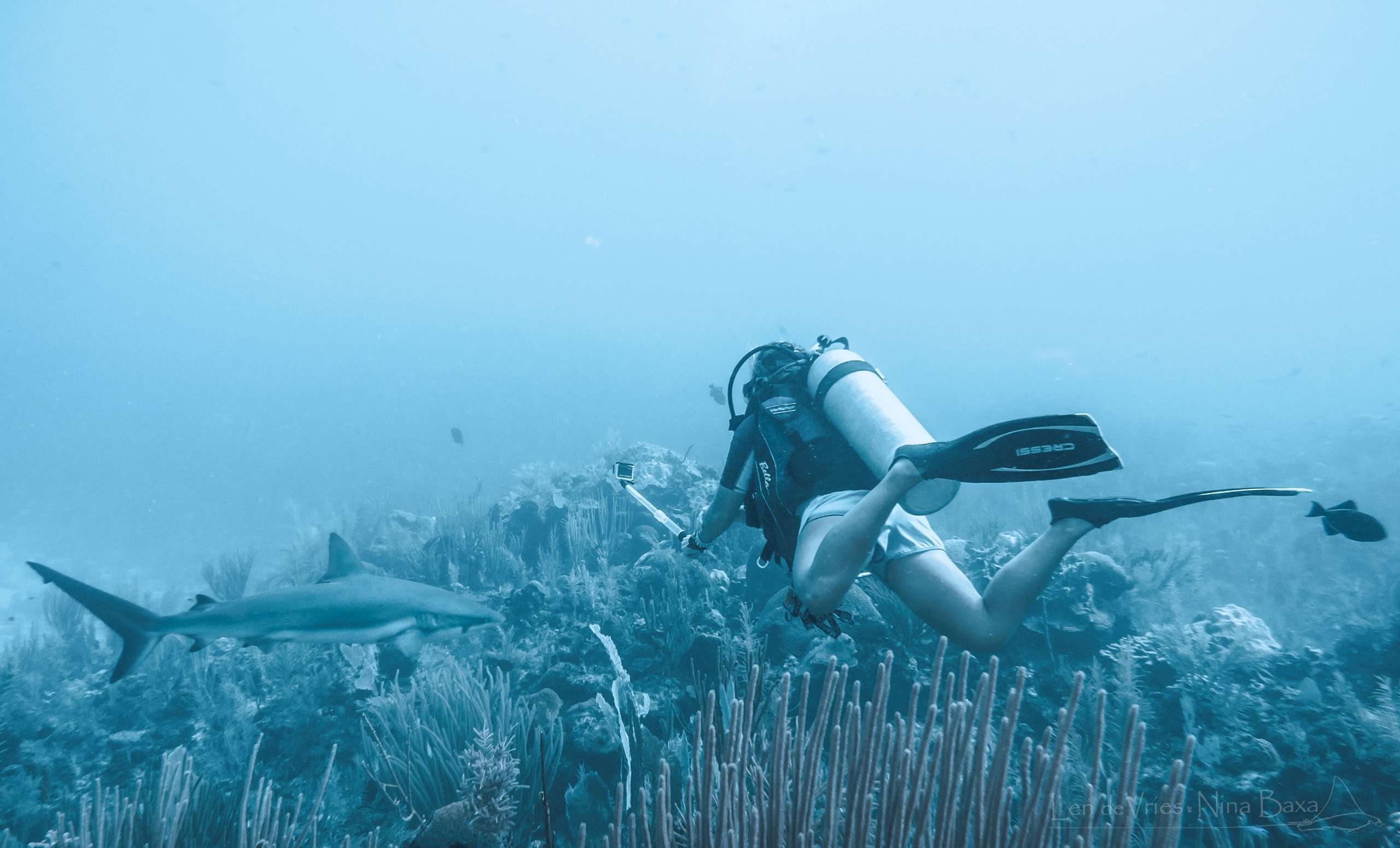
Local divers logged more than 550 shark sightings in Cayman’s waters last year, with the most commonly seen species being the Caribbean reef shark, a welcomed sign for Department of Environment’s Shark Project Officer Johanna Kohler.
Kohler, in response to queries from the Cayman Compass on the findings, said, compared to previous years, the number of shark sightings per dive has increased.
“On the one hand, this could mean that the numbers of sharks have increased; on the other hand, it is likely that the preference of local divers to pick dive sites where sharks are more frequently seen has skewed the results,” she said via email.
She added, “However it is possible that, during COVID, the reduced human disturbance, such as fishing activities and boat traffic, as well as diving, have benefited the shark population. Hence, continued monitoring will give more insight whether the observed trend is true.”
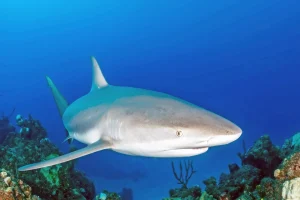
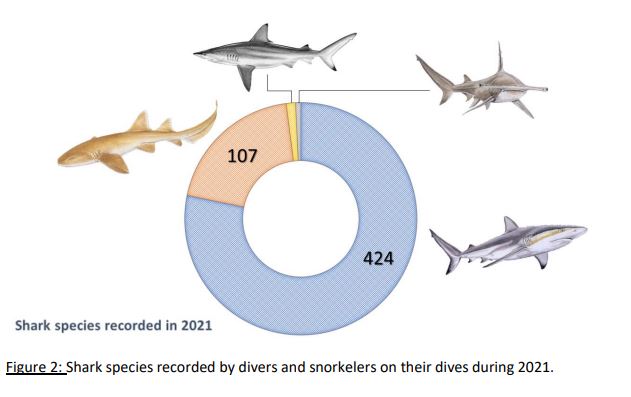
According to statistics from the Sharklogger Network’s 2021 report, four of Cayman’s coastal shark species were sighted – Caribbean reef, nurse, great hammerhead, and blacktip shark.
“Caribbean reef shark was the most commonly recorded shark, with a total of 424 sightings followed by nurse sharks with 107 sightings. Participants recorded only four hammerhead and 7 blacktip sharks throughout the entire year,” the report stated.
“It is great to see that divers saw a small number of hammerhead and blacktip sharks. As these are typically two of the lesser abundant species on our reefs, any sightings of them by divers are good news, i.e., an indication of healthier shark populations,” she added.
Healthy shark population equals healthy reef
Kohler said it was interesting to see that only four of Cayman’s eight coastal shark species have been reported.
 “This might have been due to the limited amount of diving compared to the previous years. Rare species, such as tiger and whale sharks, are less frequently encountered, so if the total number of dives is small, then it is less likely that those species are reported. The other part that is surprising is the relatively large number of Caribbean reef shark sightings,” she added.
This species, she said, is one of the most abundant on Cayman’s reefs. However, she said the number “seems to be biased because of the diving behaviour of residents who prefer to dive in areas where it is more likely to encounter a shark”.
Previous surveys have shown that tiger and lemon sharks also inhabit Cayman’s coastal shelf, but the report stated these were not seen on dives logged by participants in 2021.
Last year, the DoE relaunched its Sharklogger Network, in which volunteer divers help monitor Cayman’s shark population.
In March 2020, the programme was stopped because of local COVID health regulations implemented by the Cayman Islands government. After these restrictions were lifted in July 2020, participants resumed logging their dives and shark sightings for the programme, the report stated.
“It was fantastic that so many participants either resumed or started to log after the official relaunch, showing a major increase in the number of submitted dives. We could not do it without these dedicated and caring volunteers and companies,” Kohler said.
Support welcomed
From January to December 2021, a total of 1,093 dives were logged by 38 resident divers and snorkelers, with a monthly minimum total of 48 dives in June 2021 and a maximum of 145 dives in July 2021.
“This shows that the relaunch of the citizen science programme in June 2021 has significantly increased the data collection thereafter. Across all three islands, divers and snorkelers spent a total of 913 hours to survey 295 dive sites,” the report stated.
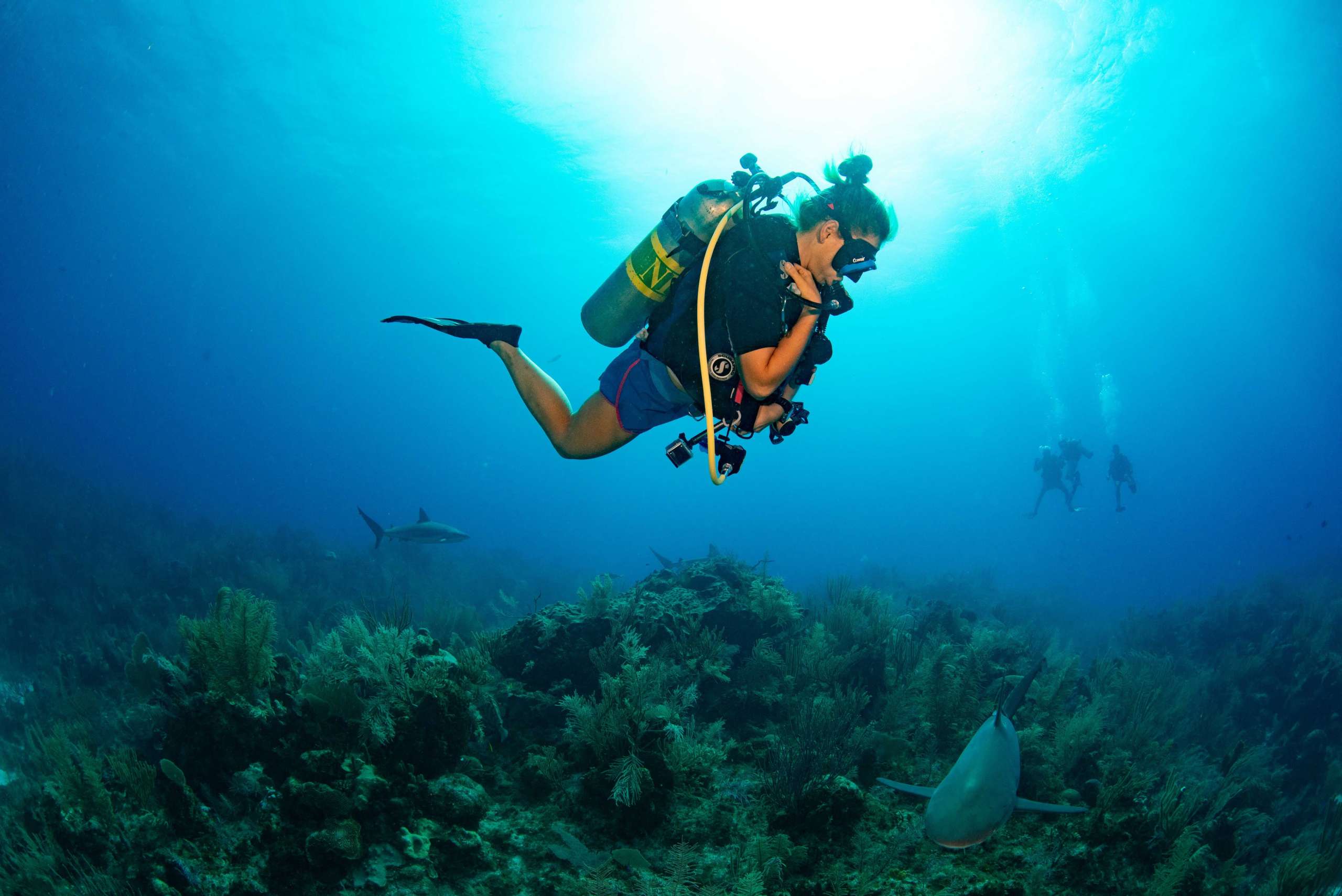
Sharks play an important role in keeping the balance of the marine environment and are protected under the National Conservation Law.
They help the reefs by keeping prey populations healthy and in balance, by exerting top-down pressure, which affects the entire food web and ecosystem.
If they were to disappear, this would have a catastrophic effect.
“In the Cayman Islands, the decrease of sharks could trigger an algae state on our coral reefs, for example, meaning overall reef health and fish populations would decline too,” she said. “So in order to keep our reefs and fish population healthy, we need sharks.
“Besides the ecological benefits, sharks are also of socio-economic value to Cayman. A shark in Cayman is worth more alive than dead. Sharks are usually the highlight of any dive they are seen on and divers do travel around the world to see them.”
How the programme works
Kohler said the sharklogging programme, which is part of the DoE’s shark research, means valuable data is collected throughout the year.
“This way, we are able to monitor our shark population month-to-month and gain detailed data,” she said. “It is designed by DoE scientists and the dive information is collected on specific spreadsheets designed specifically for this citizen science initiative to help standardise the data. This ensures a high quality of data which is important for a statistically robust analysis and ultimately confidence in results. The Sharklogger Network is an integral part of our shark research.”
According to the 2021 report, by recording every dive with shark sightings and those without shark sightings, as well as ‘sharks per dive’, the chance of seeing a shark on a dive is calculated.
“This gives an indication of the relative abundance of sharks in a particular month or area and is important information for the monitoring of our shark population throughout the year,” it said.
Sharks were encountered throughout the year, with most sightings being made in February, March and June.
However, the report noted that a noticeable, temporal decrease of shark sightings was recorded on dives between August and November 2021.
“Previous surveys have shown that sharks are more mobile in summer than in winter, making it less likely for divers to encounter individual sharks in their usual home range during the summer months,” the report stated.
Dive operations, including the Central Caribbean Marine Institute, the Lobster Pot Dive Center, Ocean Frontiers, Divetech and Red Sail Sports Grand Cayman, all participate in the sharklogging programme.
While seeing a healthy number of sharks is a sign of a thriving reef, Kohler said, accidental catch remains the number one threat to sharks.
“[This is] followed by habitat destruction, e.g., mangroves and shallow seagrass beds, where they go to pup and where the young ones live and human disturbances, such as diving activities and boat traffic,” she said.
Divers, snorkelers, and even boaters who are on the water very regularly and are interested in becoming a citizen scientist for the Sharklogger Network can sign up by emailing [email protected].
How the public can help
- Release sharks/cut the line
- Don’t harass or feed them
- Be mindful when fishing near shallow areas/mangroves as you might catch baby sharks and need to release them safely
- Report shark sightings to [email protected] in order to add your sighting to the DOE database
- Don’t buy shark products, meat and souvenirs
- Join the Sharklogger Network if you are a local frequent diver
- Report any ongoing crimes or suspicious behaviour to our DOE conservation officers (916-4271), they will respond immediately.
Related Videos







145 dives in a 31 day month like July 2021 works out to an average of between 4 and 5 dives per day. The wording seems to indicate that would be per diver, but that would be excessive. If you meant the number as an aggregate of all divers, might help to say so, and would that be more than the 38 resident divers and snorkelers referenced, or fewer? And if the number of sightings declined abruptly from August 2021 on, how do the number of participant divers compare: more, fewer, etc. Confusing. And how do any of these diver snorkeler, shark sightings, etc., numbers compare with anything available for 2022? Sorry, great article, but confusing numbers. Thanks