

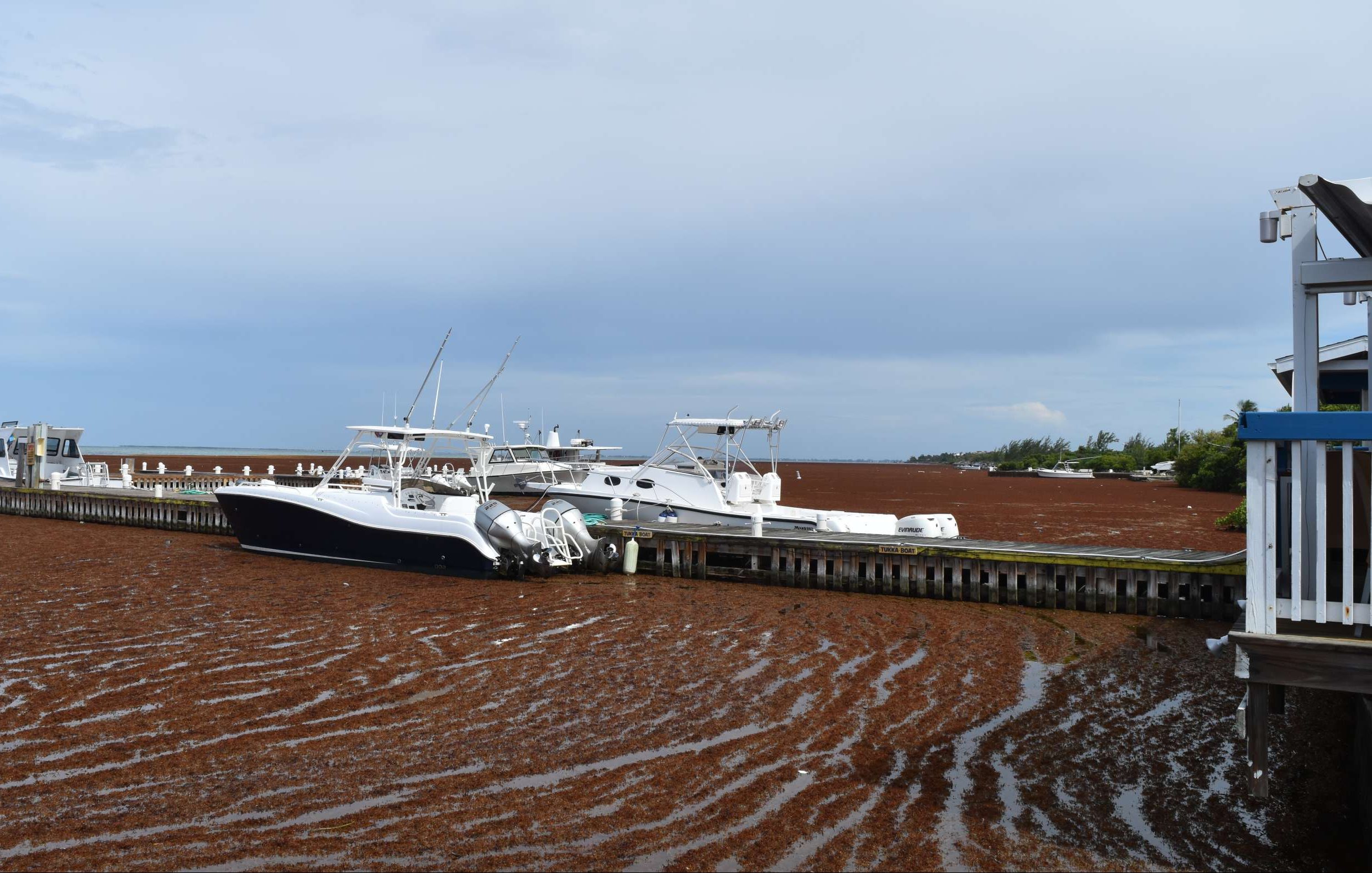
Businesses and residents along Morgan’s Harbour, West Bay were greeted with large mats of brown sargassum along the shoreline on Saturday, which they say is the worst they have experienced in the area.
West Bay resident Dareen Ebanks, with his two daughters – Ella, 4, and Mckayla, 10 – at his side, shook his head in disbelief as he surveyed the siege of the invasive seaweed Saturday afternoon.
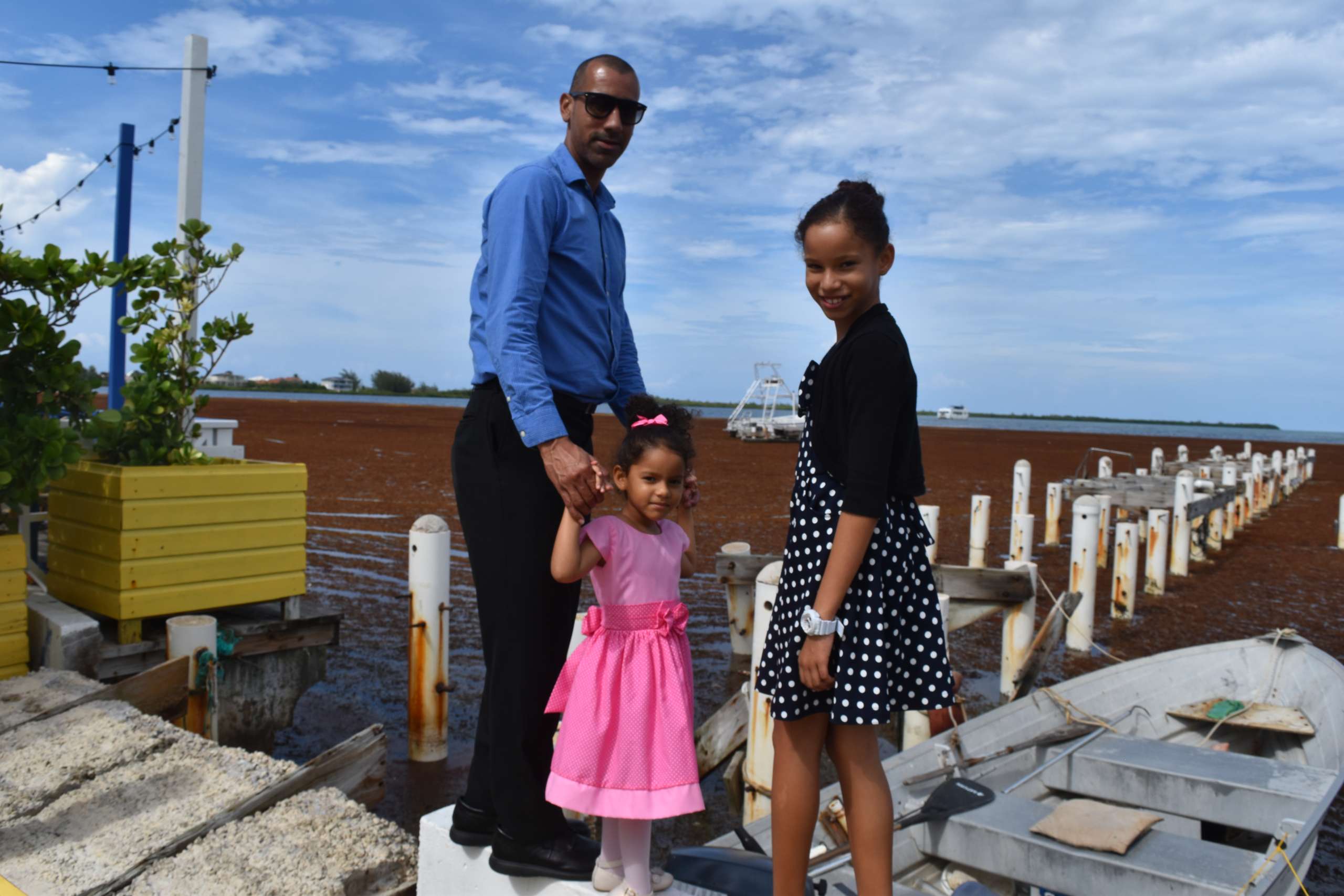
“[This is] definitely shocking. I would say over the 20 years of me just coming here with my kids or… to enjoy the view, or [ride] my jet ski… I’ve never seen it like this before. Obviously [we’ve seen] small patches, but nothing of this magnitude for sure,” Ebanks told the Cayman Compass.
Just this week, the Compass highlighted the plight of residents and businesses, particularly those along the south coast and in the eastern districts, who have also experienced some of the worst impacts from the extraordinary amount of sargassum.
For them, fishing, swimming or simply walking on the beach are no longer options in some areas.
Department of Environment Deputy Director Tim Austin, speaking with the Compass Saturday, said the department has been fielding calls from affected residents in the area and an emergency meeting is planned with government to discuss a way forward.
“Government will be having a meeting… with the DoE on Monday to start to figure out if there is something realistically that we can do to address the situation [as a] more urgent matter,” Austin said.
A blow to local tourism, businesses
With the devastating scene before him, Ebanks said he felt for the fishermen and tour boat operators whose vessels were surrounded at the dock with the vast mat of seaweed.
“For sure [there will be losses]… most of these guys here, this is how they make their living. Obviously, they have to do charters and most of [them] can’t move for next few days or maybe weeks until someone figures out a way to clean it up. So definitely, it’s shocking for sure… crazy, crazy,” he added.
It is a stark reality that Cayman Islands Tourism Association Vice President – Watersports Director Tory Leacock addressed on Saturday.
“This is the worst we’ve experienced in the North Sound. It’s inundating boating channels and docks. Though boats are able to carefully drive through the thick layers, it presents a hazard by concealing drifting debris and fouling engines,” he said.
For restaurateur Chef Ron Hargrave – whose two restaurants Tukka West and Tukka in East End have been affected by the onslaught of the seaweed – Saturday’s scenes were a terrible blow.
“Even though I have only been at the West Bay Tukka location since March 2021, this year’s sargassum is five times worse than last year. There seems to be so much more of this weed making its way into the sound and, of course, with the prevailing easterly breezes, it all ends up [near] west side properties and docks. It has nowhere to go once it arrives and takes a week to rot and sink,” Hargrave lamented, as he spoke with the Compass.
He said he will keep the doors open at both his restaurants, but he knows the increase in the seaweed will be another hit for the tourism industry already struggling to get back on sound footing.
“It’s obviously not a good experience for visitors and locals alike, but what to do? Sadly, it’s just another kick in the side of an already distressed tourism industry that I feel will struggle again this summer to make ends meet,” he said.
On the east side, Hargrave said, the situation has been the same, but with the changing winds it tends to move around more on that coast.
Austin said the situation is not likely to improve; in fact, he says it is expected that the sargassum situation will worsen locally.
“So far this year, the predictions for sargassum have surpassed anything that we had in the worst year ever, which was 2018. Already the amounts of sargassum detected by satellites out in the Atlantic and now entering the Caribbean [are] larger than [have] ever been seen before. So, we can anticipate that we’re likely to have a really rough time with this in the coming months,” Austin said.
He said sargassum in the North Sound does occur typically, but the large amount presently being seen has to do with the shift in the prevailing wind direction.
He said with the current wind projections, residents and businesses in the area will see more impact as the weekend goes on.
“I believe this morning we had some southeasterly winds associated with the thunderstorms that [were] carrying the sargassum in that direction. We need the more prevailing northeasterly [winds] to kind of move it back out of that area. But, at the moment, predictions look like they’re going to be east for the next couple of days, so that’s probably not going to help the situation,” he said.
He acknowledged that the environment will be severely impacted by the sargassum in the days to come as more seaweed washes towards the coastline.
“It’s a real problem for boaters and people that are utilising docks and those kinds of areas, because it will eventually start to degrade and rot, [which] has huge implications for the water quality. We expect to see fish dying off… ,” he said.
Austin also urged boaters to take steps to navigate their vessels safely and protect their engines as best they can.
“Obviously anybody operating a boat within it is likely to have impellers fouled or strainers clogged and that [will cause] issues with the mechanics of the boat. You need to really operate with extreme caution and be aware that you’re likely to cause [problems] with seaweed or sargassum [in] the working parts of engines. I’m sure most people in Cayman [know] how their boats operate and they are able to deal with it, but at least be aware of it,” he added.
Related Videos









Sargassum prob poses the greatest threat to the Cayman tourist industry since Covid and I can’t see anybody in Govt doing anything about it.We had a 5 month warning of this influx in weed this year yet nothing seems to have be done.In Mexico they have special boats prepared to sift out the weed before it arrives and special beach clean up vehicles and a plan to use the weed for fertilizer.Someone smart and proactive needs to be put in charge and get a plan to deal with this problem that will not go away before the tourists leave to find clean unclogged beach’s.Maybe the Compass can find the minister in charge of Sargassum and publish an article on the plan to deal with the problem we can all view.
Duncan I agree. Another thing the Govt is absent on besides everything else. They have zero sense of urgency on any issue and most disorganized group ever.
Have faith. They dealt with iguanas didn’t they?!
I think its well documented that Grand Cayman has the resources to tackle this problem. To me, the question is when? When does the government say, “Enough is enough”!! Until that time, this problem will continue to get worst.. Wake up Government!!
Harvest it before it reaches the island. When flying in I’ve seen it in ribbons floating on the surface. Collect it on the upwind side of the island and dump it in the ocean on the other side, or use it for fertilizer. By investing in the equipment now, it will save a fortune in labor and prevent the tourism industry from tanking once the problem is known to our potential visitors—bad news travels quickly!
We had a fund in the past that was used to pay for the cull on the iguanas and what is used to fund the coral disease work maybe govt can tap into this to get a few of the boats the Mexicans are using, that and a few bobcats with rakes and some trucks and maybe 20-30 people to man the operation and we could be up and running with a credible operation.Collection of the weed prior to it making landfall I am sure is the way to go.I am thinking 1.5 mil in labour cost,1.5 mil in equipment could get us up and running and making a real difference maybe the private sector could help raise the funds if govt has no money left in the environmental fund.The operation could provide 30 jobs to Caymanians for 6 months a year with little training required.We may not even have to land the weed maybe just net it and tow it past the island and let the wind carry it away but the technical side needs a bit of research as to is it poss to net and tow large clumps of weed.
just a few ideas but for sure this is an urgent matter