
Consumer price increases in Cayman are likely to remain elevated in the third quarter after US inflation data was higher than forecast in August.
The US consumer price index increased 0.1% last month, after staying flat in July. On an annual basis, inflation remained at 8.3%, down from 8.5% a month earlier.
Economists had expected a monthly CPI decline of 0.1% and a drop in annual inflation to 8.1%.
Data points to further interest rate hikes
The higher-than-forecast price increases will maintain pressure on the US Federal Reserve to keep up planned interest rates hikes for the remainder of the year, to bring down consumer prices.
At the next US Fed policy meeting, analysts expect a third consecutive 0.75 percentage point rate increase. This would raise the federal funds rate to a target range of 3% to 3.25%. By the end of the year, the benchmark policy rate could reach 3.75% to 4%.
This will affect both borrowing costs and savings rates in Cayman. Local banks tend to adjust their base lending rates for residential mortgages, consumer loans and corporate loans and other variable interest products in line with changes to the US federal funds rate.
Lower gas prices offset by housing, food
In August, a 10.6% drop in gasoline prices in the US was offset by higher costs for housing, food and medical care.
Food prices were up 0.8% over the month and housing costs rose 0.7%.
Core inflation, which strips away the more volatile food and energy prices, jumped 0.6%, a larger increase than in July, the US Bureau of Labor Statistics reported.
Air fares, communication, and used cars and trucks were among the segments that showed lower prices in August, in addition to fuel. However, other energy costs such as natural gas and electricity continued to climb.
While gasoline prices exceeded US$5 a gallon earlier this summer, the national average is currently $3.70, according to the American Automobile Association.
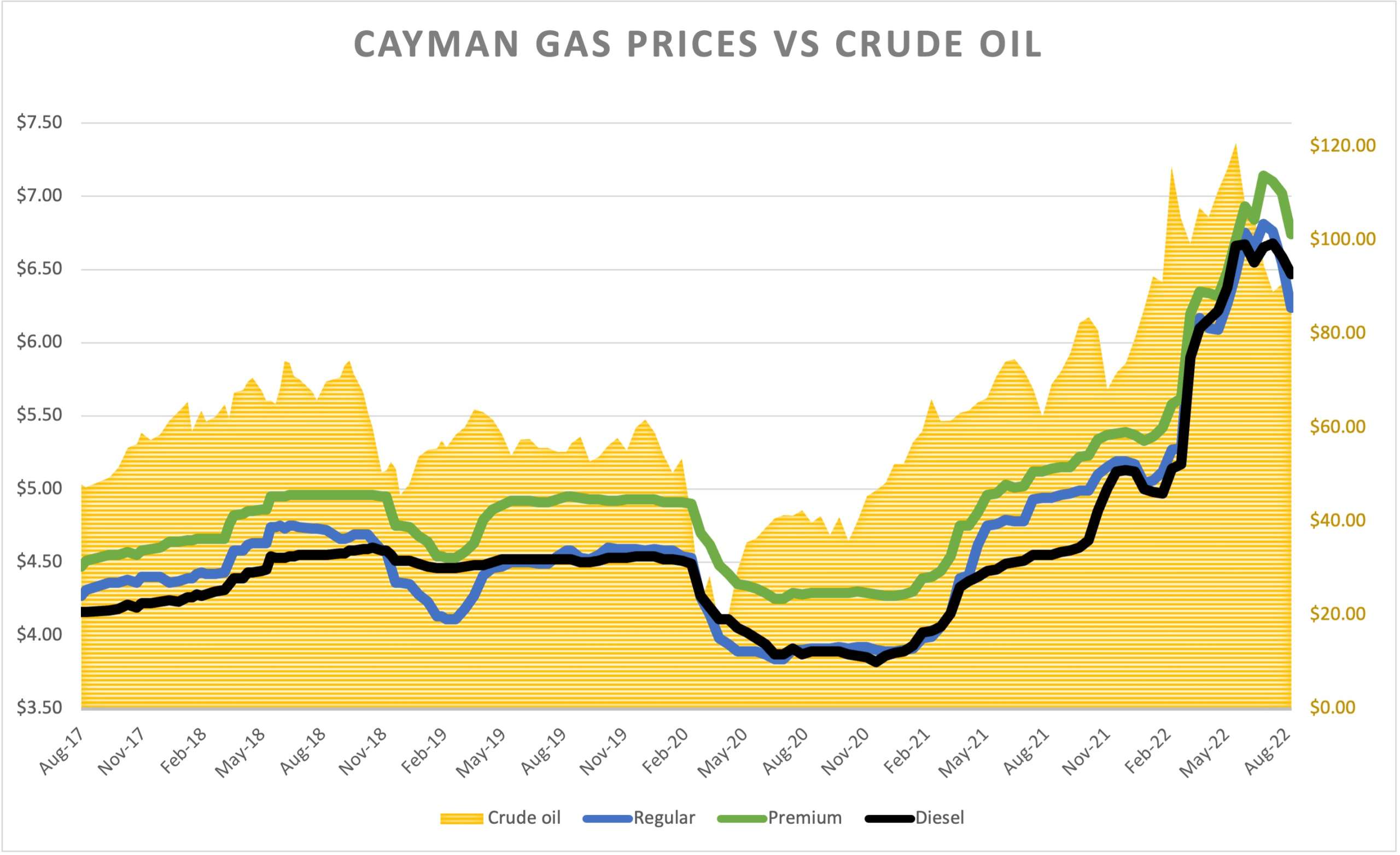
In the Cayman Islands, which receives its refined gasoline from the US, gas prices have come down moderately as well. The average per gallon price of regular fuel peaked at CI$6.81 in July and is now at $6.24. Premium fuel has dropped from $7.14 to $6.74, while diesel declined only marginally from $6.68 to $6.47.
Despite a slight easing of gasoline prices, quickly rising US food prices will keep grocery bills in Cayman high in the third quarter.
Double-digit inflation remains across OECD
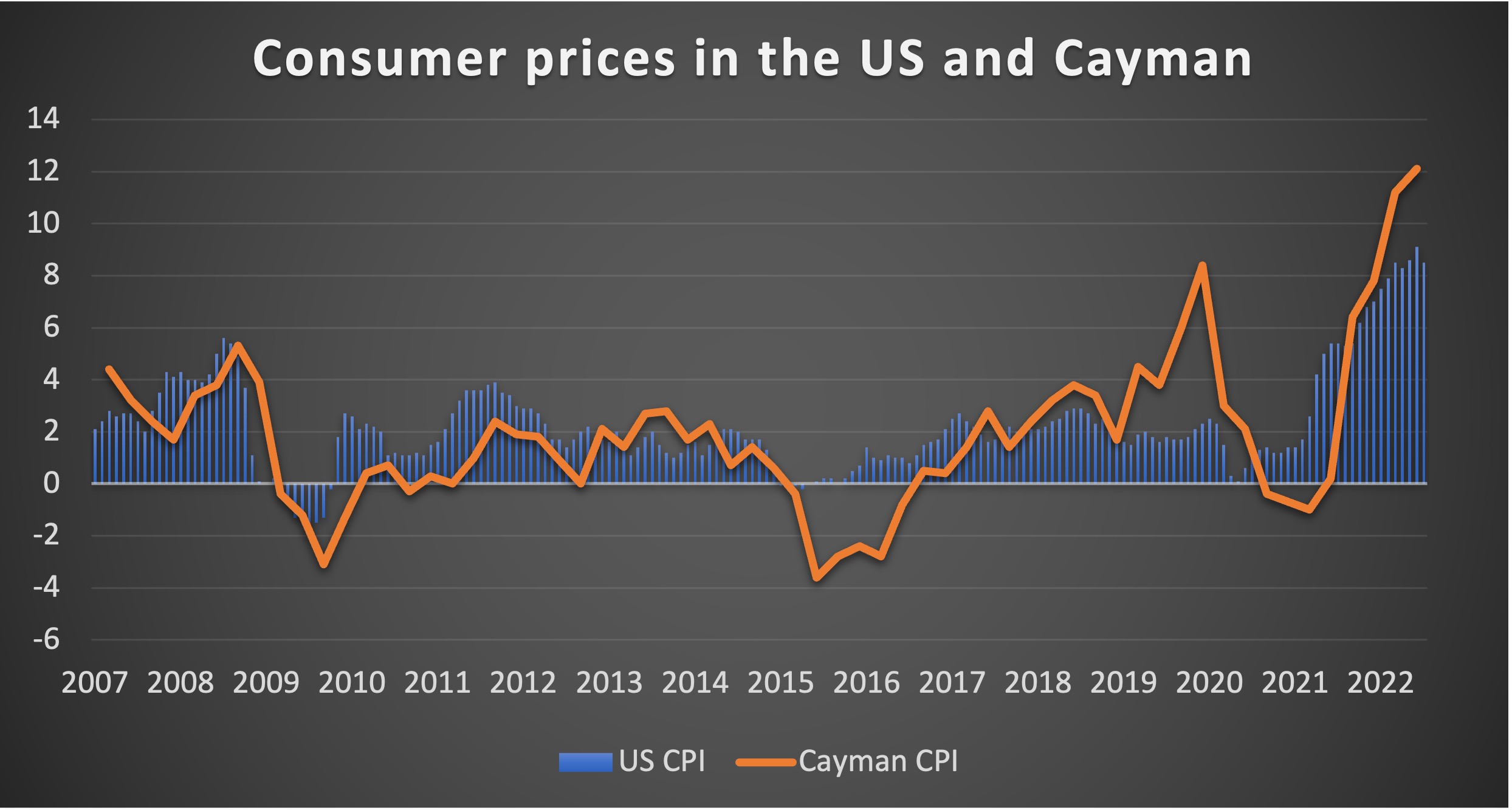
Overall, the Cayman Islands saw consumer prices rise by 12.1% in the second quarter, with energy, transport and housing costs the main price drivers.
Inflation locally is higher than in the US and compared with other developed nations.
Consumer prices in the OECD decreased only slightly to 10.2% in July from 10.3% in the previous month.
However, it was the first inflation decline since November 2020.
While year-on-year inflation fell between June and July 2022 by at least 0.5 percentage points in Canada, Greece, Luxembourg and the US, the number of countries registering double-digit inflation increased from 13 to 15.
Annualised energy price inflation in the OECD dropped from 40.7% in June to 35.3% in July, with decreases in 26 of 38 OECD countries. In contrast, food price inflation in the OECD continued to rise, reaching 14.5% in July 2022.
Excluding food and energy, core inflation increased to 6.8%, compared with 6.5%.
Among G7 countries, annualised inflation dropped from 7.9% to 7.6%. While core inflation was the main contributor to overall inflation in Canada, the UK and the US, food and energy prices were mainly responsible for overall inflation in France, Germany, Italy and Japan.
Related Videos