

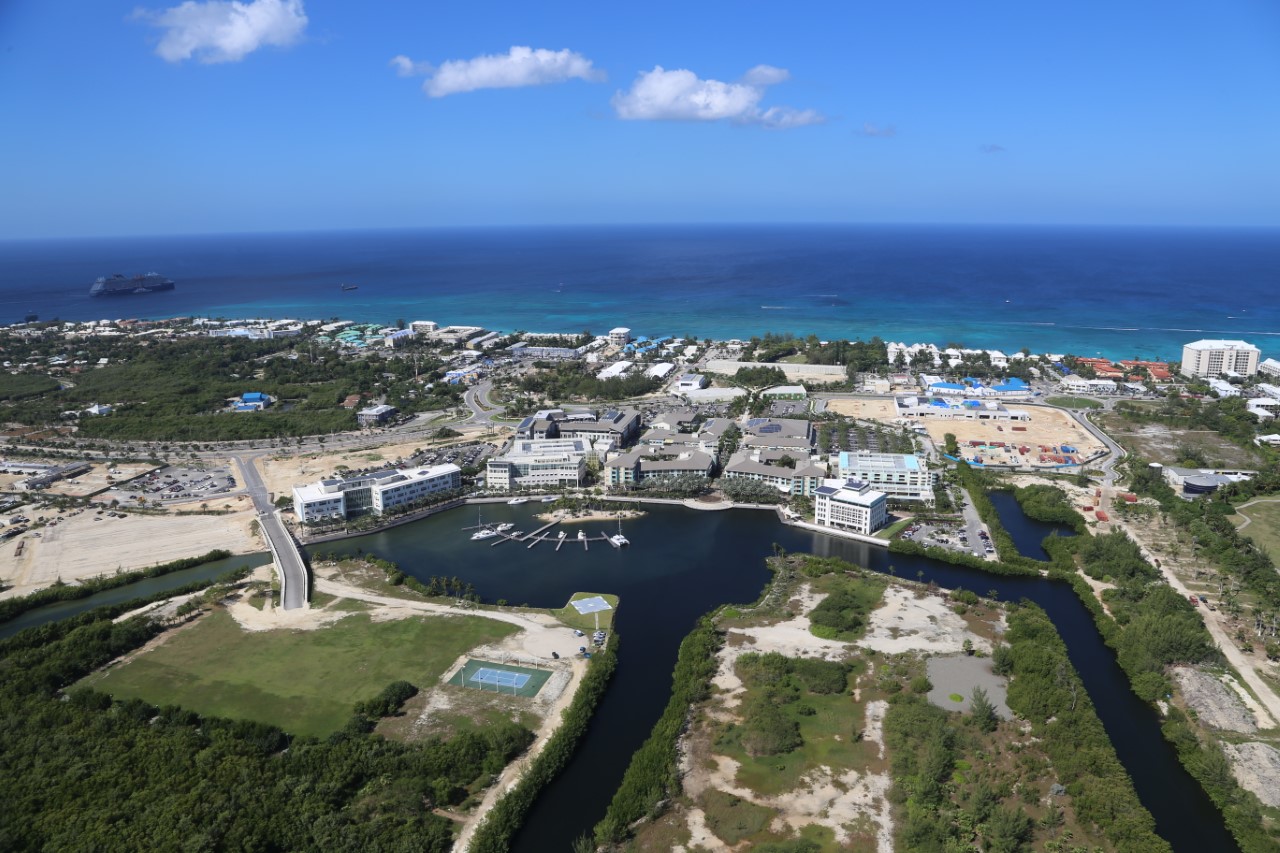
Deputy Premier Chris Saunders has thrown his weight behind policy changes to allow buildings to go “much higher” than the current 10-storey maximum.
Saunders, who is also the finance minister, went off-script in a speech to Chamber of Commerce members Wednesday to voice his support for allowing building heights of up to 30-storeys in Grand Cayman.
Acknowledging his views may be controversial, Saunders said he believed developers could be incentivised to build higher inland and ‘free up the beaches’.
He said, “We need to do something about building heights in this country. This 10-storey building [limit] is not going to work.
“We need to start going much higher,” he told a packed conference room of business leaders at a Chamber lunch at the Marriott resort.
Saunders said he did not advocate for “anything crazy, like 80 storeys” but suggested 20-30-storey heights would be appropriate, especially inland.
“We don’t want them on the beaches. That’s not where they belong,” he said.
He acknowledged it could take ‘a generation’ for the policy change to make a difference but said in the long term it would help shift development from the coast.
“At least maybe before some of us die we can drive along the road and actually see the beaches. It was madness to build that close to the water to begin with,” he said.
Commercially viable
Saunders’ comments resonate with recent suggestions from property developers that building higher could be a means to make new projects commercially viable without eating up scarce land.
Advocates for the environment remain sceptical about the impact of population and tourism growth on the island and have previously expressed concern that increasing building heights will only exacerbate the problem.
The Dart group is a long-term advocate of building higher, and previously raised the idea of an ‘iconic tower’ in Grand Cayman. The developer has continued to advocate for easing restrictions on building heights.
Director Jackie Doak recently indicated Dart would be waiting for the new development plan – which is expected to bring clarity around allowable building heights – before proceeding with any marquee projects.
Several other developers have also joined the call for higher buildings, suggesting it would provide a powerful incentive to redevelop climate-threatened coastal property farther inland.
Alluding to concerns that tall buildings could be out of keeping with Cayman’s character, Saunders acknowledged it was a “difficult conversation”.
But he insisted Cayman needed to increase both hotel and residential beds.
Housing task force
The island’s population has surged since the border reopening, growing 10% to almost 80,000, in the space of eight months, Saunders said.
Highlighting spiralling rents, he said there was a supply-and-demand problem fuelling a housing crisis. Homes coming off the residential market to go to short-term vacation rentals as tourism returns, are exacerbating the issue for residents, he said.
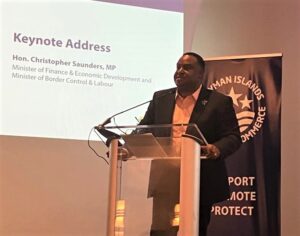
Saunders said government has set up a housing task force to help tackle some of those challenges.
But longer term, he said allowing building heights of up to 30 storeys would help ease that problem.
Saunders said mixed-use buildings with shopping plazas on the bottom floor and housing or hotel rooms higher up would be a good formula inland of the beach.
He suggested government could incentivise this kind of building to help keep the wheels of the economy spinning.
The deputy premier acknowledged his comments were a departure from his written remarks and were “not something everybody wants to talk about”.
But he said if government was looking at a target of preserving 30% of its land by 2030, in line with United Nations guidelines, it needed to think differently.
He said this would be difficult to achieve while meeting the housing and tourism needs of a growing population, unless higher buildings were considered.
Saunders appeared to rule out government intervention to control population growth, saying the Cayman islands had always been, and should remain, a ‘private sector-driven economy’.
He also ran through some of the island’s economic fundamentals, saying government was expected to pull in $1 billion in revenue this year, running a moderate surplus.
But with inflation and interest rates surging, he said it was imperative that government controlled its own costs as much as possible.
He said support for those worst impacted by the financial crisis would need to continue, however, and an announcement is expected shortly about an extension of the fuel-cost credit programme to help people pay CUC bills.
Related Videos











This is a good idea perhaps in a city where visitors spread out over town.
But visitors come to 7 mile beach to sit on the beach. Already hotels like the Ritz-Carlton and Kimpton line up loungers on the beach 3 rows deep. How many rows would be needed to accommodate the large number of vacationers that would occupy a 30 floor hotel?
Even worse than Miami Beach.
And where are all the cars going to go. The is not enough blacktop now. The traffic will only get worse
Located inland, a tower of apartments with parking making up the the first two stories or so would be preferable to sprawling housing. With any development – there should be a prerequisite for a proportionate amount of green space, preferably wild green space to accommodate / balance out the development. Developers, as a precondition to building permits could be compelled to “purchase” a predesignated or preferred wild area -such as securing several acres of mangrove to prevent future development on that space. This mandated preservation area need not be adjacent to the development. The views from upper floors could be spectacular if properly planned for, so immediate capping the height for any future building along any coast line should also be part of this program.
While we are at it, considering how to accommodate a larger population – we should have free public transport for all major road ways with large buses traveling at a regular, frequent, 24/7 schedules. With the $2 minibuses taking over collecting passengers at pre designated junctions along our major tributaries to provide transport further into residential and industrial areas.
(We could start with about 20 big buses traveling constantly from North West Point Road and the top of Batabano southwards to West Bay Road and Esterly Tibbets Highway – One route going down South Church st and one taking Crewe road and doubling up when they meet at Shamrock Rd. Splitting agin for the East Arterial, and joining again and Shamrock, Splitting again so one travels up Frank Sound, while the other continues Seaview Road- those bus routes would be passing each other in opposite directions around East End. If the busses had preset stops and times they were expected to be at each stop, and if we had a smart phone “Bus App” similar to Uber – so we could see the buses traveling real time and know the time a bus would be at our main route stop…I think a lot of people would leave their cars at home. The “main route” buses would have to be free for riders to get on and off, and would only stop at preset stops as per their schedule.
It might cost less than building new roads, would provide a safer way to get around the island for many and I would wager our economy would receive an unexpected boost.