Government has announced a multi-million dollar relief package to help cover the rising costs of electricity for Cayman Islands residents.
The aid programme could see government paying as much as $100 towards the electricity bill of the majority of households across the three islands for the next three months.
Premier Wayne Panton announced the plan Friday amid growing concern over what the Caribbean Utilities Company has described as “unprecedented” rises in the price of fuel. The intervention comes ahead of the hottest months of the year when electricity consumption typically spikes.
The full cost of the programme to government coffers remains unclear, but the premier previously indicated in parliament that around $5 million would be set aside to support families with power bills in the summer months.
Panton said government had come to an agreement with CUC, which supplies power to Grand Cayman, and Cayman Brac Power and Light, the Sister Islands’ utility company, to create a credit scheme to cut the electricity costs for consumers.
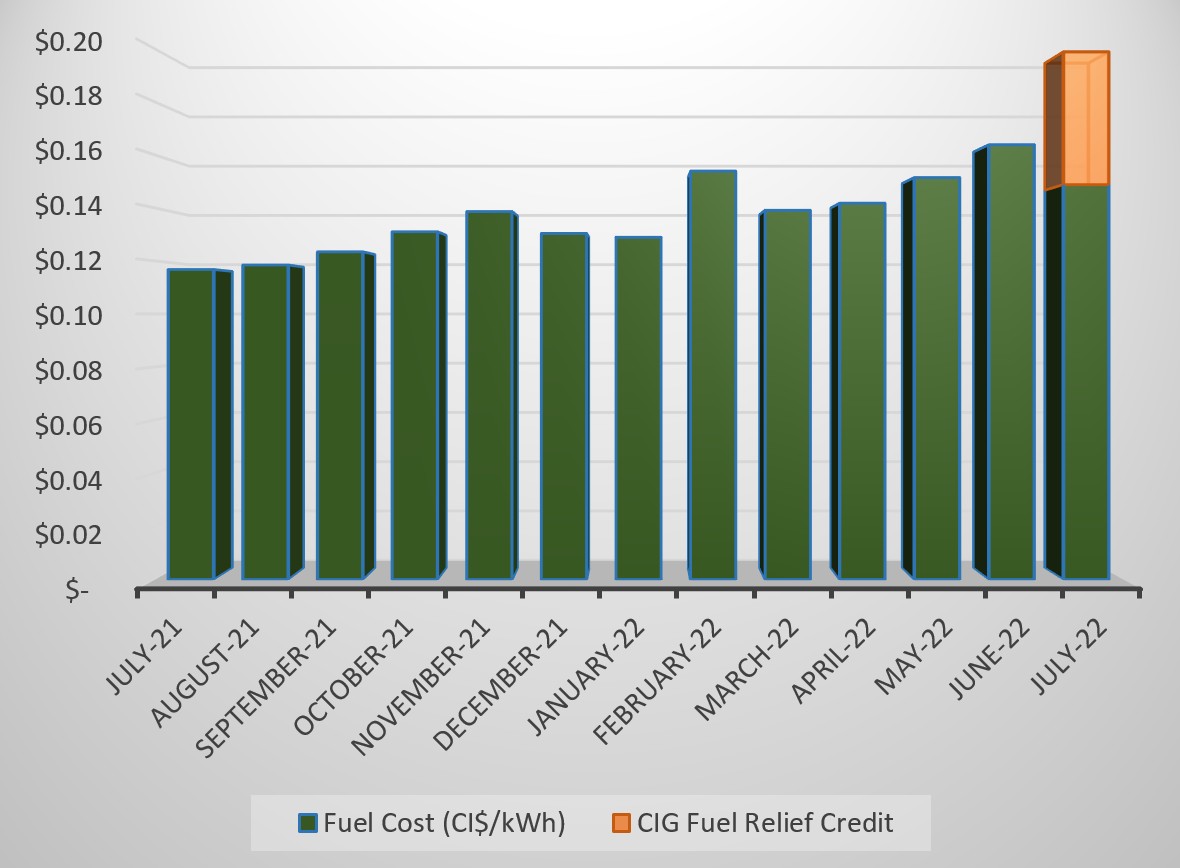
The assistance programme will be in the form of a credit provided over three months that will mean the majority of customers will be charged 15 cents per kilowatt hour, regardless of how high the price of fuel gets, Panton said.
The exact costs to the public coffers of the program are unknown at this stage.
“This assistance provides cost relief and certainty to eligible customers during the three hottest months of the year,” he said.
The credit from the programme applies to energy consumed in July, August and September and billed in August, September and October. Eligible pre-pay customers will receive a credit at the beginning of the following month.
CUC has said that an increase in the cost of fuel, due to the war in Ukraine and supply chain issues, will be reflected in July’s power bills, which will be sent out in August.
Those bills will reflect a fuel charge of 20 cents per kWh, which is 4 cents higher than last month. The higher costs kicked in today, Panton noted in his statement.
“Like CUC and CBPL, Government has been monitoring the fuel market and anticipated significant fuel price increases,” he said. “In the past year, external factors like the war in Ukraine and supply chain shortages have made everything more expensive. The result is volatility in the commodity prices and an increase in the price of oil, diesel, gasoline, which has resulted in an increase in the cost of electricity.”

Who is eligible?
The government assistance programme offers a fuel cost credit for residential customers who have monthly consumption between 101 kWh and 2,000 kWh.
“No matter how much higher the fuel costs go above $.015/kWh this summer, Government will absorb the difference. For eligible households, electricity customers can expect to see the Government assistance credit of up to $100 off their bill depending on their consumption,” the statement noted.
Residential customers with usage greater than 2,000 kWh per month and lower than 101 kWh will not qualify for the programme.
According to government, the new scheme will assist about 80% of CUC’s residential customers on Grand Cayman and almost 90% of residential customers in the Sister Islands.
President and CEO of CUC, Richard Hew, said the company welcomed the arrangement, and noted, “High fuel prices are impacting energy consumers globally and it is beyond the control of CUC, Government or customers. This action by the Government will bring needed relief to those persons who qualify for this programme.”
The government assistance credit will automatically be added to the bill through the CUC and CBPL billing systems.
“I encourage all residential consumers to check your electricity bills and if you typically consume more than 2,000 kWh per month, this is your chance to make changes now, and start lowering your monthly consumption so that you too come in under 2,000 kWh and benefit from the savings,” Panton said.
Related Videos