

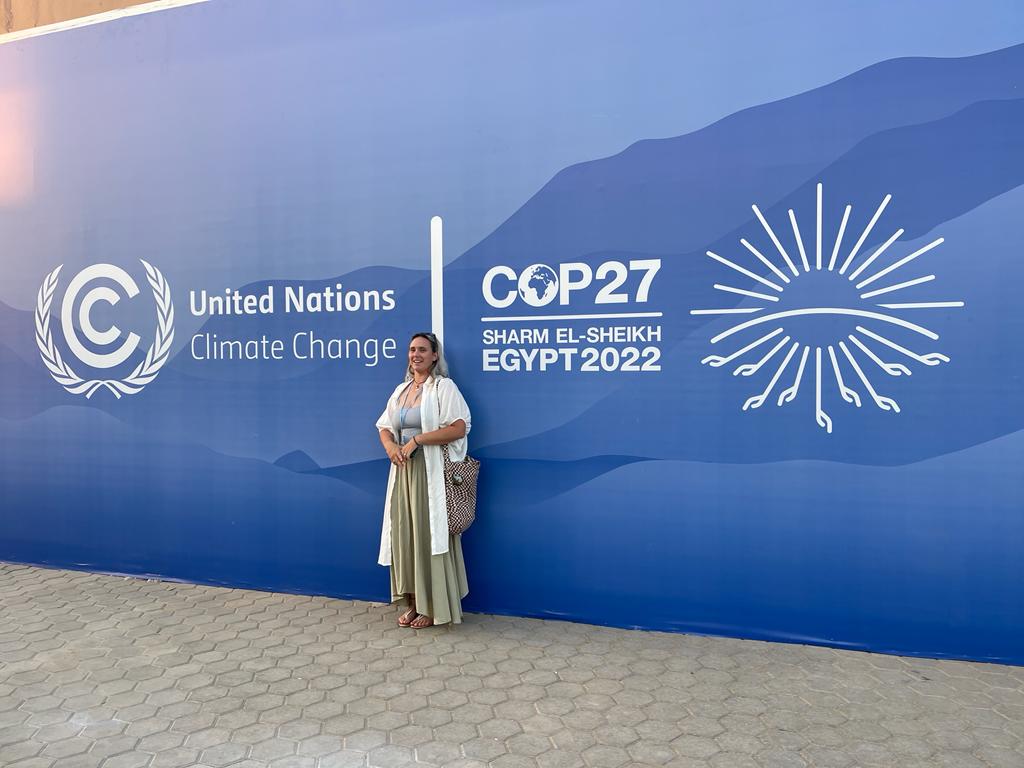
By guest columnist Bella Rooney
My 7am alarm goes off and I open my eyes to the realisation that I’m flying to Egypt in six hours to attend the biggest climate convention on the planet. What the heck?
After airport hopping and the longest flight of my life, I finally land in Sharm el-Sheikh, a southern Egyptian city on the tip of the Sinai Peninsula. Was I aware of my carbon emissions on every flight and the waste I was responsible for after two inflight meals? Yes I was, and still am. But as a conscious consumer I had to tell myself the experience would be worth it.
On arrival, I met up with Catherine Childs, the National Trust’s environmental programmes manager, and our very own COP mentor, along with Aleigha General, another Caymanian youth delegate and my partner in crime for the next week.
Inside the conference centre, people from all over the world walked by, some in traditional dress, some in business attire, some in shorts and T-shirts. Different languages and dialects, but all talking about the same thing – climate change.
Overseas Territories poorly represented
At the youth pavilion, young people streamed in and out, networking and sharing their stories from home. Many spoke passionately about loss and damage, how our futures lie in the hands of those above us, and that, sadly, if we want to see change, we must make it happen ourselves, make our voices heard. Amongst the youngsters were delegates from the Bahamas, Grenada, Anguilla, Trinidad and Tobago, Barbados and other islands. We shared our dismay at being poorly represented as British Overseas Territories with Devon Carter, a youth rep from Anguilla.
As we learned, BOTs were unable to attend COP27 independently and government officials relied on passes provided by COP27 organisers to gain access to higher priority zones. This year, it seems only five passes were available to all 14 of the BOTs.
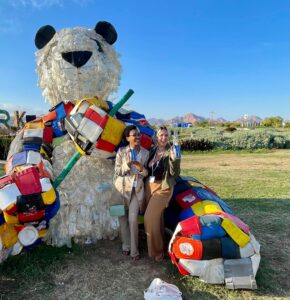
As islands on the frontlines of climate change, how we choose to tackle this crisis as a country and community cannot be decided for us without our input. When the number of delegates with ties to fossil fuels outnumber the combined delegations from the most vulnerable countries, how can we defend our islands against climate change when those leading us must fight for a place at this critical event?
Reliance on the Global North
This feeling of helplessness continues as we realise accessibility to renewable energy and climate financing is dictated by the Global North, the countries with a “buffer”, as the unofficial ‘President of the Caribbean’ Mia Mottley herself calls it. The countries that have the “capacity to rebound and absorb” after a natural disaster, while small island nations like us must increasingly rely on bigger countries for support in the wake of devastating natural events.
As global temperatures increase by 1.5 degrees C, the time for politeness has passed. The Cayman Islands must step up as a global leader in this sustainable revolution and demand the necessary resources to become self-sufficient and capable of mitigating and adapting to future effects of climate change. We must work together and invest in our natural resources to become capable of protecting the three pieces of earth and ocean we call home.
As Prime Minister Mottley said in her speech, “When 1% of the world’s population controls 46% of its capital, then that’s not fair… Let’s start to have the conversations about how we protect the global commons, and the first global commons that has to be protected is what? The planet Earth.”
Before leaving for COP27, we were encouraged by Premier Wayne Panton and Governor Martyn Roper to soak in as much information as we could. After meeting with Department of Environment Director Gina Ebanks-Petrie and Cayman Renewable Energy Association president James Whittaker, it became clear to me that we needed to focus on how we could educate the public on the need for sustainability in all its many forms.
One of the biggest learning curves is the need for a switch from fossil fuels and related products, to renewable energies and full circle perspectives on waste and food security. Despite our small carbon footprint as a country, our per capita emissions are amongst some of the highest in the world, at around 15 tons.
After listening to the amazing efforts of the Pacific Islands, and islands closer to home like Barbados, where single-use plastic laws are making renewable energy a right for every citizen, it is clear we have been falling behind with a lack of public support and knowhow.
We cannot thrive if our ecosystems are broken and polluted. COP27 highlighted for me the power of knowledge, collaboration and unity. If the breakthrough loss-and-damage fund born at COP27 fails like so many other action plans of the past, then continuing the blame game will not move us any further forward. It is our responsibility individually to protect what we love and demand change.
Thank you to the Cayman National Trust and International National Trusts Organisation for this amazing opportunity to learn from the world’s best. Maybe I’m a foolish optimist, but I believe anything is possible when enough people care.
Related Videos








When will OFreg and CUC allow the Cayman Islands to be powered almost entirely by the sun? Why is ANY of our electricity coming from fossil fuels? When home owners are prevented from installing solar panels due to CUC’s “quotas” something is very wrong. Do CUC shareholders really care more for their profits than the future survival of the Islands? The full page advert in the Compass placed by CUC promoting its supposed path to renewable energy is pure rhetoric /hypocrisy when it continues to obstruct the unlimited use of solar power in the Cayman Islands.
I dream of a future Cayman where every roof top has solar panels and CUC’s main functions are grid management and the storage of this 100% sustainable, clean, solar energy!
I absolutely support what Sarah has said. We have been waiting 5 months and continue to wait, indefinitely, for our Solar installation due to delays in decision making by Offreg and CUC. I too dream of a fossil free Cayman. It is time that CUC have competition to reduce their enormous cost to the consumer.