


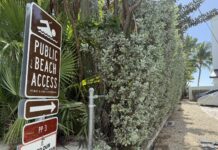
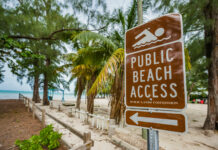
Property owners and managers of seven premises have found themselves before the Summary Court on charges of obstructing public access to local beaches.
The charges were brought by the Office of the Director of Public Prosecution on Tuesday, 28 Feb., on behalf of the Public Lands Commission and make up a total of 39 ongoing investigations of a similar nature.
“We have 11 in this round, seven were dealt with today and four were put back so we could re-issue the summonses,” said PLC Chief Inspector Winsome Prendergast, who noted that her office monitors just over 200 registered accesses.
Speaking with the media after the hearing, Prendergast said her office had undertaken a robust enforcement plan to ensure all registered beach accesses were being kept clear.
“The whole aim is to get the public to be compliant with the rules and regulations of the Public Lands Act,” said Prendergast, who added that people who refuse to comply would be prosecuted in the near future.
All of the properties which were flagged for prosecution, with the exception of one, had their charges dropped after it was revealed that they had become compliant with the PLC’s orders.
“It’s only in extreme circumstances, where we see that persons refuse to clear these accesses, that we will bring charges against them. However, if the compliance period is after the matter has been registered in court, the complainant will have to report to court,” she said.
Each of Tuesday’s cases related to blocked registered public access, though not all properties were connected to conventional sandy beaches. Nonetheless, Prendergast stated that her office was committed to upholding the public’s right to access the shoreline.
When warning the single property owner who failed to comply with the PLC’s directions ahead of the hearing, Chief Magistrate Valdis Foldats reminded the public of the heavy financial penalty that comes with blocking such accesses.
“The law prescribes a fine of up to $500 per day for each day that the registered access is blocked. While such a fine would be reserved for the worst case, it is in the best interest of the landowners to clear the accesses to avoid such heavy fines,” said Foldats.
The cases come on the heels of recent discussions around the public beach access along the high water mark of Cayman’s shorelines – the rules which govern this access are obscure and at times conflicting.
Prendergast said her office is also actively investigating claims of prescriptive rights, though those matters would have to be brought through the civil division as they would not be considered criminal offences.
“Prescriptive rights are rights to use a property that develop over a period of time… about 20 years of people using it,” said Prendergast. “The law is not really clear here with how you deal with prescriptive accesses; however, I think there is legislation coming for that.”
Related Videos











Unless, and until, the Crown is able to get these Cases on the Court’s agenda, complete a Hearing, and sucessfully conclude a prosecution, then the non-compliance will not be taken as serious! Justice must not only be done, but seen to be done.