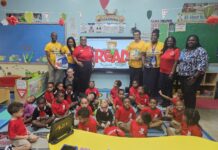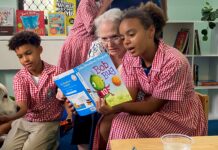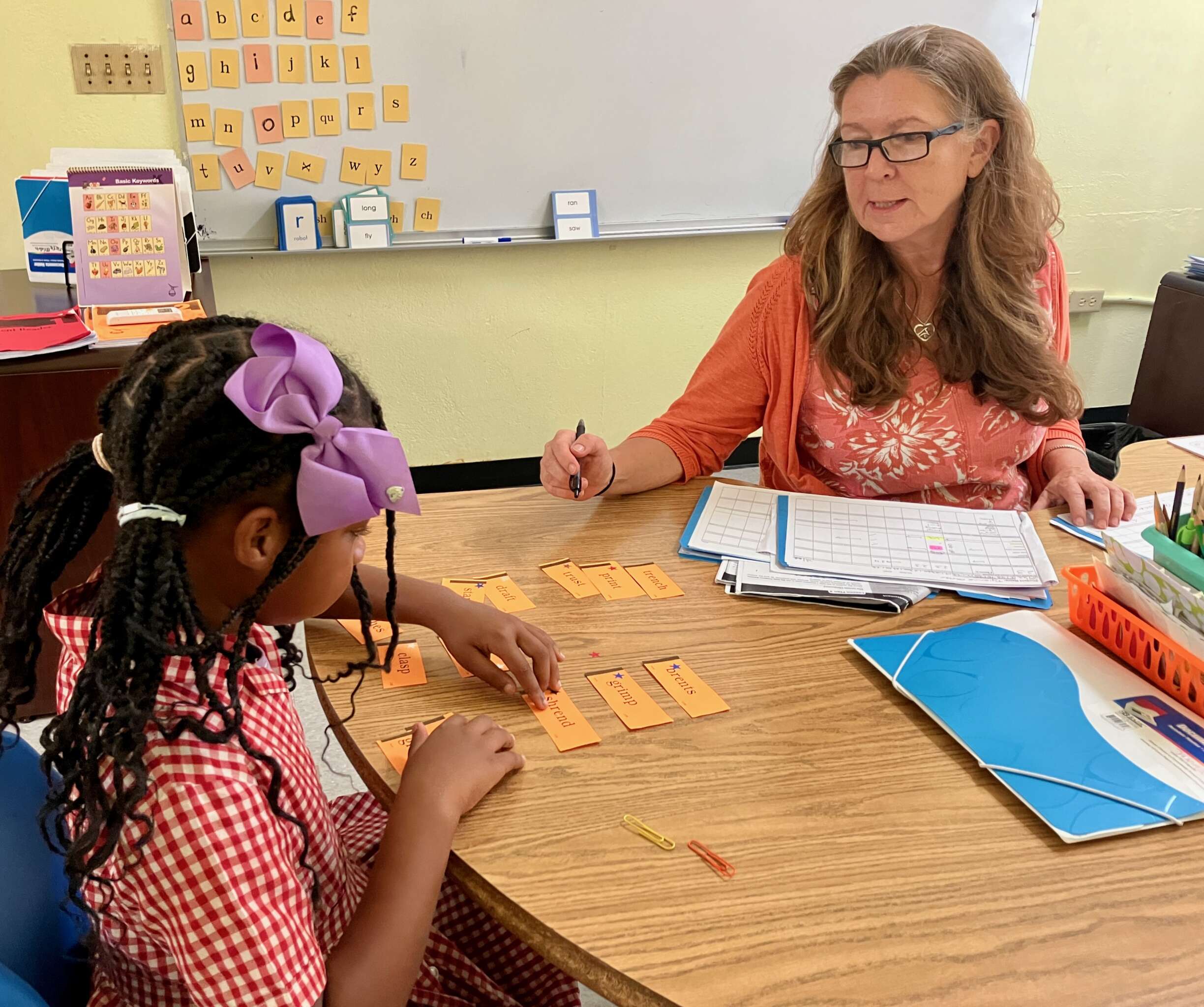
In a dedicated classroom in a quiet corner of West Bay’s largest primary school, a group of students plays reading games with their teacher. There’s gentle encouragement, patience and most importantly, individual attention as they work through the fundamentals of word sounds.
But the questions aren’t just about their school work. Staff check in with the children on how things are going at home.
Do they have electricity? Did they eat dinner last night? Did the hole in the roof get fixed?
Ordinarily, the school would not be able to devote this kind of attention to such a small group.
But a pilot programme, funded and run by charity Acts of Random Kindness, is providing extra support to children who are way behind their age-group peers in reading.
Sometimes the class is two or three students. Sometimes it is one-to-one teaching.
ARK’s ‘Mentor, Educate, Reinforce’ programme seeks to address academic disparities that are rooted in economic disadvantage.
“Last time I was here, one of the girls said, ‘We have no water again, can we get water for Christmas?’,” Tara Nielsen, director of ARK, told the Compass during a recent class at Sir John A. Cumber Primary School in West Bay.
Many of the youngsters that need specialist support are from households that ARK helps through its other programmes – families that each week struggle for a roof over their head, to keep the lights on or to pay for groceries.
“One of the mums works every day from 6am to 10pm. Even with three jobs, she is struggling to have food security,” said Nielsen.
“That is the kind of family we need to help.”
Home life linked to academic outcomes
When basic needs aren’t met, education sometimes gets shuffled down the list of priorities.
“There is a definite correlation between home life and ability to learn,” says Nielsen.
“Unless you deal with extreme poverty, with emotional trauma, with food security and everything else, you can’t possibly have a child that is ready to learn.”
The result is that by the time some children start school they are already years behind. The MER programme seeks to help them catch up.
“With intensive learning remediation at a key stage in these children’s development, we can significantly change their life prospects for the better,” ARK’s website states.
The programme started as a business sponsored private tutoring scholarship for kids who needed extra reading support. It has largely retained those principles but now operates
from a headquarters at John A. Cumber.
ARK has recruited Mary Dixon, a special education teacher, on a full-time basis to help those children with five 40-minute sessions each week.
For now, MER is only open to students at the school.
In the long term, depending on donations, Nielsen hopes to expand to other areas.
But the need in West Bay is great and the programme dovetails with some of the work that is already going on at the school.
Emotional and learning difficulties
For Kimberley Yapp-Brady, special education needs coordinator at the school, early intervention is key.
“We have become experts at early detection. I think I can say we have mastered that,” she says, as she reels off some alarming statistics.
Some 7% of the school population has special educational needs and half of those have social, emotional or mental health difficulties or disabilities. Even more – 32% of the students – have reading or other literacy challenges.
Brady and her colleagues don’t just use testing to track progress.
The special education team includes an education psychologist, school inclusion specialist, school counsellor, and speech and occupational therapist.
They get regular feedback from teachers and meet every month to discuss trends coming from the classrooms.
If a child has lost a parent or is struggling for shelter or food, Yapp-Brady knows about it. If a child is lagging behind, is disruptive in class, or struggles to keep up with the work, she knows about it.
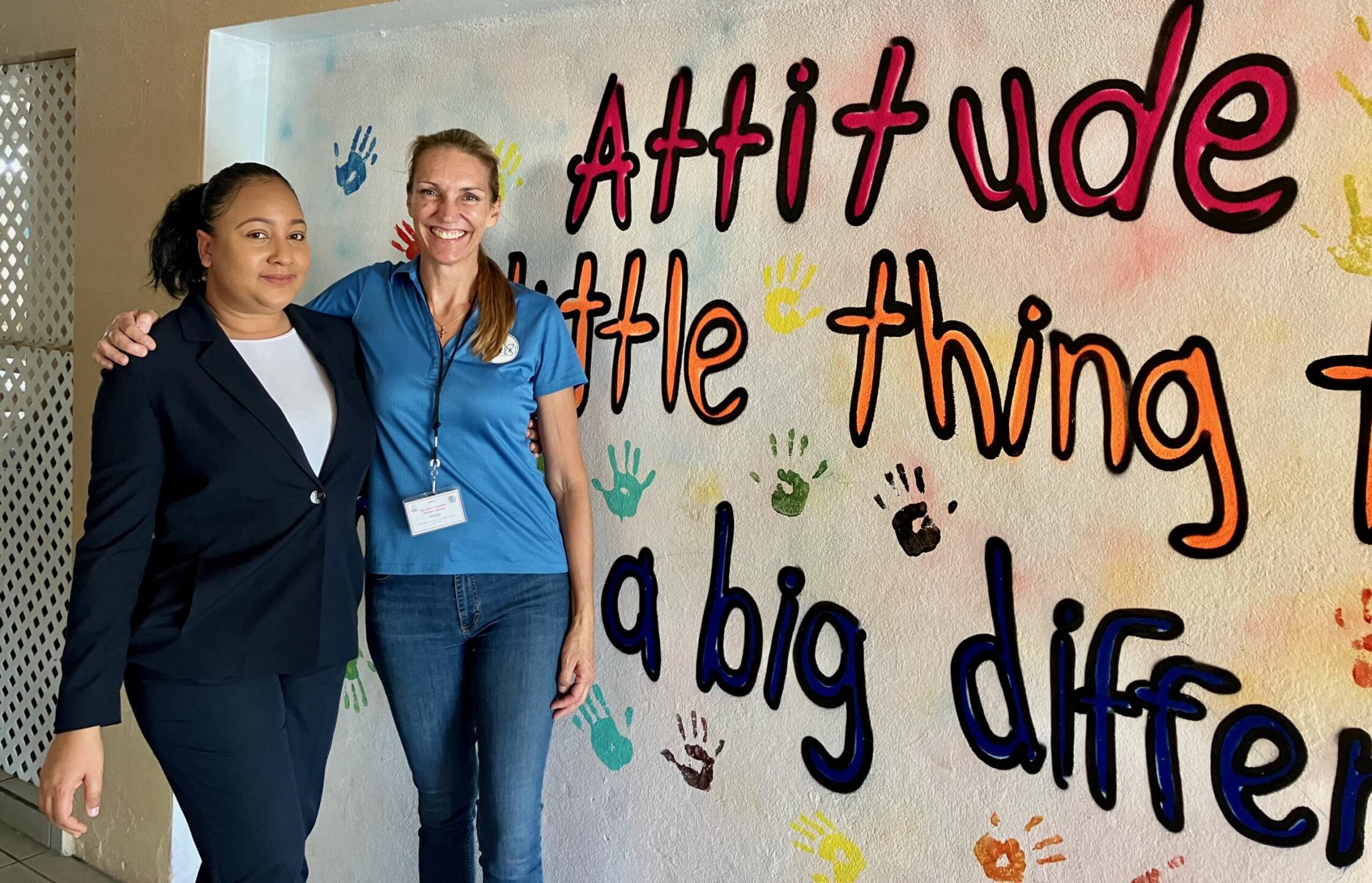
At John A. Cumber at least, the challenge has not been identifying the problem.
“On analysis of the school data, it was obvious we needed more support for students not meeting the expected levels or reading,” said Yapp-Brady, who took the
job in 2020.
The ability to leverage partnerships with organisations like ARK has helped expand the school’s ability to deal with those issues.
“Any help we can get for our kids, we are going to make the most of it,” Yapp-Brady said.
ARK did background checks on the children selected, including a home visit and interview with the parent. The first 12 students began working with Dixon last year.
Yapp-Brady added, “It was easy to highlight students that were far below the benchmark. I could find 12 more children that need this programme tomorrow if we had the resources.”
ARK hopes to be able to provide that capacity in short order.
But part of the long-term hopes to grow the programme depends on demonstrating success to donors.
Small steps
The walls of the classroom are adorned with pictures celebrating the children’s progress. Learning to read is an incremental undertaking but every small step is acknowledged.
Dixon uses the Wilson Reading System, which helps develop reading skills in small steps in small groups.
There is also a partnership with the 345 Robotics programme, which pairs the children with other youngsters to work on designing and building robots. Some find they have a talent for working on practical projects, and it brings an added confidence in the classroom.
“They are starting to put their hand up and participate in class,” says Yapp-Brady.
Behaviour has improved in mainstream classrooms too, with ‘work refusals’ decreasing since the programme was put in place. “We have had students move from very poor to average,” she says. That can be enough. “The idea is not that they go into the programme and stay there forever. The aim is to get their level up so they can go back into a mainstream classroom with confidence, and cope.”
Early data from the first few years of the programme show the majority of children moving up in reading-age levels thanks to the intervention. But for some, it is likely to be a longer haul.
Learning difficulties
Almost all the students selected for the MER programme were diagnosed with special needs – attention deficit hyperactivity disorder, learning difficulties, or intellectual disabilities.
Some of them are on the Lighthouse School waiting list.
“We need to accommodate students in mainstream education because there aren’t spaces, but some of them just can’t function in a mainstream classroom.”
Principal Jovanna Wright said she is hopeful that more capacity will be coming soon at the specialist school. But for now, she is happy for all the support she is getting.
“I went to this school as a child,” she said.
“To have people interested in helping the children most at risk, how could I say no?
“We will support the charity any way we can and do everything we can to make it work. We are happy and we wish we could do more.”
Related Videos