With questions ranging from the identity of famous fiddlers of yesteryear to the date the islands’ mosquito control unit was established, the history and culture test has long been a source of intrigue and sometimes controversy for those seeking permanent residency.
And while the latest revelations of inaccurate and out-of-date questions appearing on test papers will have done little for credibility of the process, island historians maintain it has real value as part of the process for those who may ultimately go on to become Cayman citizens.
A knowledge and understanding of Cayman’s history should be a fundamental requirement for anyone seeking residency in the jurisdiction, according to two professors who helped devise questions for the test.
Roy Bodden, former president of the University College of the Cayman Islands, and Christopher Williams, a history scholar at the college, helped come up with a bank of questions used as part of the ‘history and culture test’, which potential Permanent Residency Certificate holders must sit.
Both men said the responsibility for updating and administering the test falls to the WORC department. While they are concerned at reports that erroneous or out-of-date questions have found their way on to the test papers, they defended the concept of the quiz itself.
Cayman’s history is lesser known globally than the US or the UK, and some applicants have found the questions to be obscure.
Examples range from obviously pivotal dates in the islands’ past, like Christopher Columbus’ first sighting of the Sister Islands, to more niche areas of knowledge, such as the date of a post office fire.
Williams, a history professor at UCCI who used to teach a four-week survey course of Cayman’s history, primarily aimed at potential permanent residency applicants, said enthusiasm levels for the subject had been mixed, but his aim was to run an entertaining course that would “convert the agnostic”.

“Some were grateful that they really got the chance to know about Cayman of yesteryear,” he said, “but there have been others that just want the answers for the test.”
He said there had been complaints from some students that the course hadn’t necessarily reflected the questions in the final test. But while his course covered the bulk of the material that could possibly appear, he said UCCI has no part in setting or checking the final 40-question test, which is generated at random from hundreds of possible questions.
History important to understanding modern Cayman
While he is ambivalent about the ability of a test to measure interest and knowledge of history, Williams is passionate about the value of learning about the past, and he resists accusations that some of the questions on Cayman’s history are obscure.
“Anyone who wants to call Cayman home shouldn’t see it as random or obscure; they should see is as important and necessary,” he said.
“Knowing about the Cayman of the past helps you understand where we are and who we are today.”
He said many Caymanians didn’t value history as much as he believes they should. And he argues there is a resistance to discussing less palatable aspects of the islands’ past.
But he argues that knowledge of history is important for a sense of national selfhood – both for born Caymanians and those that seek to become Caymanian.
Even for those who do not see the value, he said it was not too big a challenge to read a couple of books and learn.
“There are 20 points in play, so if you get all of it right, then that could be quite helpful.”
Under the application system, those seeking permanent residency must attain a minimum of 110 points, 20 of which can be obtained by answering all the questions correctly on the multiple choice history and culture test.
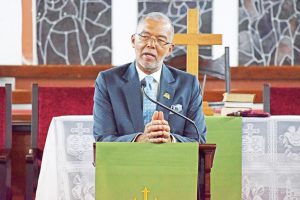
Bodden said he and Williams and other members of the UCCI faculty had helped produce questions about Cayman’s history for the test.
He said the answers to these could be found in the pages of Michael Craton’s comprehensive history of the Cayman Islands, ‘Founded upon the Seas’ and his own book, ‘Cayman Islands in Transition’.
Answer banks circulating
Bodden supports the concept of a history and culture test as part of the requirement for permanent residency.
Similar tests are held in many other countries, though it is common in many cases for a booklet of questions and answers to be provided to applicants.
Informal answer banks have circulated in Cayman. There’s a PDF sheet with hundreds of possible questions and answers and even a smartphone app.
Bodden doesn’t see that as a huge problem. The idea is to get the information across, he said.
“The test should be designed to ensure a person has a reasonable knowledge of the jurisdiction to which they wish to become a part, not to catch you out or trip you up,” he said.
Bodden agrees that knowledge of Cayman’s history should be a fundamental part of becoming a citizen.
But he argues that more serious reforms of the PR and citizenship process are needed.
He would like to see an end to categories of citizenship based on wealth or that can effectively be purchased.
“That is not how you nation build,” he said, as he called for more emphasis on acculturation of new arrivals.
Bodden would also like to see greater prestige put on PR and Cayman status, with applicants aspiring to become Caymanian and accessing a suite of rights, including the right to run for office, once they achieve that goal. He believes new Caymanians would feel a greater sense of belonging to the islands if they were able to earn these rights, and argues that process is cheapened if others can purchase the same.
He said the process should be elevated to a more celebratory and prestigious occasion, as it is in some other countries.
“In the US, you have a special ceremony and your family comes along and you are presented with a flag,” he said. “It’s a big deal. You are being reborn as a citizen of another country and it should be an important moment.”
Related Videos