A newly published education report has revealed damning statistics on attainment and attendance in government primary and secondary schools in the Cayman Islands.
According to the document, only 27% of pupils in government primary schools achieved expected standards in reading, writing and mathematics last academic year.
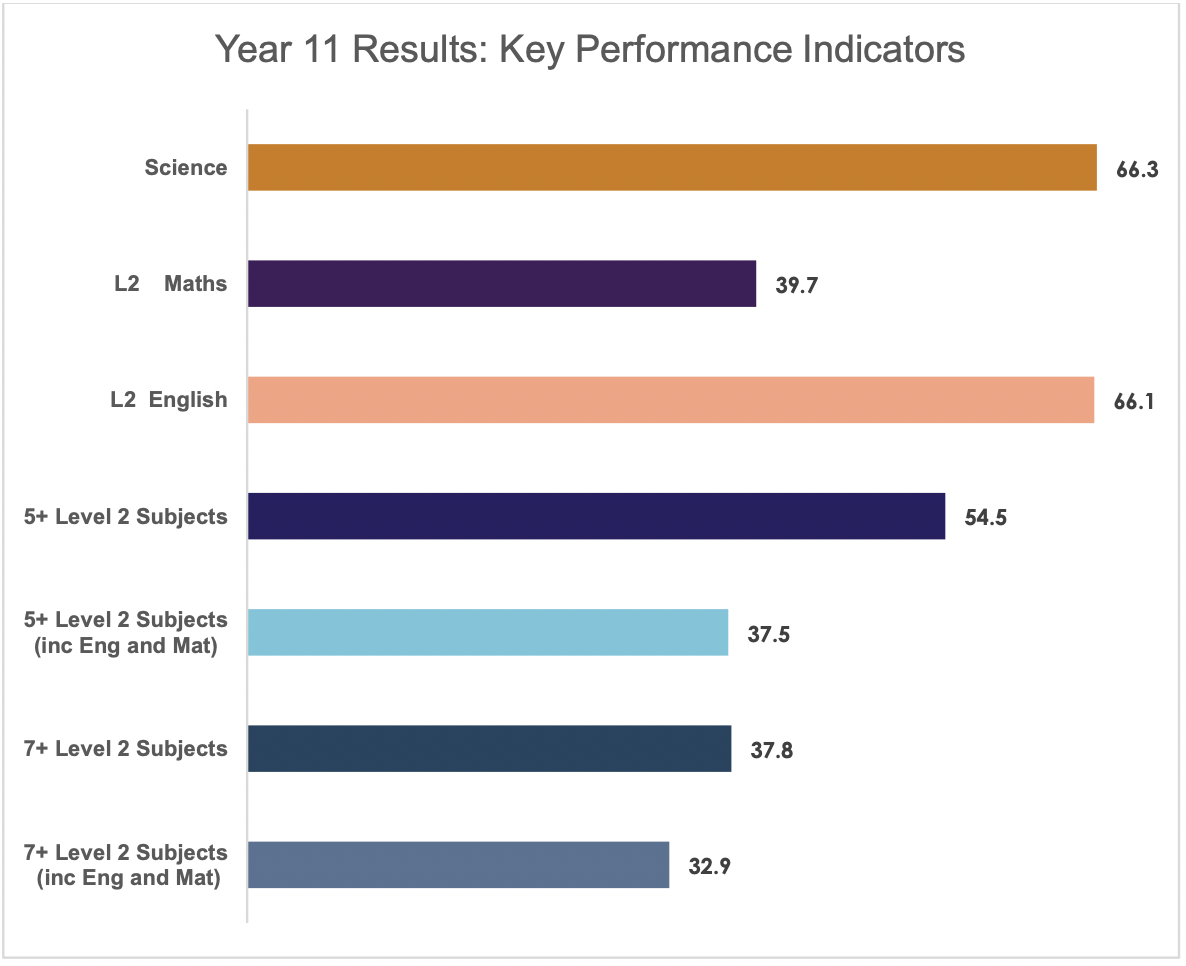
Students in government secondary schools did not perform much better, with 37.5% reaching the national expected standard of five subjects at level two, including English and maths.
And during the year, attendance rates at both primary and secondary schools dropped to the lowest in a decade, according to the Data Report for the Academic Year 2021-22.
Government education chiefs have said little about the failings, with their focus staying mainly on the slight positive trend in attainment over several years.
However, teachers have expressed their concerns over the “very poor” figures, with one asking, “Why is everyone not up in arms about this? Surely this should be a major priority.”
Lower attendance
Attendance at school for 185 days in an academic year is mandatory for children aged between 5 and 17 (or until they have a high school diploma) who are legally resident in the Cayman Islands.
The average attendance for academic year 2021-2022 in government schools was about 88.9%, according to the Department of Education Services’ report.
This was a marked drop, with attendance hitting the lowest point in a decade.
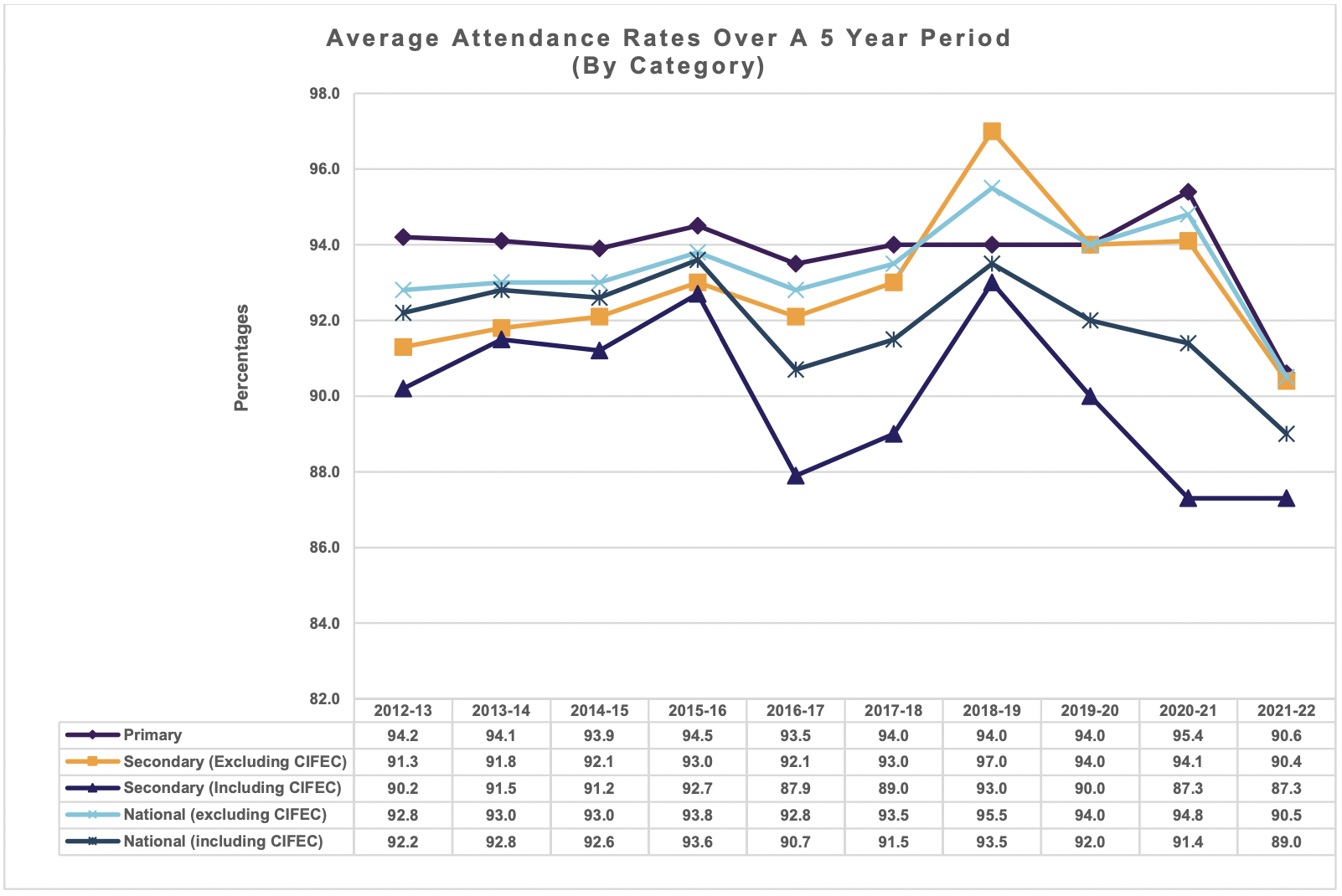
In the report, the department appears to dismiss the recent dip, saying, “At the secondary level, not including CIFEC, the attendance graph shows a slightly positive trend averaging 92.9% for the period considered.”
However, those secondary school attendance numbers have been decreasing since the 2018-2019 academic year.
“Raising overall attendance standards is linked to improvements in the attendance monitoring and consistency of recording,” the report, published on 27 April, read.
It said ongoing work of targeting truancy and absenteeism will continue to be prioritised.
Primary performance
The government adopted, adapted and implemented the 2014 UK Key Stage 2 curriculum in all public primary schools in August 2019.
Year 6 students, aged 10 to 11, are tested in the areas of English reading, English grammar, punctuation and spelling, and in mathematics.
Writing is assessed using externally moderated teacher judgements based on a range of classroom evidence.
Key Stage 2 Standard Assessment Tests were administered in May 2022 for the first time since the introduction of the new national curriculum.
Of those taking the test, 27% achieved the expected standard in reading, writing and mathematics. In the UK, 59% achieved that standard.
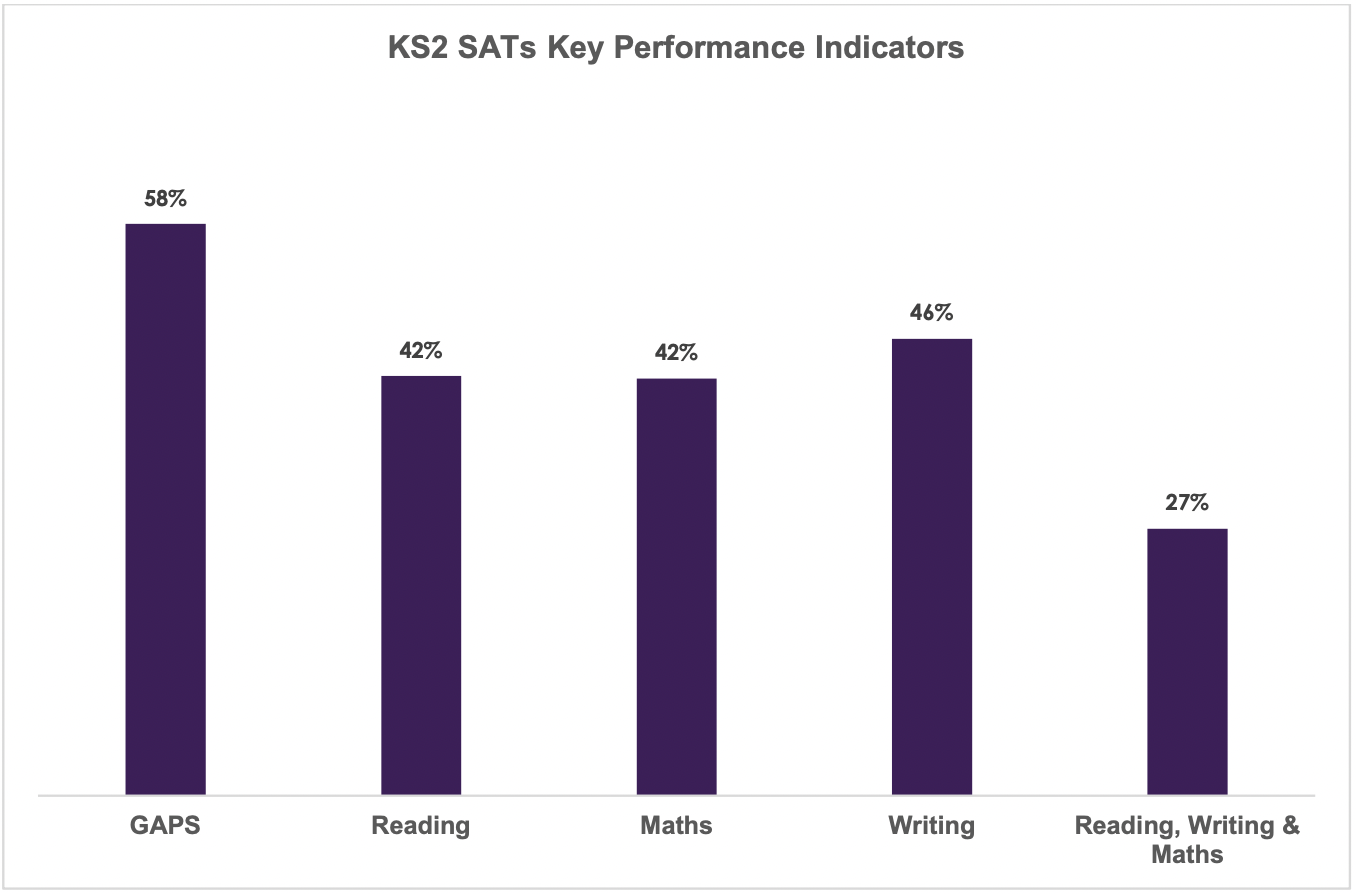
A total of 42% achieved the expected standard in reading, 42% reached the expected standard in maths, and 46% hit the expected standard in writing.
In addition, 58% achieved the expected standard in grammar, punctuation and spelling.
A test for progression, called CAT4, also showed that primary pupils performed “significantly below” their projected standards.
Secondary performance
The report details performance of Year 11 and 12 government secondary school pupils in Level 1 and 2 qualifications such as GCSEs, CSCEs and BTECs among other awards.
The national expectation is that students will achieve a minimum of five Level 2 qualifications including in English and mathematics by the end of Key Stage 4.
During 2021-2022, only 37.5% of Year 11 pupils achieved the national expected standard – a drop of 2% compared to the previous academic year.
In the UK during the same year, nearly 50% of students hit the required standard.
For Cayman students, a total of 66.1% achieved a Level 2 qualification in English language, 39.7% reached that qualification in mathematics and 66.3% accomplished that in science.
Only performance in science showed a slight improvement on the previous year.
Trends show performance levels are now back to those of 2017-2018, after dramatic improvements over the 2018-2019 and 2019-2020 academic years.
In Year 12, 46% of students achieved five Level 2 qualifications including in English and mathematics – a drop from 64% the previous year.
A ‘success’?
On publication of the report, the government’s education leaders brushed over the failings.
In a press release, Ministry of Education Acting Chief Officer Lyneth Monteith said overall trends appeared similar to those the preceding year, “with improvements in some areas”.
Mark Ray, director of the Department of Education Services, commended the 136 students who attained passes in five or more subjects last year.
“Their success indicates our schools’ ability to support our children’s learning,” he said.
Ray did, however, say information in the report, along with school improvement plans and other reports, will be used to determine the action plans for schools.
He added that the department is “working on collating the action plans into a cohesive document to guide the next steps”.
A focus on maths
MP Barbara Conolly, speaking on behalf of the Opposition, said poor secondary school mathematics results are stopping pupils from attaining the overall expected standards.
In a 3 May press statement, she said she has “consistently” urged the education minister to devise and implement a new national strategy for mathematics.
“I fear we have wasted a year because this government has failed to listen to the warnings I was giving,” she said, adding, “There can be no more excuses.”
Minister of Education Juliana O’Connor-Connolly in a 5 May statement spoke favourably of Cayman’s education system and school inspection results.
But she admitted that “concerns about the report needing more evidence of school improvement overall have been raised”.
She said the ministry is taking steps to enhance students’ progress and academic performance in mathematics, which is “not ideal”.
They include the implementation of a new Schools Numeracy Strategy, professional development sessions and the recruitment of 14 new primary school maths teachers.
“Our commitment to providing the best educational opportunities for our children remains strong,” the minister added.
‘A major priority’
Speaking anonymously to the Compass, several teachers in both public and private schools expressed their concerns over the latest statistics.
One private school teacher told the Compass that the figures sound “very poor indeed”.
“Of course, there are students who perform well above this average but if such a big majority don’t, this should be a huge concern,” they added.
Another private school teacher said the figures are “awful”, adding: “Why is everyone not up in arms about this? Surely this should be a major priority.”
A government school teacher blamed the results on the children, who they said have no accountability, cannot be expelled and are guaranteed work despite failings.
They also said some teachers are not competent, but added the government is trying to fix that by refusing contract renewals.
A third private school teacher said poor attainment could be down to the COVID-19 pandemic which will “hit them hard for a good few years to come”.
They added that more supportive measures are needed to bring results back to where they need to be.
Related Videos