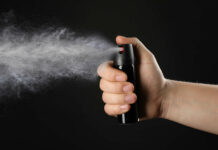
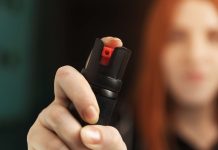
Legislators plan to examine if the use of non-lethal self-defence tools like mace and pepper spray should be legalised, after residents raised the topic at a public meeting on crime.
Minister Kenneth Bryan, who with Minister Sabrina Turner hosted the event at Constitution Hall, told attendees “there’s a legitimate reason for discussion among the lawmakers”.
A commenter watching the 13 July live broadcast on social media initially raised the subject by asking if use of self-defence tools during an attempted robbery could be made legal.
Inspector Ian Yearwood, head of the community policing department, responded simply: “It is not legal, and it’s not permitted at this time.”
The Penal Code (2022 Revision) says “any weapon of any description or design, adapted for the discharge of any noxious liquid or gas” is prohibited.
Anyone who imports, manufactures, sells, hires or has in their possession a prohibited weapon risks a fine of up to $10,000 and ten years in prison.
Yearwood added: “In a robbery, let’s be quite honest and frank, do you want to, under those circumstances, have a confrontation with your attacker at that time?
“Our advice to you would be to be very compliant. You stand a better chance of your own safety than trying to antagonise the situation and can make it worse off for yourself.”
The officer’s response provoked a strong reaction from some members of the audience, with one saying he disagreed “vehemently” that people should not defend themselves.
Following a round of applause, the speaker said, “I understand why one would want to be cautious, would want to not be overzealous in doing things in a reckless way.
“But I do not like the idea that people are being discouraged from defending themselves, because the history of criminals is that they do not care what the law says.
“No criminal gets up and says, you know what? I can’t rob this place, that would be a crime. No, no, no, they just have a disregard for law and order.”
Self-defence with guns
The Cayman resident then brought up the Firearms Act (2008 Revision).
This allows people with a Firearm User’s (Restricted) Licence to use their gun for “the lawful protection of his person or property or of the person or property of some other person”.
“In other words,” the man said, “in existing law, people who lawfully own firearms, and that’s the key word – lawfully – can defend themselves against crimes.”
The speaker said there is an element of crime prevention that police officers cannot do “and that is sometimes a person has to survive the attack, before they can call for help”.
He suggested that the police service should be willing to recommend to government ministers to modify the law so that people can have mace or pepper spray for self-defence.
“And if you don’t have to use lethal force, then don’t use lethal force. But that decision can only be made by the person in the moment who is being attacked, and has an option.
“Because if I listened to what you’ve said, basically the person would not have an option. That you’re saying – just do whatever they say.
“That’s people putting their lives at the mercy of criminals, and I don’t agree with that.”
Another resident, who described herself as a walker, asked why pepper spray is not legal, and told the room that she mixes her own spray for her early morning walks.
“We have no other way of protecting ourselves,” she said. “And for years, I’ve been saying – and I will keep saying it – why are we not allowed to use pepper spray?”
Reason for discussion
Chief superintendent Brad Ebanks clarified that Yearwood had meant that residents who are victims of a robbery should not put their lives at risk for the sake of any amount of money.
“Whether it’s $100, $1,000, $10,000 – it’s not worth your life to resist that person and cause that person to cause you fatal harm,” he said.
To that, Bryan noted, “I think that’s a legitimate summary of what was said.
“I think, though, based on the response I saw from the audience with that resounding clap, is that there needs to be an analysis on the public’s position on that.”
He added: “There’s a legitimate reason for discussion among the lawmakers.”
Superintendent Roje Williams, head of uniform and special operations, agreed: “It’s something that we will discuss at the policy level and police level.”
Past action
In 2011, Alden McLaughlin, as part of the Opposition, took a motion to the House which called for the legalisation of pepper spray for personal protection.
The motion was passed unanimously at that time, but no further progress was made.
Opposition MP Ezzard Miller, in 2019, sought to resuscitate that effort through another motion to have pepper spray legalised, after a woman was assaulted in North Side.
McLaughlin, as premier, supported that motion, but spoke of concerns that such weapons could be used by the “wrong persons for the wrong reasons”.
Infrastructure Minister Jay Ebanks then attempted to get pepper spray legalised after a spate of crimes against women in 2022.
But he told the Compass he was unable to get support from the National Security Council or police to move law changes forward.
At the time he said, as a “fighter for the people” he would “continue to push it until it becomes law”.
Related Videos