For the latest information on storm activity in the Cayman Islands, as well as information on how to prepare for hurricane season, visit Storm Centre.
Both the Met Office and Colorado State University have released updated storm forecasts that predict an above-average Atlantic hurricane season.
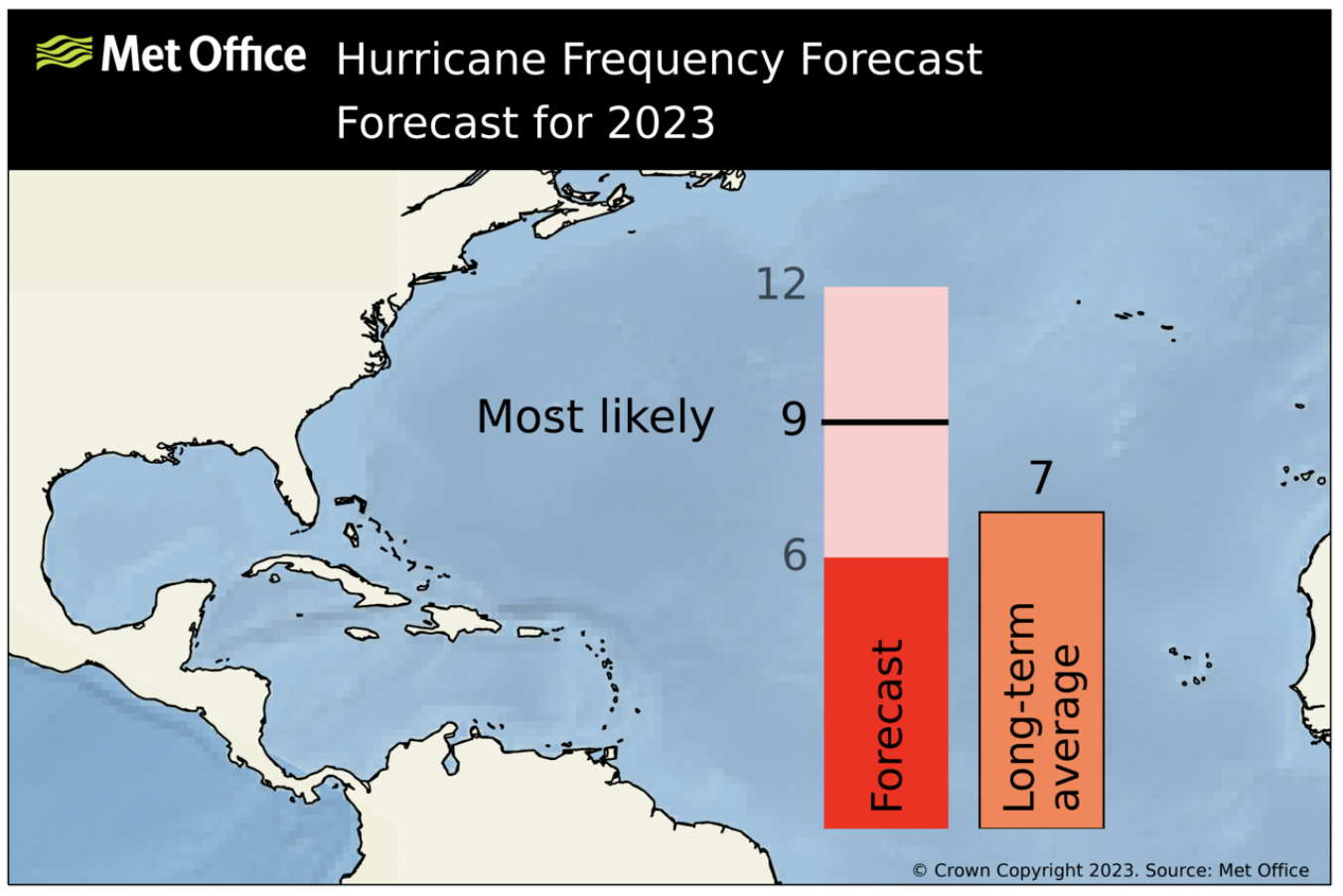
The UK’s national weather service, in its 1 Aug. update for the entire 1 June-30 Nov. storm season, says there will likely be nine hurricanes in the North Atlantic, with six of those becoming major hurricanes rated Category 3 or higher; those numbers are slightly lower than its forecast issued 26 May.
The more widely publicised Colorado State University forecast, in a 3 Aug. bulletin, predicts 13 hurricanes for the remainder of the season, with four reaching major hurricane strength, an increase from their earlier forecast of a below-average storm season.
There has been little storm activity over the first two months of the season, though typically, August, September and October are the more active periods.
Both of the Met’s forecasts significantly surpass the 1991-2020 long-term average of seven hurricanes and three major hurricanes from June to November.
El Niño and warmer waters
According to the Met Office website, the latest forecast predicts El Niño – the warming of sea surface temperature that occurs every few years, typically concentrated in the central-east equatorial Pacific – will develop and persist through the peak of the Atlantic hurricane season.
“This would normally be expected to increase vertical wind shear across the tropical North Atlantic, suppressing tropical storm activity,” it read.
“However… the 2023 forecast predicts most likely high tropical storm activity in the Atlantic.”
It explained that there are several factors which are likely counteracting the influence of El Niño resulting in potentially high activity.
Vertical wind shear through the troposphere over the tropical Atlantic is predicted to be lower than previously seen during El Niño events, the Met Office said.
And sea surface temperatures are predicted to remain “well above average” across the tropical North Atlantic during the whole hurricane season.
The weather service said the transition from neutral to El Niño conditions is likely to take place over the next few months.
However, the season will be affected by the speed of transition, its intensity and the time it takes to influence Atlantic hurricane activity.
Meanwhile, the Colorado State University website says the 2023 hurricane season is exhibiting characteristics similar to 1951, 1969, 1987, 2004, 2005, 2006 and 2012.
The team predicts that 2023 hurricane activity will be about 130% of the average season. By comparison, 2022’s hurricane activity was about 75% of the average season.
“Waters across the tropical and subtropical Atlantic continue to be near or at record levels across most of the basin,” the website reads.
It said the “extreme warmth” is the primary reason for the above-average seasonal hurricane forecast, despite the presence of El Niño.
However, given the conflicting signals, the team stresses that there is more uncertainty than normal with this outlook.
Tropical storms
The Met Office predicts a total of 19 tropical storms, including hurricanes, this season – down slightly from 20 in its pre-season forecast.
However, the 1991-2020 long-term average is just 14.
Its forecast has been calculated from observed activity during February to July and the six-month GloSea6 forecast activity from August to January 2024.
Colorado State University has forecast a total of 18 storms during 2023, including the five past storms – an unnamed subtropical storm in January, Arlene, Bret, Cindy and Don.
Don, a fish storm, became the first hurricane of the year in July.
Related Videos