What does six dollars mean in Cayman? A cup of coffee. A loaf of bread. A new inner tube for a punctured bicycle tire. An hour’s labour for perhaps as many as 3,600 workers.
As the Cayman Islands contemplates the first increase to its national minimum wage since it was introduced in 2016, the Cayman Compass is taking a deeper look at the issues surrounding the controversial topic.
Going beyond the numbers to look at the stories of people struggling to survive below the poverty line, we will investigate the human cost of low-wage labour in these islands. The line of inquiry takes us beyond the simple question of salaries, to housing issues, cost-of-living pressures and, in some cases, exploitation of workers.
We will also talk to business owners, economists and community figureheads and take a sector-by-sector look at some of the key industries impacted. Diving into the available data – which is scarce and vague compared to other jurisdictions – we will examine the demographics most impacted by the wage debate and look at the price tag to business and the economy of raising salaries.
Over the next month, we will delve into those issues in finer detail.
In our series opener today, we pull extracts from more than a dozen interviews with workers and employers to answer some of the key questions surrounding the debate.
Lemuel Hurlston, the chair of the Minimum Wage Advisory Committee; Dan Scott, a former partner at EY; and Woody Foster, the former chair of the Chamber of Commerce and owner of Foster’s supermarket chain, also spoke to the Compass as part of this initial special report on the delicate balancing act facing Cayman’s lawmakers as they attempt to find some equilibrium between the needs of the economy and the rights of its most vulnerable workers.
When and why was the minimum wage established?
Cayman’s minimum wage of $6-an-hour was established in 2016. There is a carve-out for hospitality workers who get gratuities and for domestic helpers who are provided with accommodation that the hourly rate can be as low as $4.50.
At the time, it was estimated that almost 6,000 workers were earning less than that threshold.
The Minimum Wage Advisory Committee, led then, as it is now, by former Deputy Governor Lemuel Hurlston, described it as a conservative introductory rate that would be manageable for employers.
The committee recommended that it be reviewed annually. Government implemented the rate, but not the review mechanism, and the wage has stayed at $6 ever since.
In 2016, then Employment Minister Tara Rivers said the country had a “responsibility” to ensure the “minimum needs” of workers were met, and argued that the introduction of a minimum wage would also prevent the “importation or perpetuation of poverty”.
Has it worked?
It’s an open question as to how impactful the policy has been. The minimum wage was deliberately set at a low rate that would be manageable for business, so there were limited reports of job losses or other impacts as a result.
Over the past seven years, inflation – largely a consequence of factors unconnected to raising the wage rate – has obliterated any gains that workers would have made.
Compass analysis suggests the spending power of $6 today is equivalent to just over $4 in 2016. In other words, anyone whose wage has remained fixed at $6 an hour has seen a ‘real terms’ pay cut of 33%.

With rent, groceries, fuel and electricity being the biggest drivers of record inflation over the past few years, lower-income workers have been disproportionally impacted as those items form a greater proportion of their monthly budgets.
Who earns minimum wage?
The people earning minimum wage or thereabouts in the Cayman Islands right now are generally domestic helpers, servers in restaurants, hospitality workers, security guards, janitorial workers and landscapers.
It is estimated there could be as many as 3,600 workers earning $6 an hour – or, in some cases, less, contrary to the law. Several thousand more could be impacted, depending on how high the wage is increased.
Our interviews, with more than a dozen low-wage workers and employers, suggest that most of the workers on minimum wage are expatriates, with the overwhelming majority coming from the Philippines or Jamaica. All of the individuals we spoke to were linked with the job opportunity through a friend or family member already on island.
How can people live on $6 an hour?
To many people in Cayman, where the median wage is a little less than $3,000-a-month, the idea of trying to live on minimum wage – the equivalent of around $1,000 a month for a 40-hour week is unfathomable.
In our series, we hear from workers, who describe the sacrifices they have made to make ends meet on that salary. Some work as much as 70 hours each week, waiving overtime rights to get additional shifts. Others live in cramped homes, sharing rent and food costs to bring bills down.
I can’t fathom how someone can live on the current minimum wage in the Cayman Islands.
– Dan Scott, former EY partner
One woman told us she paid $180 for a one-fifth share of a studio apartment – a fairly typical scenario for some workers. Others have moved to East End or North Side in search of cheaper accommodation, opting to contend with an unreliable and inefficient bus service that can take hours to deliver them to workplaces on West Bay Road at the expense of more than an hour’s pay.
“I sleep, I work, I pay bills,” one employee told the Compass.
Dan Scott, a former partner with EY and former chair of the Education Council, pays employees at his home a minimum of $10 an hour and subsidises agencies who provide temporary staff to the home in order to ensure they are able to earn a minimum of $10 per hour.
“I can’t fathom how someone can live on the current minimum wage in the Cayman Islands,” he said.
How do workers feel about the minimum wage?
Almost all the workers we spoke with, perhaps predictably, felt the wages should be higher.
Though they travelled to Cayman, in most cases, from poorer countries, where the wages are low, they were surprised by the cost of living, in particular the rental prices, and struggled to save.
One security guard, who came to Cayman from Jamaica, said he had hoped to send money home, but ended up having to borrow money from his mother to pay rent, rental deposit and air fare. Despite working up to 70 hours a week, he is still paying that money back.
I think they could afford to give us a little more.
– Cleaner who earns less than $50 a day.
Others said they had been able to manage for a while, but rising rents have made life harder on the minimum wage in the past few years.
Another woman, a cleaner, said she had scrubbed some of the finest houses in Cayman, only to earn less than $50 for an eight-hour day.
“I think they could afford to give us a little more,” she said.
A small minority were happy with their wages. One woman earning $400 for a 50-hour week – equivalent to $8 an hour – said she was able to send $800 a month home to the Philippines to pay for her child’s upkeep and education. She shares a small studio with two other people and lives off $400 a month.
The vast majority felt a fairer wage for Cayman’s cost of living would be in the region of $10-$12 an hour. Many felt it should be higher, but were not expecting a jump of those proportions.
Some seemed aware of the Bermuda minimum wage – around $14 – and wondered why Cayman’s was so much lower.
How do employers feel about it?
Employers generally pitched their estimates of what the minimum wage should be a good bit lower, with most suggesting no more than $8.
“We could cope with $8,” one business owner told the Compass. “Anything more and we would have to start cutting hours.”
According to Chamber of Commerce research, increasing the minimum wage to between $7.50 and $8 per hour was supported by most members contacted.

Woody Foster, a former chair of the Chamber, said staff at his Foster’s supermarket chain are paid well above the minimum wage, and that those wages have been incrementally increasing over the past four years to the point where the lowest earners will be making $10 within the next year.
He cautioned, however, that every additional dollar does have an impact. Going to $12, for example, would cost upwards of $2 million for the business – something that he says would be unachievable without raising the price of groceries.
“A minimum wage of $6 is too low, but where does it go, and how do you get there? That’s a more complicated question,” he said.
So will the minimum wage impact prices?
Businesses will be willing to take a hit up to a point, if they can afford it, says Foster.
But the reality amid a post-COVID supply-chain crisis and inflationary impacts from US suppliers is that there is little margin in most businesses’ budgets. While a pay rise feels like the right thing as the cost of basic essentials grow, it could end up contributing to a higher cost of living.
“Either people believe we are making so much money that we can eat more than $2 million a year – which we are not – or they know that prices are going to have to go up,” Foster said, of the prospect of a $12 minimum wage.
“There is no solution that says going from $6 to $12 is immediately going to fix things because you are assuming nothing else is going to change.”
If we put wages up and I don’t increase my prices, we won’t last three weeks. We would be done.
– Security firm owner
Several other business owners said any increase to wages would have to be funded through price increases.
A security firm owner told us that even going to $8 an hour would be a challenge, unless stratas and business were willing to pay more for security.
“If we put wages up and I don’t increase my prices, we won’t last three weeks. We would be done,” he said.
A janitorial business owner, responding to a Chamber of Commerce survey, was unequivocal.
“The only change that will occur is the increase of the already high cost of living,” the business owner said. “We will experience price increases in building services, food and beverage, hospitality and the retail industries.’’
An ancillary point, and a fear espoused by both business owners and workers, is that landlords will immediately increase rents in response to any increase in the minimum wage, undermining the point of the exercise.
Will businesses fail?
Hurlston cautions that a certain amount of businesses are likely to go under as a consequence of being forced to pay higher wages.
And he said the committee was proceeding with caution.
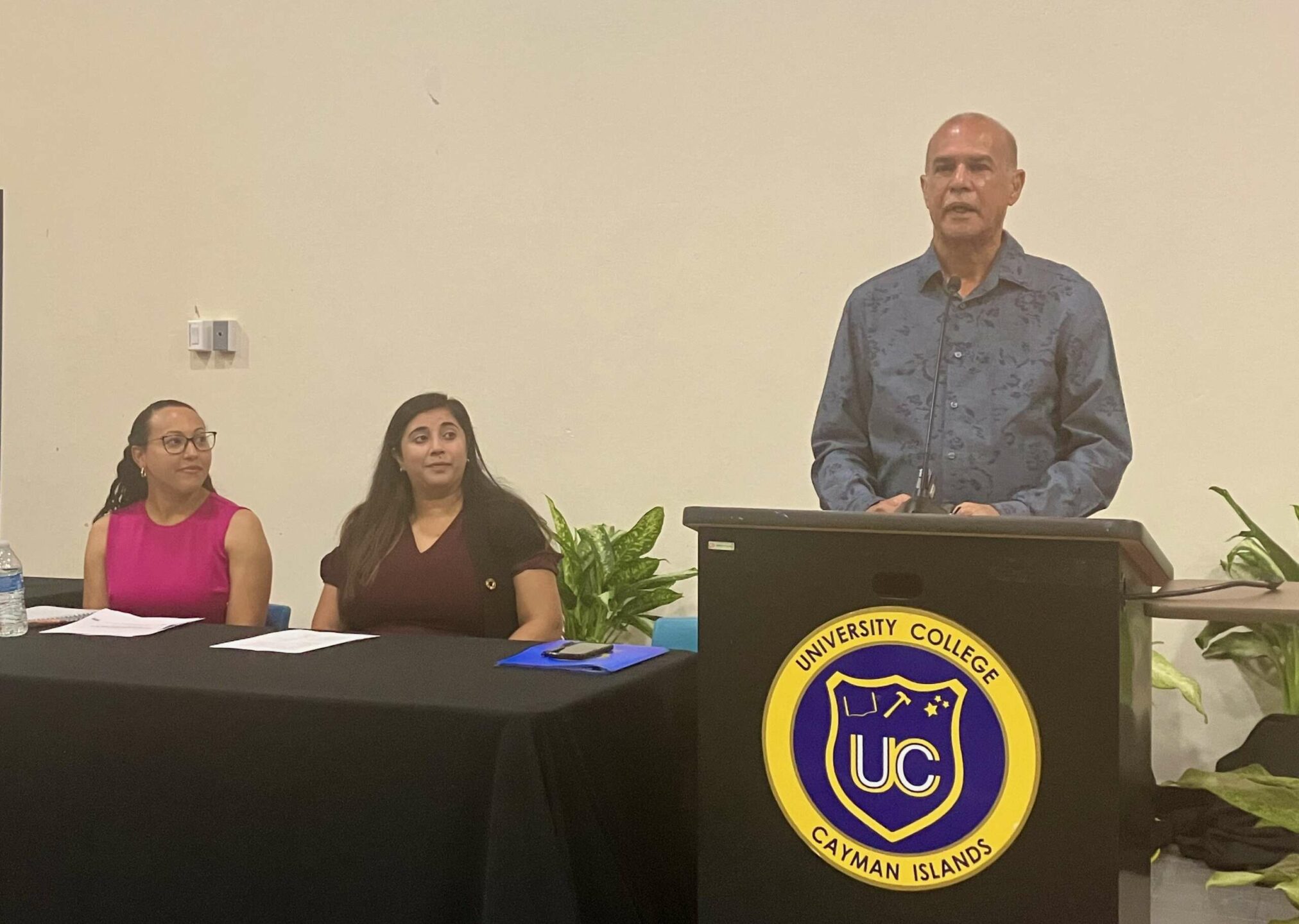
“If we put the minimum wage too high, the consequences of that will be devastating. We have to be practical and sensible and look at what is a affordable and what is reasonable,” he said.
Nonetheless, he expects some businesses to fail.
Scott argues that those businesses who are unable to afford paying above the present minimum wage may need to re-examine their current business model.
Most businesses that we spoke to felt they would be able to survive a small increase in the minimum wage, but indicated a belief that anything above $8 would be more challenging, and $10 or $12 would lead to significant impacts, including job losses, cuts in hours or the collapse of the business.
Is a minimum wage increase good for Caymanians?
The question of ‘How is this good for Cayman and Caymanians?’ is often at the forefront of politicians’ minds.
While increasing wages may open up more entry-level positions to young Caymanians, providing a foot on the ladder in industries like childcare or hospitality, while providing worthwhile money, the impact is most broadly going to be felt by expatriate workers.
The reality is that 70% of minimum wage workers are from overseas. More Caymanians likely employ minimum wage workers than earn that salary themselves.
Dwayne Seymour, the minister for labour, articulated this most bluntly, asking in a recent radio interview, “Who is the minimum wage going to benefit?”
Pointing out that the salaries of nannies had doubled from $3 to $6 per hour when the threshold was first introduced, he said, “And who did that affect? It affected Caymanians who needed a nanny to care for their children, and now they can’t afford it, so they have got to share a nanny now.”
Minimum Wage Advisory Committee chair Hurlston, answering similar queries from the public about the pay of nannies at a recent public meeting, said the committee had a difficult balancing act to negotiate. He said he was very conscious of the impact of raising nannies’ wages and potentially making it unaffordable or not worthwhile financially for Cayman mothers to go to work.
Hurlston also indicated his belief, based on the work of the commission and its research, that there were certain jobs that Caymanian people did not want to do, and that there were factors beyond the low salaries behind that.
Should there be separate treatment for nannies?
As Seymour’s comments suggest, there are some who believe household workers should be considered differently. Hurlston said the current minimum wage considers that by allowing a lower rate for live-in domestic staff. He told the Compass in a recent interview that a lot of Cayman families often rely on nannies to “run the household” while both parents go to work.

“That class of worker is critical to the Cayman Islands family and those workers often become part of the family,” he said.
The Compass will explore the issue of wages and working conditions for domestic helpers in a future story. And while several workers, who spoke to the newspaper, agreed with Hurlston’s characterisation, others told of long hours, difficult working conditions, extremely low pay and sometimes humiliating treatment from employers.
Questions have been raised, too, about whether a private nanny is strictly necessary for every family in Cayman. But amid a shortage of childcare facilities, some parents say they have no option and they have to pay what they can afford.
What are the arguments for increasing the minimum wage?
Simply keeping up with inflation would suggest a minimum wage of around $8 an hour is appropriate in Cayman – based on the decision that $6 was appropriate in 2016.
There is an important humanity aspect to increasing wages, says Scott.
“With our current minimum wage, we are importing poverty and any country that is built on the back of exploiting people is destined to fail,” he said.
“I don’t expect any of us want to deprive any human being of the right to eat and live safely, but that’s exactly what we are doing.”
He also argues that a higher rate would make some of the jobs currently filled with imported labour more attractive to unemployed Caymanians.
“Minimum wage jobs do not attract many Caymanians because they are simply not able to live in such a wage.”
I don’t expect any of us want to deprive any human being of the right to eat and live safely, but that’s exactly what we are doing.
– Dan Scott
A similar argument is made in a thoughtful commentary piece covering the findings of the Chamber survey, by writer Christopher Tobutt.
“By reducing the disparity between the lowest paid guest worker and the kind of jobs that Caymanians may seek, we are reducing our dependence on an unfair, two-tier labour system that fragments our communities and compromises the fabric of our culture,” he wrote in piece weighing up the pros and cons of a higher minimum wage.
If the rate is too low, why do people accept the jobs?
There is an argument that market forces should be allowed to dictate wages. And while workers continue to accept pay of $6 an hour, some question why the government should intervene.
Some of the workers who spoke to the Compass felt that wages were too low and life was hard. But they acknowledged that the attraction of a Cayman-dollar salary was still strong and if they were able to save even $50 or $100 each month – that was money that could have meaningful impact in their home countries.
Even those who were simply making enough to cover living expenses said it was worth it for them to be in Cayman in the hope of moving on to a slightly higher-paying job, which would make a life-changing difference for family members back home.
One business owner questioned the value of raising wages as a means to raise living standards in Cayman, suggesting many workers would continue to live in the same way, while sending more money out of the country to fund homes and businesses in their homelands.
While some of those interviewed indicated that is what they would do, others said they would first seek to find more secure accommodation or increase meagre monthly food budgets.
Some workers have already voted with their feet and left, while others said they were thinking of following suit and that the economics of low-wage labour in the Cayman Islands no longer worked for them.
“When you have made sacrifices to come here and you see you are just working all the time to pay bills, you do wonder if it was worth it,” a security guard told us.
What about a weekly minimum wage?
While the focus is on an hourly rate, Scott maintains that there should also be a weekly minimum. At $6 an hour, he said, a 40-hour week pays less than $1,000 a month – a difficult amount to survive on in Cayman.

One domestic worker told us she was very happy with her salary of $15 an hour but was only employed for 20 hours a week, making it hard to survive.
A landscaping business owner told us all of his employees wanted more hours – but he could not afford to pay overtime rates and wanted them to be fresh and efficient for a hard job in the hot sun.
“I don’t want them working 60 hours a week,” he said.
One large business owner argued that the Labour Act should be amended to allow people to work a longer week. Currently, anything over 45 hours means overtime at time-and-a-half must be paid, Although waivers are often granted for certain sectors, the business owner said this was not consistently applied.
He suggested a 60-hour work week would be fair.
“Quite a few people are here to work. They want to work as many hours as possible.”
The overtime costs mean it is currently more practical for employers to hire more staff and shift them to a maximum of 45 hours, a dynamic which he said benefited neither employer or employee.
Will the minimum wage be adjusted annually?
If the minimum wage had been pegged to inflation, it would already be at almost $8.
Hurlston said his committee had recommended in 2016 that the rate be reviewed annually and is likely to make a similar suggestion this time.
He said the committee was also looking at the prospect of a phased introduction of the new rate – potentially allowing businesses a grace period to implement it.
When will the new rate be introduced?
After months of research and public consultation, the committee is expected to file its recommendations on a new minimum wage to government at the end of this month.
The committee is purely advisory and it will be up to government to decide whether or not to follow its recommendations.
Though the report goes to government in September, it won’t necessarily be released to the press or public at that time. Hurlston said it would be up to government to decide what happens once it has handed over its research and recommendations. There is no established timeline for when it will be implemented. Again, that is in the hands of the elected members.
Related Videos