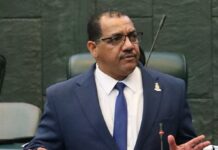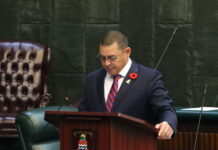
Government revenue for 2023 is expected to be “marginally shy” of the year’s targeted $1.037 billion, according to Premier Wayne Panton.
For the first eight months up to 31 Aug., it was expected that $785.4 million would have been received; however, the actual figure was $3.2 million less at $782.2 million.
Despite the shortfall, revenue was still $13.2 million higher than the same eight-month period in 2022, said Panton, who is also Minister for Finance and Economic Development.
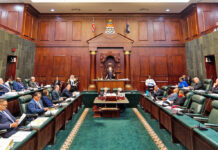
The premier gave the latest figures on the government’s financial performance during his statement in Parliament on Wednesday, 20 Sept.
He said the figures follow the same trend as in the first half of the financial year, with higher revenues from import duties, and tourism-related fees and taxes compared to 2022.
“In general, we have seen that positive financial performance in some areas has compensated for underperformance in other areas,” the premier explained.
Operating revenue
The original budget for the 2023 financial year, which was presented to Parliament in November 2021, indicated that government revenue in 2023 would be $978.1 million.
“By now, this is an out-of-date figure and it is more appropriate that the government track its performance against the revised estimates of revenues and expenditures,” Panton said.
These were established in the Strategic Policy Statement, which was tabled in Parliament in late April 2023. It contained an updated forecast for 2023 of $1.037 billion.
For the first eight months up to 31 Aug., the government made $782.2 million – this included $735.7 million in ‘coercive revenue’ which involves no exchange of service, such as taxation.
The premier said the most significant positive year-to-date revenue variances were recorded in work-permit revenues, tourism-related revenues and investment revenue.
In work-permit revenues, this is due to the continued increase in labour demand that followed the reopening of the borders after the COVID lockdown and continued economic growth, he said.
The finance minister explained that for tourism-related revenues, the positive variance is because of the increase in stayover tourism after the borders were reopened in 2022.
In investment revenue, the significant positive change is firstly due to the relatively high rates of interest earned on fixed deposit balances of the government, Panton said.
And secondly, the “currently significant bank account balances” of the government that are placed on fixed deposits.
Operating and financing expenditures
Expenses for the eight-month period that ended 31 Aug. were $647.7 million. This was $5.5 million more than the $642.2 million incurred over the same period in 2022.
The premier said variances between actual and budgeted expenses are largely due to excess spends on tertiary healthcare costs, and the cost of indigent care.
“These overages were somewhat offset by underspending in other areas of expenditure, particularly in the personnel, and supplies and consumables cost categories,” he said.
The Finance Committee has approved, and will soon further approve, supplementary funding in the areas where spending is expected to exceed budget estimates, he said.
A significant proportion of core government’s operating revenue is earned during the first quarter of each financial year – which is when financial services fees are due.
Historically, revenue levels taper off as the year progresses, Panton explained.
However, the government is expecting to end the year in a positive position with a small forecasted operating surplus.
Bank and debt balances
At the end of August, core government’s closing bank account balances totalled $620.5 million while core government debt balances stood at $471.7 million.
In June of this year, US Treasury Notes previously held at their purchase price of US$333.6 million, or CI$276.9 million, matured.
The funds from this investment have been reinvested in local US Fixed Deposits, Panton told Parliament.
The Cayman Islands’ debt-to-GDP ratio of 7.7% “remains amongst the lowest in the world – and is a very modest debt metric”, he added.
Japan’s debt-to-GDP ratio is over 200% and the UK’s is over 80%, the premier said, indicating “our local government has debt under control and is very prudent with respect to borrowing”.
Responsible financial management
For the 2022 financial year, core government ended the year in compliance with all the ‘principles of responsible financial management’, Panton said.
This was an improvement over 2021 where the government ended that year with a deficit.
The positive compliance with the principles included:
- The government achieved an operating surplus of $54 million.
- Net worth is forecast to be positive at $2.1 billion.
- Debt-servicing cost, which includes both interest and principal payments, was calculated to be 7% – within the 10% threshold.
- Net debt – the ratio between government’s total debt and bank balances – was 16.6%, comfortably within the maximum 80% threshold.
- Cash reserves were at 107.8 days of operating expenditures ‒ which is above the 90-day minimum legal threshold.
Government also expects to be in full compliance with all of the principles at the end of the current 2023 financial year, Panton added in his statement to Parliament.
Related Videos