Government members were locked in behind-closed-doors talks for much of Monday, as Premier Wayne Panton sought to hold on to his slender grip on power amid divisions over spending priorities.
Parliament was scheduled to reconvene Tuesday, with no official word out of the PACT camp, following the resignation of Labour and Border Control Minister Dwayne Seymour on Friday afternoon.
The most credible challenge to Panton’s leadership of the PACT coalition of independents is understood to come from his current deputy Juliana O’Connor-Connolly. Panton appeared to have weathered the storm by Monday night, however and is likely to hold on to the top job – at least for now.
Isaac Rankine, the East End MP who has been tipped as the most likely successor to Seymour in the Cabinet, sent a message to constituents over the weekend insisting, “the PACT Government remains intact”. And that seemed to have held true through the end of Monday.
None of the current Cabinet members – including Panton and O’Connor-Connolly – responded to calls and messages from the Compass throughout Monday. It is understood that the caucus was involved in intense discussions at the Government Administration Building throughout the day.
Meanwhile, the wider opposition group – which now numbers eight of the 19 members, including the six remaining Progressives members and independents Seymour and Chris Saunders – huddled at the George Town Yacht Club.
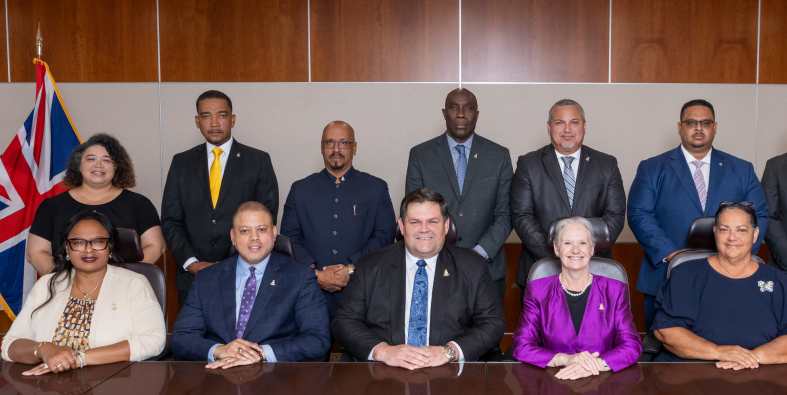
David Wight, the MP for George Town West posted a picture of seven of the members (minus sister islands MP Moses Kirkconnell) with the caption ‘Government in Waiting???”
But the parliamentary maths, at the time of Wight’s tongue-in-cheek post on Monday evening, still favoured the PACT coalition by 11-8.
A house divided
Some of the divisions within that group of 11 have been laid bare in recent months. First, speaker McKeeva Bush was forced to step down following fresh criminal charges. Earlier this month, Tourism Minister Kenneth Bryan took out a billboard to urge swifter action on immigration reform, and just last week, several PACT members voted against the premier on a number of private member’s motions.
With Katherine Ebanks-Wilks now in the speaker’s chair – and only able to vote in case of a tie – the slender majority could prove a problem for the coalition in getting legislation passed unless every member of the team is present in the House and on board.
Premier Panton, as finance minister, will have to sit as chair when government goes into Finance Committee to approve its budget – meaning he will only be able to cast a deciding vote in a tie for any financial bills.
With disputes over spending priorities at the root of much of the division in the PACT administration, there are concerns that it could be a rocky ride to approve the $2 billion, two-year government spending plan for 2024/2025 which has to be approved and gazetted by the end of December this year.
Challenge to pass $68m spending bill
A more immediate headache for Panton and PACT – assuming he holds on to the leadership – will be to get $68 million supplementary budget amendments approved Tuesday morning.
The Finance Committee of Parliament was scheduled to meet Friday afternoon to debate the additional spending. But Seymour’s public resignation late in the afternoon and the opposition group’s decision to sit out the hearing meant business was suspended until 10am Tuesday.
Much of the funding requests – needed for this year – appear to be for money that has already been allocated.
There is $2 million requested for primary education services, for example, including expenses for 14 new maths specialists that have already been hired.
An additional $23.8 million is requested for ‘tertiary medical care at overseas institutions’ – which covers costs to send patients, who don’t have full insurance, abroad for specialist treatment.
If those appropriations are not approved by Parliament, it would be problematic for government.
In a hypothetical worst-case scenario, it could mean there is no money to pay teachers or fund overseas healthcare, come December. That remains extremely unlikely, however, as the government still holds a 10-8 majority on the floor of the house and the opposition group is unlikely to try to block spending on healthcare and education.
‘Out of control’
Former finance minister Chris Saunders, who resigned from PACT amid disagreement with Panton earlier this year, said it was by no means certain that the opposition would wave through the full $68 million in supplementary spending, however.
Government is now scheduled to end the year with a marginal surplus, compared to $50 million that was forecast when the Strategic Policy Statement was presented earlier this year.
“They have completely lost control of the finances of this country,” said Saunders, arguing that running surplus budgets and maintaining strong cash reserves had saved Cayman during COVID-19.
He said it was essential for Cayman to have rainy day funds in case of a downturn in the economy or a major hurricane, for example. With “economic headwinds” on the horizon including the impact of cuts in diesel exports from Russia, he said government needed to be sensible.
“All these things will impact the quality of life for every day families who are already feeling the impact of the high cost of living,” he added.
Saunders said opposition legislators would not obstruct spending to land political punches, but he insisted he and others would be demanding answers over government’s budget decisions.
“We expect a responsible budget,” the former finance minister said.
“They always called me draconian, but when you are spending the people’s money you have to be prudent.
“The last thing we want is the UK telling us our revenue model is unsustainable and insisting on some kind of income tax. That is what keeps me up at night.”
Budget challenges
This week’s finance committee wrangle could be just a taster for the budget debate, expected in November or December.
Spending priorities are said to be at the centre of the divisions between Panton and some of the PACT members, with the premier’s support of sustainability initiatives said to be out of step with some of his ministers.
Seymour alluded to this in his resignation speech, accusing the premier of leading in an autocratic way and failing to get the budget agreed in a “timely and consultative manner”.
O’Connor-Connolly has also appeared to contradict the premier on spending priorities, albeit in a much more low-key manner. She outlined what she called “some unsolicited, broad-brush guidelines” on salary-increase recommendations for educators last month – in the same week as Panton’s internal memo calling on civil servants to slash $50 million from the budget by the end of the year was widely publicised.
The premier has acknowledged government is likely to miss its $1 billion revenue target for the year, despite increases in income from tourism and work permits.
Despite those concerns, the premier struck an optimistic tone in a speech to the House Friday, describing the economy as “strong and getting stronger”.
Key sectors of the economy – financial services, tourism and construction – all saw significant growth during the year as the post-COVID bounce-back continued. Meanwhile, the population surged again, hitting a new high of 83,671. The number of work permits increased from 26,321 in December 2021 to 36,372 in June 2023, as the tourism industry reopened and businesses got back to full speed after the pandemic.
An additional 3,000 Caymanian jobs were created over the same time period, with the local unemployment rate down to 3.7%.
“I am proud to report that, as predicted, Cayman’s economy is strong and getting stronger; and we are steadily recovering from the devastation of the COVID-19 pandemic,” Panton said.
“International business is thriving. Shops are bustling and, for those that want them, jobs are available up and down the economic ladder.”
In those circumstances, Saunders said, it was even more of a mystery that government was anticipating a surplus less than what was forecast in the SPS.
“I am saddened to see the government in this position considering the work we did in the first 2 years,” he added, referencing the shift in the country’s financial position from a pre-election forecast deficit of $158m to a surplus of $32 million.
Those gains, made at a time when government was still paying for costs related to COVID and the Electricity Assistance Program, were now at risk of being lost, he said.
Related Videos