Artificial intelligence could make millions of white-collar jobs, including in the Cayman Islands’ key industries, obsolete within the next decade, delegates at an investment conference in Grand Cayman have heard.
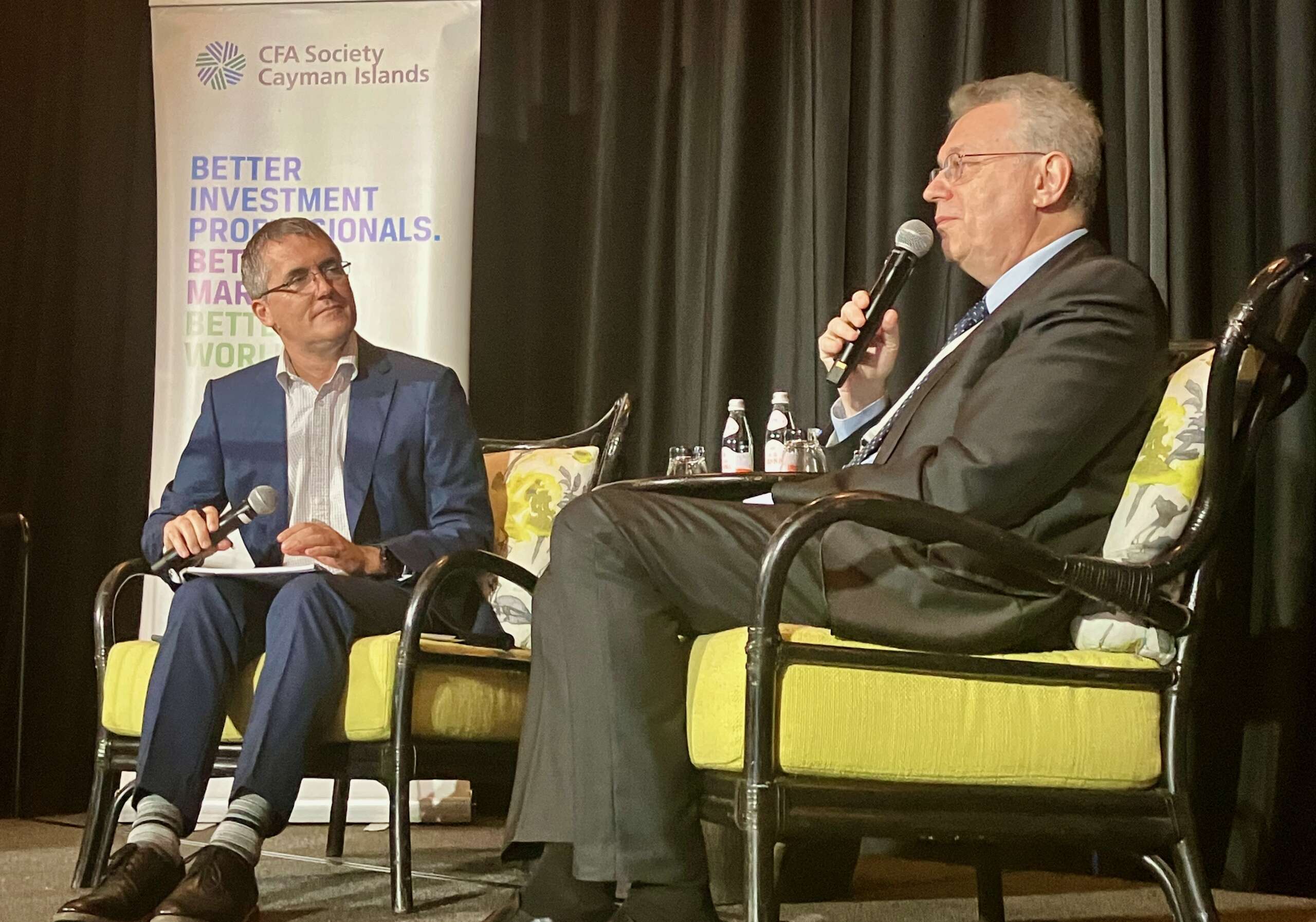
From amphibious drones modelled on flying squid and 3D printers that can produce homes in a matter of minutes, to the decline of democracy and the end of human usefulness, four international speakers painted a bewildering vision of the future at the 9th annual CFA Cayman Investment Forum on 2 Nov.
The conference, aptly titled ‘The Conundrum of Constant Change’ highlighted threats and opportunities, both for investors and, more broadly, for humanity, in the anticipated acceleration of technology and geopolitical flux.
A word cloud of the speeches during the afternoon at the Kimpton Seafire Resort would have heavily featured terms like ‘havoc’, ‘chaos’ and ‘dystopia’.
For those seeking stability, there was always the opportunity to run to the lobby, where one of the event sponsors Strategic Wealth Preservation offered the chance to hold an $800,000 gold bar.
The chance to feel the weight of that historic symbol of wealth was a reassuring counterpoint to the narrative of the afternoon, which focused on a less tangible future.
Will robots solve climate change or eliminate mankind?
Will artificial intelligence take our jobs or usher in a world of constant leisure?
Will war, pandemic, climate change or some other ‘black swan event’ bring more disruption to our world?
The questions were clearer than the answers, and different speakers had different takes on the range of possible outcomes. But one thing was agreed. Things are about to get surreal.
‘Havoc will rule’
Viktor Shvets, an investment banker and author of ’The Great Rupture – Three Empires, Four Turning Points and the Future of Humanity’ – began the afternoon with a sobering prediction.
“ChatGTP and its next evolution will create a really [reduced] value for most white-collar employees over the next five, six, seven years.
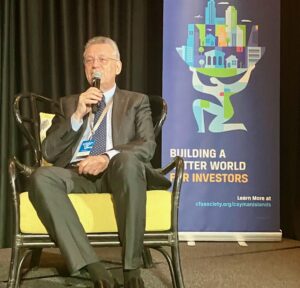
“They will experience what factory workers in Detroit and Michigan and Melbourne and Birmingham and Manchester experienced in 1990s,” he said, referencing the huge losses of blue-collar jobs in that period.
Artificial intelligence, he predicted, would eventually replace most human jobs.
“We can already print a house in 24 hours for $10,000, we just can’t scale it yet, but we will be able to,” he said.
By the time that technology propagates throughout the economic system, he predicts, “I don’t think there will be anything left for humans to do or contribute to.”
The final consequences of that, he acknowledged, were an open question that could end with Universal Basic Income for all and a form of ‘enlightened communism’ as a governing principle for societies where the work is done by machines. But the interim period, he warned, would be one of extremes.
Likening the current era to the 1930s, a time in which despotic leaders emerged amid political upheaval in the run up to the Second World War, he predicted, “Havoc will rule for the next couple of decades.”
Meet the robots
Speaking later at the same conference, Miko Kovac, director of the aerial robotics laboratory at Imperial College London, gave shape and form to what that havoc might look like and a more optimistic take on what it means for humanity.
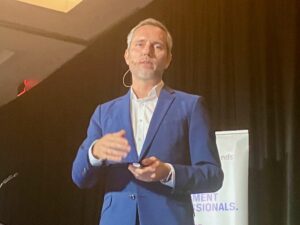
He described flame-resistant robots that could fly into fires and extinguish them; biodegradable machines that can blend into a forest and provide data to help reverse the impacts of climate change; and amphibious drones – based on flying squid – that can monitor ocean health or work on offshore wind farms.
Kovac said investment was needed to create experimental seedbeds where these ideas could be tested. He said humans needed to get used to the idea that robots were here to stay and would be an increasing part of our lives and economies.
But he expressed hope that their influence would be for the betterment of mankind.
“It is about technology,” he said, “but it is also about humanity – what do we do with that technology? It is about the heart, and it’s about how we then use that to develop the robotics, the technology in symphony with this.”
Related Videos