

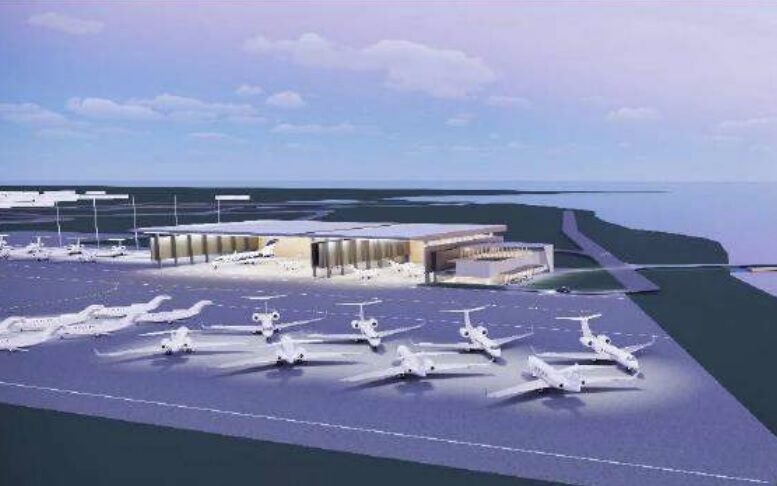
Government’s plans to upgrade the general aviation facility at the Owen Roberts International airport has taken another step forward with the opening of tender bids for design consultancy services for the project.
The request for proposals, which was issued on the government procurement Bonfire portal, is seeking firms to design the general aviation parking apron, heliport and marine dock project.
The plans consist of the construction of an approximate 70,000 square-metre flexible and non-flexible aircraft parking apron, an approximate 10,500 square-metre heliport apron and a small marine dock with an associated seawall.
“The GA apron will consist of a connection to the existing taxiways G and H. The design scope will include all access roads, underground utilities and necessary external works required as outlined in the conceptual design included in the CIAA 2041 Master Plan. The site is located at the Owen Roberts International Airport in Grand Cayman and is adjacent to the existing easterly apron and the North Sound,” the RFP stated.
The deadline for submissions is 22 Jan. 2024.
No EIA required
Included in the RFP documents is the Department of Environment screening opinion, which found that the proposed development does not require an environmental impact assessment “as there are no likely significant adverse effects that require further assessment”.
However, the DoE did say there are likely to be minor adverse effects related to air quality, ground conditions, and noise and vibration from the proposed development.
Pointing to the proposed design, the DoE said the Cayman Islands Airports Authority should adequately take into account climate change in its project.
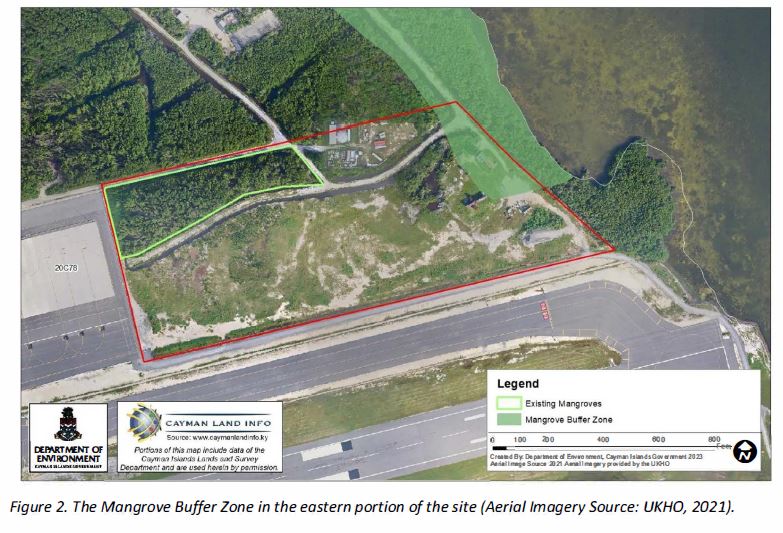
It is also recommending that it “restore the 1.5 acre encroachment into the Mangrove Buffer Zone into mangrove habitat to mitigate for the loss of 3 acres of mangroves across the remainder of the site”.
The general aviation upgrade forms part of the government’s Airports Master Plan, which outlines the way forward for aerodromes on all three of the Cayman Islands over the next two decades.
The Cayman Islands Airports Authority document, unveiled in July, indicates that the total estimated price tag for the many projects in the plan is just under $660 million.
Some of the projects are considered to be of such high priority that they need to be completed within the next five years, while others are much farther down the to-do list.
Of that amount, almost $491 million will be spent on Owen Roberts International Airport in Grand Cayman, $79 million on the Charles Kirkconnell International Airport in Cayman Brac, and $47.5 million on the Edward Bodden Airfield in Little Cayman.
‘Well beyond’ extended life expectancy
The CIAA, in its project details in the request for proposals, explained that the existing general aviation terminal at Owen Roberts “is well beyond the building’s original and extended life expectancy”.
“The ageing building requires ever-increasing maintenance and repairs, and the facility fails to provide the high-value brand image that the Cayman Islands Government is working to foster for its visitors,” it said.
The authority said it acknowledged three key issues with the existing facility – the relatively poor condition of the terminal building, the lack of space required for general aviation aircraft parking during peak periods, and delays to both general aviation and commercial airline operations due to wait times for aircraft ‘backtracking’ taxiing operations and resulting in extra time occupying the runway.
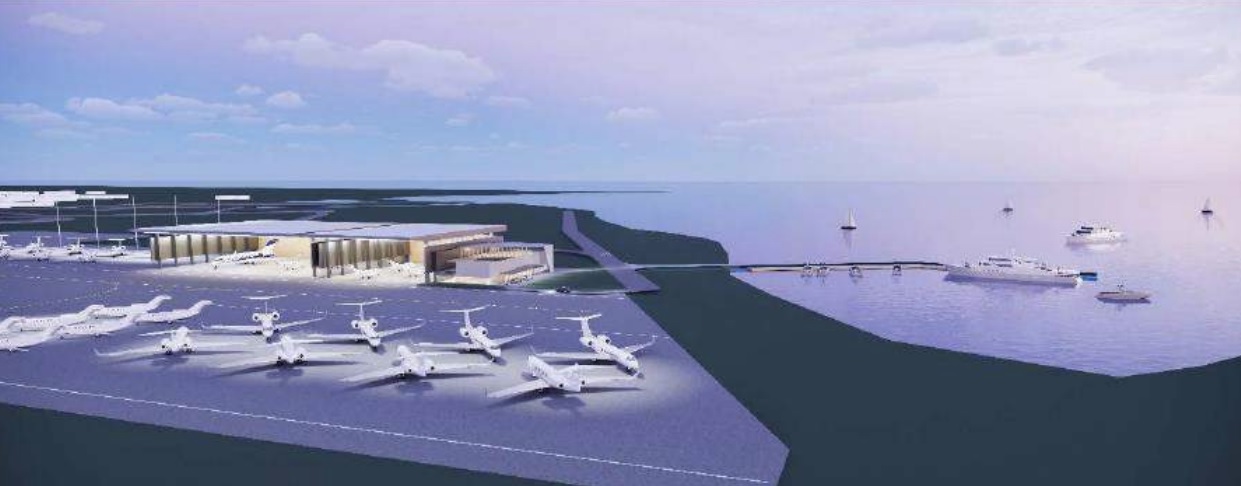
Work on upgrading general aviation, the CIAA said, will be done in phases, with the first part for completing the aircraft parking apron, the heliport apron and the small marine dock.
The second phase is to build the general aviation terminal, with the final phase to construct a hangar, both of which are outlined in the master plan.
The current request for proposals, the CIAA said, is broken down into two stages – design; and project management and construction administration.
The CIAA says the anticipated execution of the project is 1 March 2024.
Related Videos










If they wish to have a “high-value brand image”, they should immediately spend the relatively small amount needed to ensure passenger jet-ways are installed at all existing gates. First impressions matter enormously. To have to navigate rickety staircases in torrential rain clutching hand luggage with maybe a few children in tow is hardly the “high-value” to which they aspire. 20th century third world comes to mind.