


Cayman’s national minimum wage is one of the least generous in the developed world when compared with average earnings in other countries, research by the Cayman Compass has revealed.
Set against other economically developed countries, other Caribbean nations, and even other international financial centres, Cayman’s national minimum wage sits almost last among the 35 countries analysed.
Minimum wage earners in Chile and New Zealand are twice as well paid as Cayman’s, the data reveals.
Even if the minimum wage increases in line with proposals made by an advisory panel last month, the lowest-paid workers in countries, including Turkey, Slovenia, the British Virgin Islands, Romania, Bermuda and Slovakia, would all be better-off, compared with their compatriots, than Cayman’s lowest-paid workers would be with theirs.
Several experts questioned whether, in light of the analysis, the proposed increase was sufficient. The government has so far taken no action on the panel’s recommendations.
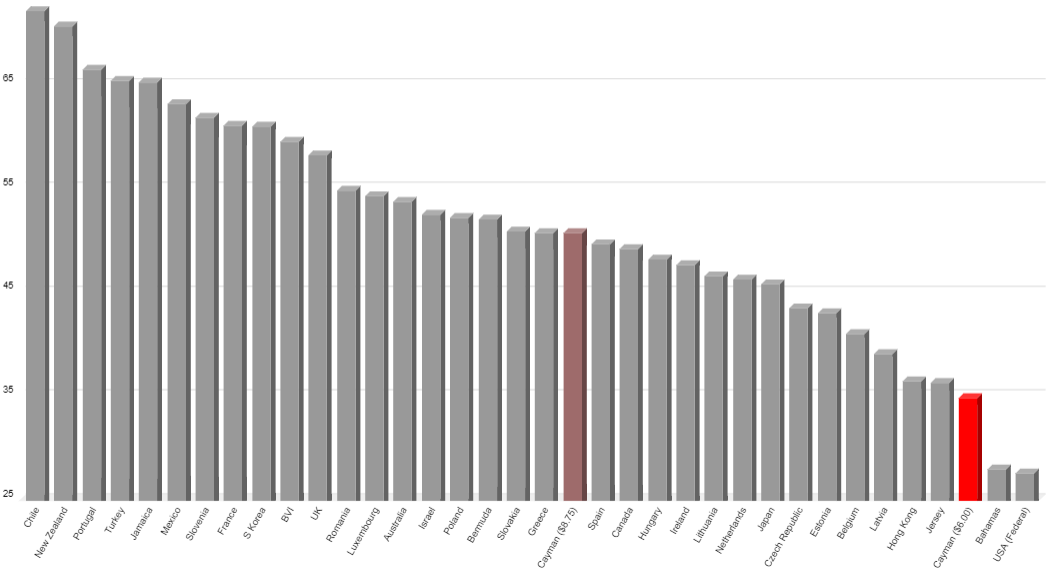
The current minimum wage is also less generous than in Hong Kong and Jersey, comparable low-tax international financial centres.
Of the countries analysed by the Compass, only the minimum wage in Bahamas and the federal minimum wage in the US represent a smaller percentage of median earnings – but 30 of 50 US states, and many US cities, have a mandated wage higher than the federal minimum.
What is a median wage and why does it matter?
In order to compare the value of the minimum wage in different countries, economists often compare it to ‘median income’ – a specific mathematical term.
The average (the mathematical ‘mean’) income can often be skewed by a small number of very high or very low earners.
So experts tend to use the ‘median’ – the wages of the person who earns more than exactly half the population, and less than the other half.
For example, in a group of five people who earn $3, $4, $5, $6, and $100, the median is the person in the middle, who earns $5.
The mean, or average of those numbers, is $23.60, which would not accurately reflect what the ‘average worker’ in that group earns.
Last out of 28 developed countries
Cayman’s minimum wage is $6 per hour which, for a 40-hour week over 52 weeks a year (assuming paid holidays), equates to an annual wage of $12,480.
According to the latest Labour Force Survey, for spring 2023, conducted by the Economics and Statistics Office, Cayman’s median wage is $2,999.50 per month, or $35,994 a year.
Cayman’s minimum wage is therefore just over one-third – exactly 34.67% – of the median wage.
For comparison, according to 2022 data compiled by the Organization for Economic Co-operation and Development, in New Zealand that number is more than two-thirds: 70.47%.
The data shows that in Mexico it is 63%, in the UK 58%, and in Slovakia 51%.
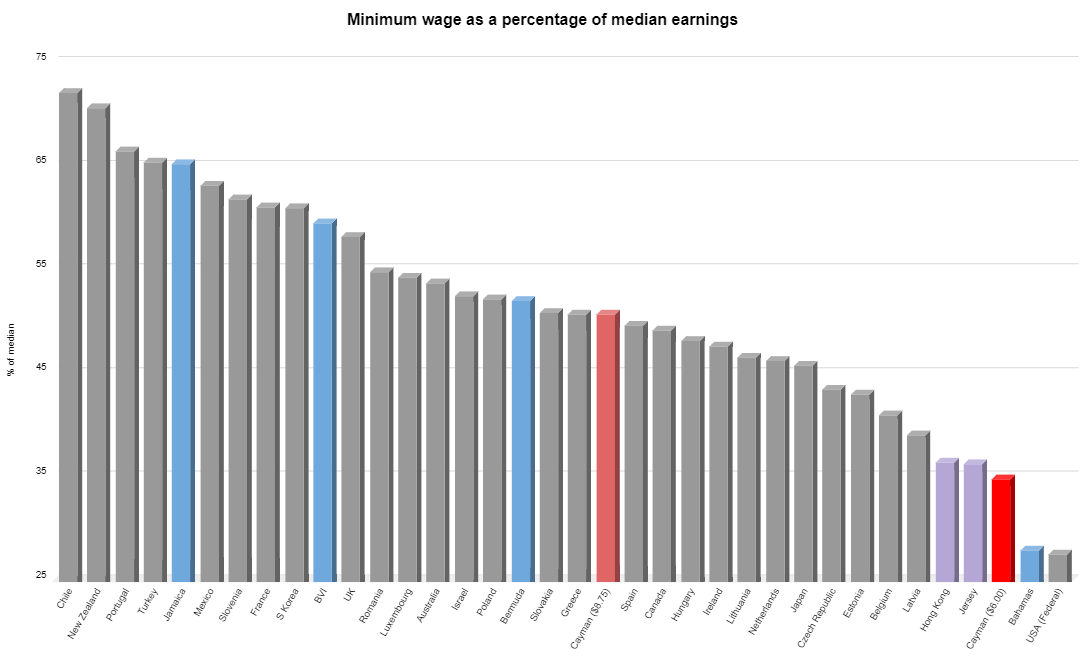
Of the 28 nations compared by the OECD, not a single one has a less generous minimum wage, compared to median earnings, than Cayman.
The European Commission advocates an adequate minimum wage of 60% of the median wage. A recent report published by the UK’s HM Treasury recommends a similar level.
Even proposed increase would not see Cayman overtake its neighbours
The Compass also compared other island nations, using their own government statistics, and found they are mainly more generous than in Cayman.
In Jamaica, the recently-increased minimum wage will be 65% of median wages when it goes up to J$15,000 per week in June.
The BVI’s minimum wage is 59% of median, and in Bermuda it is 52%.
These will all still be higher than Cayman even if the minimum wage is increased to CI$8.75, as recently recommended by the Minimum Wage Advisory Committee. This would bring the figure to 50.56% of median wages.
However, in nearby Bahamas, the minimum wage of 260 Bahamian dollars per week is only 29% of the median wage of around 48,600 Bahamian dollars.
Low tax, low spend
Compass analysis also considered international financial centres Hong Kong and Jersey.
In both cases, the minimum wage is just over 36% of the median wage – low on the table but still higher than Cayman.
Some such jurisdictions do not have any minimum wage, including Singapore and Dubai.
This is also true of many developing countries which have no, or very low, minimum wages.
But the Compass did not compare Cayman’s figures to nations like Indonesia, where the minimum wage is 71 US cents per hour, or Rwanda where it is 7 cents an hour, because those economies, and their costs and standards of living, are not analogous with Cayman.
Given the lack of personal taxation in Cayman, though, low-wage earners may keep more of their income than in many other countries. However, in many of these countries the state provides services such as a level of healthcare free of charge, whereas most Cayman residents must pay for such services privately.
And tiered income taxes are progressive – meaning those with the smallest income pay less. In the UK, for example, no tax is due on the first £12,500 of income.
By contrast, flat taxes, such as apply in Cayman (where goods face 22% import rates which are passed on to the consumer at the till) are arguably regressive, because poorer sections of society spend a greater proportion of their income on tax than the wealthy.
What the committee found
Although review of minimum vs median wages was not a primary responsibility of the Minimum Wage Advisory Committee, its 130-page report included analysis of the figure, known to economists as the Kaitz index.
The committee found that in 2022, the Kaitz ratio in the Cayman Islands equalled 27.8; that is, the minimum wage is 27.8% of the median wage in the population.
“This would be considered low by international standards; the [International Labour Organisation] 2020 Global Wage Report shows that among some 40 emerging and developing economies, only seven countries have a Kaitz index of less than 30 (Bangladesh, Cameroon, Gambia, Mongolia, Niger, Sierra Leone, and Viet Nam), whereas exceptionally a country can reach a ratio above 80.”
The report continues: “Almost all countries show ratios with values between 40 and 60 – i.e., they have a minimum wage between 40 and 60 percent.”
The report’s figure for the Kaitz index was sourced from the International Labour Organisation, ESO officials told the Compass.
It is even lower than the Compass analysis of 2023 data, and would drop Cayman below The Bahamas on the Compass graph.
What the experts said
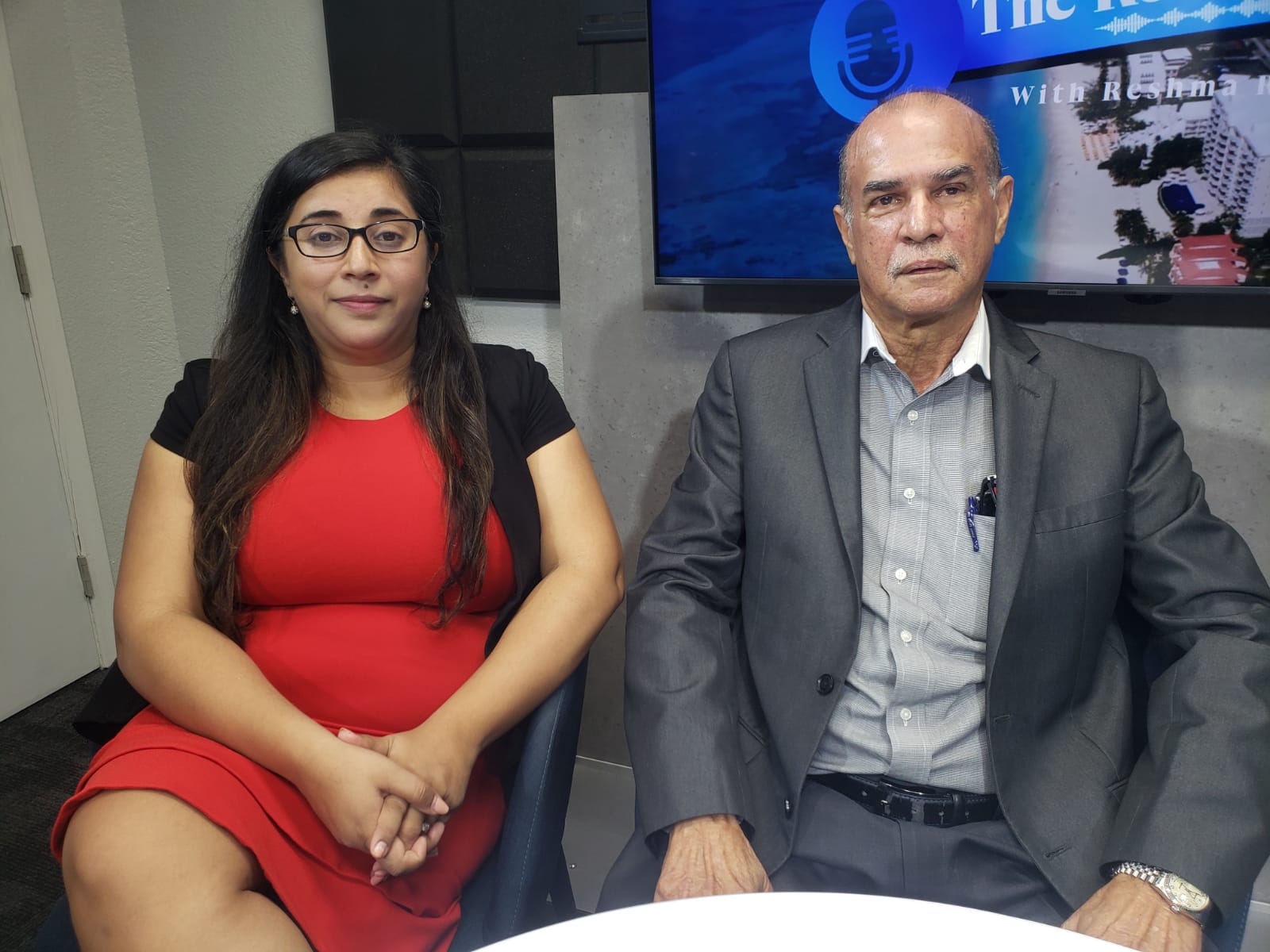
Mahreen Nabi, of the Business and Professional Women’s Club, who sat on the Minimum Wage Advisory Committee, said, “This analysis reiterates the need for a significant update to the national minimum wage.
“During its tenure, the committee heard time and time again from both businesses and employees that an increase is long overdue and necessary.
“One of the key things that is important to note is that the wage proposed of $8.75 was done with the expectation that the committee’s recommendation for an automatic increase mechanism tied to inflation be implemented as well.
“Although based on this Compass analysis, it doesn’t look like the initial increase is enough to move us to where we perhaps should be, it is the start of the forward movement needed to ensure employees receive a fair and proper wage for their work.
“The proposed mechanism was developed to ensure two things: that increases to this wage occur regularly and that the increases are in line with what the economy can bear.
“If implemented as suggested, it will likely bring us closer to our regional counterparts over time. “
Investment manager Simon Cawdery said: “This is very good analysis since it shows how ‘trivial’ the proposed numbers really are. If you adjust for cost of living they are even more puny.
“The cost of living is higher than most other places, thus using any other country as a barometer of ‘where Cayman’s should be’ needs to scale for that.”

He added that many countries on the table have social security or subsidised healthcare systems, where minimum wage is supplemented by housing allowances and free medical coverage.
“Economists use a term called ‘Income Elasticity of Demand’ to assess how individuals respond to receiving extra income. Rich people save it predominantly. Poor people spend it,” he said.
“Thus a higher minimum wage would likely go into spending, boosting the economy.”
Paul Byles, economist and director of consultancy FTS, said, “We need to take a closer look at the ‘living wage’ concept if we are serious about basic quality of life for anyone living here.
“The Compass analysis which compares the proposed minimum wage to the median income is useful because it’s a good proxy for income inequality.
“What it shows is that even at $8.75 per hour, there would still be a very large gap between the so-called haves and have nots in the Cayman Islands as compared to several other countries.”

He said, of roughly 8,000 people earning less than CI$1,600 per month, 2,000 are Caymanians.
“If we want to have a harmonious society and lower crime rates we need to consider the state of wages as one of several solutions,” he said.
He added that the high cost of living in Cayman means despite many work-permit holders sending funds home, “a large percentage of that wage increase is spent within the domestic economy and contributes to the livelihood of many small businesses.”
Catherine Welds, who sat on the Minimum Wage Advisory Committee, said finding a happy medium was one of the challenges they faced: “It’s not that we didn’t care about the median wage, but we specifically had to find the new, updated, legally enforceable minimum wage.”
She went on: “We would have loved for people to have a higher minimum wage, but what would happen, based on feedback we have been given, is many businesses would either cut hours or terminate staff if they had to pay much higher than what they were willing or able to pay without being adversely or negatively impacted financially.
“So we only went slightly higher than what they said they’d be willing or able to pay without doing those things.
“We couldn’t just say, ‘We’ll follow Bermuda and do a living wage’, or there would be a high unemployment rate for minimum wage workers, and we really want to avoid that. So, we had to find a balance between their interests and the businesses.”
She stressed the board was only advisory and that the government can decide to set any figure it chooses.
Will anything change?
Cayman introduced its first national minimum wage eight years ago.
Last month, following a six-month $50,000 consultation process, the Minimum Wage Advisory Committee reported to the Ministry of Labour that the wage should increase to $8.75 from this summer, with automatic inflation-linked increases in years to come.
They recommended that those in the service sector should not have their wage ‘topped up’ with gratuities, as it is currently, but should receive the full minimum wage with tips on top.
Labour Minister Dwayne Seymour, who is charged with taking the findings of the minimum wage report forward, has so far taken no action and there have been no debates in Parliament.
However, in response to Compass queries, a representative of the labour ministry said it is accepting feedback on the report from the public and stakeholders until 9 April, “after which the Minimum Wage Advisory Committee will report their finding to Cabinet. Cabinet will then review and decide next steps. It’s important to the Government to hear back from the public on the report recommendations so time is being allowed for this process.”
To provide feedback to the ministry, email [email protected].
The full findings of the Compass research on national minimum wage are as follows. Data is for 2022 or later.
| Country | Minimum wage as % of median earnings |
| Chile | 71.98 |
| New Zealand | 70.47 |
| Portugal | 66.33 |
| Turkey | 65.21 |
| Jamaica | 65.09 |
| Mexico | 63.03 |
| Slovenia | 61.69 |
| France | 60.89 |
| South Korea | 60.86 |
| British Virgin Islands | 59.37 |
| UK | 58.03 |
| Romania | 54.7 |
| Luxembourg | 54.16 |
| Australia | 53.6 |
| Israel | 52.35 |
| Poland | 52.08 |
| Bermuda | 51.90 |
| Slovakia | 50.76 |
| Greece | 50.61 |
| Cayman (proposed minimum wage of $8.75) | 50.56 |
| Spain | 49.52 |
| Canada | 49.06 |
| Hungary | 48 |
| Ireland | 47.51 |
| Lithuania | 46.41 |
| Netherlands | 46.11 |
| Japan | 45.64 |
| Czech Republic | 43.29 |
| Estonia | 42.87 |
| Belgium | 40.88 |
| Latvia | 38.91 |
| Hong Kong | 36.30 |
| Jersey | 36.13 |
| Cayman (current minimum wage of $6) | 34.67 |
| Bahamas | 27.82 |
| USA (Federal) | 27.38 |
Related Videos













That’s absolutely great, it should stay the same. Chile and New Zealand? – aren’t you looking up to the two most Socialist countries in this list, with their economies in tatters?
Simon C. speaks – I listen. Guy usually makes good cents (sense – see what I did there folks)
Cayman is successful on the backs of ex-pats who are exploited by wages too low to make a decent living. Caymanians were themselves in that position in their ancestral past. Be the Cayman Kind you like to be known for.
The impact of a minimum wage which is lower than any livable wage has many consequences especially for female workers who may resort to prostitution to fill the gap. Additionally the diet of those people is poor because they can only afford rice and sardines which results eventually in poor health. The minimum Shic 1 health insurance premium is also not very affordable to them and they frequently are required to fully buy their own insurance with no assistance from their employers who don’t mind breaking the law since there are usually no consequences. They may resort to an illegal second job to be able to send money home to loved ones who frequently depend fully on such remunerations. The repercussions are endless not to mention the fact that it reflects poorly on the conscience of not only the Government but the people of these fair islands.