Climate experts have suggested 2024 temperatures are on track to rank as the warmest on record as global temperatures maintain their rise and heated oceans continue.
The projection comes following the warmest June recorded in 175 years of tracking by the US National Oceanic and Atmospheric Administration (NOAA).
The month also marked 13 consecutive months of record-warm global temperatures, said NOAA’s National Centers for Environmental Information (NCEI) in their Monthly Global Climate Report for June 2024.
Rising temperatures
The NCEI Global Annual Temperature Outlook has said, “There is almost a 60% chance that 2024 will rank as the warmest year on record and a 100% chance that it will rank in the top five”.
The Cayman Islands was not immune from the high temperatures.
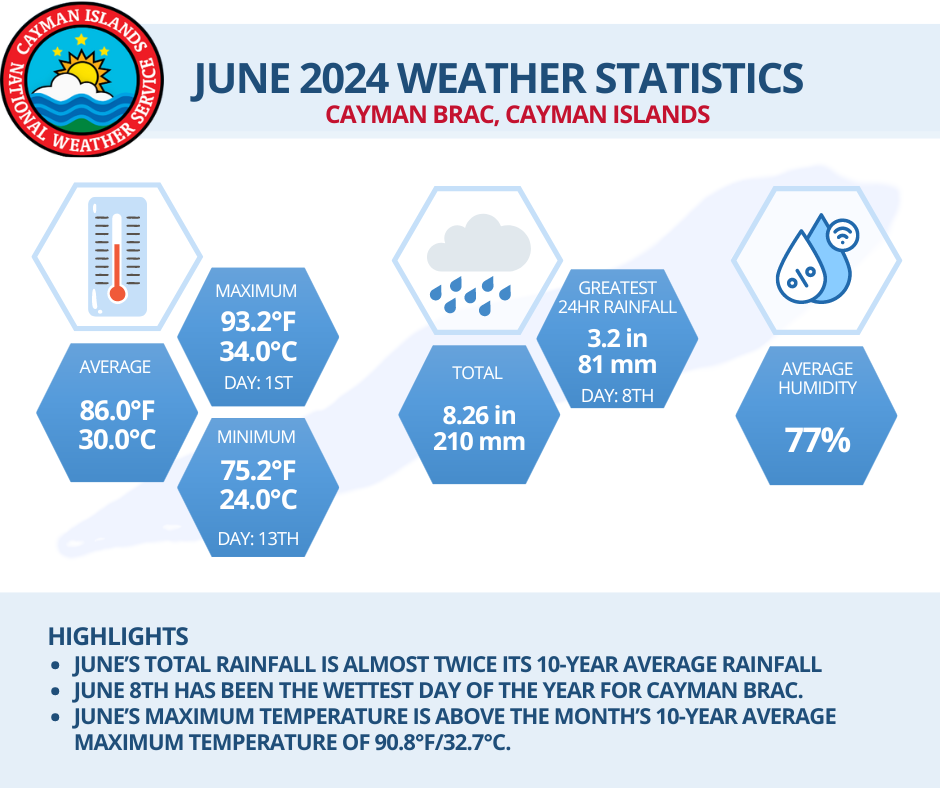
The Cayman Islands National Weather Service, in its June climatological report, stated that the month’s maximum temperature in Cayman Brac was above the 10-year average maximum temperature of 90.8°F/32.7°C.
That maximum recorded temperature, recorded 1 June, was 93.2°F/34.0°C.
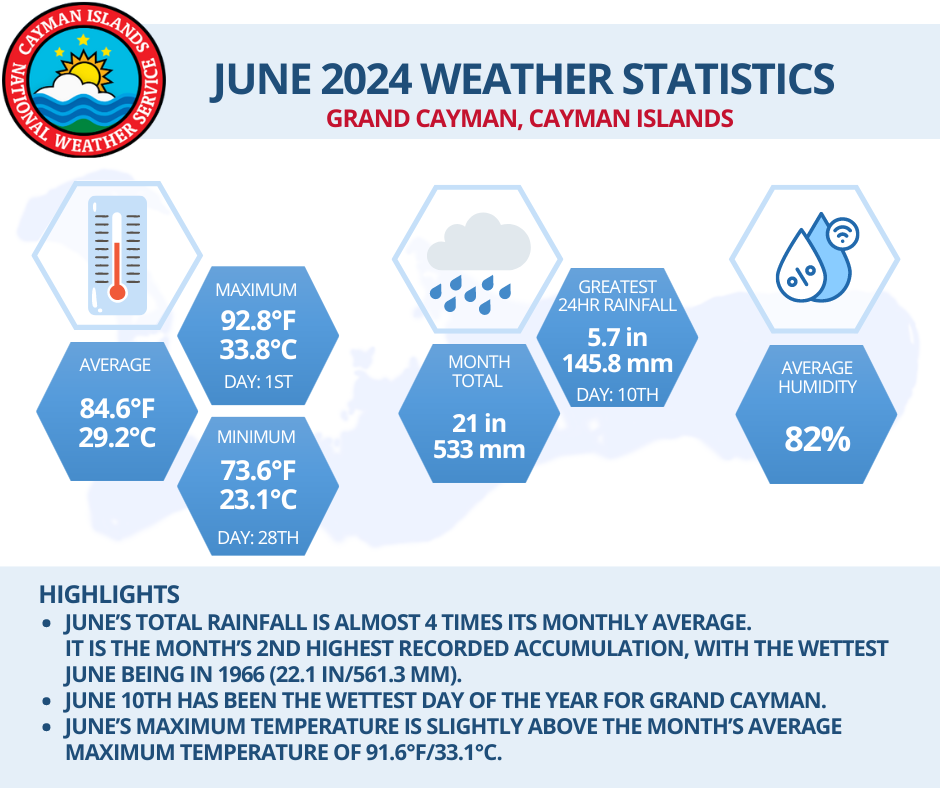
On Grand Cayman, June’s maximum temperature of 92.8°F/33.8°C was slightly above the month’s average maximum temperature of 91.6°F/33.1°C.
Kerrie Forbes, a forecaster at the National Weather Service, said in contrast to the global report from NOAA, the islands did not experience their warmest June on record. Cayman’s record remains June 2000.
“June 2023 had a higher maximum temperature in comparison to June 2024, which can be attributed to the lower maximum temperatures reached on days of heavy showers. In Grand Cayman, June 2024 marks the 15th consecutive month in which the maximum temperature was either greater than or equal its month’s average maximum temperature,” she said.
The maximum temperature for June 2024 was forecasted to be 70% above average, she said, adding that the highest maximum temperature experienced in June was 92.8°F/33.7°C, which fell within the forecasted temperature range.
This June, Forbes said, did not set any temperature records for the month.
The NCEI Global Climate Report stated that the Caribbean region had its warmest January–June on record at 1.41°C (2.54°F) above the 1910-2000 average.
“This was 0.35°C or 0.63°F above the previous record-warm January–June in 2020,” it added.
The report also stated that June’s global surface temperature was 2.20°F/1.22°C above the 20th-century average of 59.9°F/15.5°C.
“This is 0.15°C or 0.27°F warmer than the previous June record set last year, and the 13th consecutive month of record-high global temperatures. This ties with May 2015-May 2016 for the longest record warm global temperature streak in the modern record (since 1980). June 2024 marked the 48th consecutive June with global temperatures, at least nominally, above the 20th-century average,” the report stated.
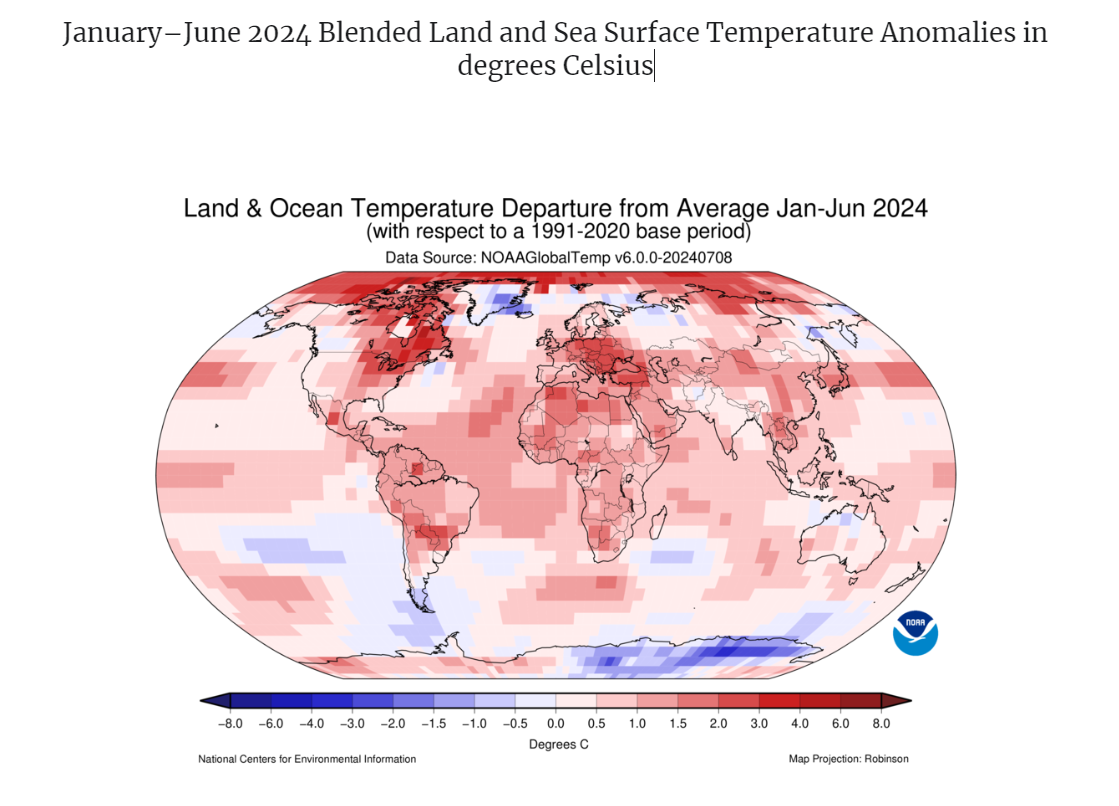
The global land-only June temperature was also the warmest on record at 3.15°F/1.75°C above average, the report added.
Ocean-only temperatures, the report said, ranked the warmest on record as well for June at 1.76°F/0.98°C above average, which was 0.09°F/0.05°C warmer than the previous record-setting June last year.
Those figures made June the 15th-consecutive month with a record-high ocean temperature.
These record temperatures have occurred under El Niño–Southern Oscillation (ENSO)-neutral conditions.
“The El Niño-Southern Oscillation (ENSO) is a recurring climate pattern involving changes in the temperature of waters in the central and eastern tropical Pacific Ocean,” the US National Weather Service stated.
Record rainfall
According to NOAA’s Climate Prediction Center, the ENSO-neutral conditions are still present, while La Niña is favoured with a 65% chance to develop during July-September and an 85% chance to persist into the Northern Hemisphere through November-January.
The National Weather Service, in its monthly climate bulletin for July, said, “a transition to La Niña conditions is usually marked by an increased chance of heavy showers, higher rainfalls totals, higher temperatures and enhanced tropical cyclone activity during the Hurricane Season”.
The heated temperatures in June led to drier-than-average figures in most of the western United States and Alaska, as well as large parts of the far eastern United States, the climate report stated.
However, there were some areas of the globe that recorded “wetter-than-average” totals in June, the report stated, which included parts of southern Japan, areas of eastern Europe, much of western Australia, large parts of the central United States, and southeast China.
In Cayman, wetter-than-usual conditions were also experienced as June’s total rainfall was almost 4 times its monthly average.
National Weather Service statistics showed that this June was the wettest June in 58 years. The climatological rainfall range from April to June at the Owen Roberts International Airport was 293.9 to 379.2 mm.
The total rainfall recorded for the three-month period was 622.3 mm, while June’s rainfall total of 533.4 mm surpassed its climatological value of 161.0 mm.
That total made it the June with the second-highest recorded rainfall accumulation. The highest was recorded in 1966 at 561.3 mm.
The weather stats also showed 10 June as the wettest day of the year so far for Grand Cayman.
On that date, the National Weather Service recorded the greatest 24-hour rainfall at 145.8 mm.
Cayman Brac’s rainfall also surpassed records.
The month’s total rainfall was almost double its 10-year average in Cayman Brac at 210 mm, the National Weather Service stated.
The stats also shows that 8 June was the wettest day of the year for Cayman Brac.
The greatest 24-hour rainfall on Cayman Brac was also recorded on that day at 81 mm.
While more wet days may be ahead with the transition into La Niña conditions, Forbes said temperatures are also expected to be 70-80% above average for the month of July 2024.
“Last year, the Cayman Islands recorded its newest record maximum temperature in July 2023 of 95.0°F [35°C]. As we are expecting higher temperatures for July 2024, the maximum temperature could have the possibility of approaching this value,” she said.
Given the anticipated high temperatures in the Cayman Islands this year, Forbes said it’s recommended that the public stay hydrated and minimise outdoor activities during the hottest parts of the day.
She urged residents to protect their skin from the sun and stay informed by monitoring weather forecasts provided by the Cayman Islands National Weather Service.
Related Videos