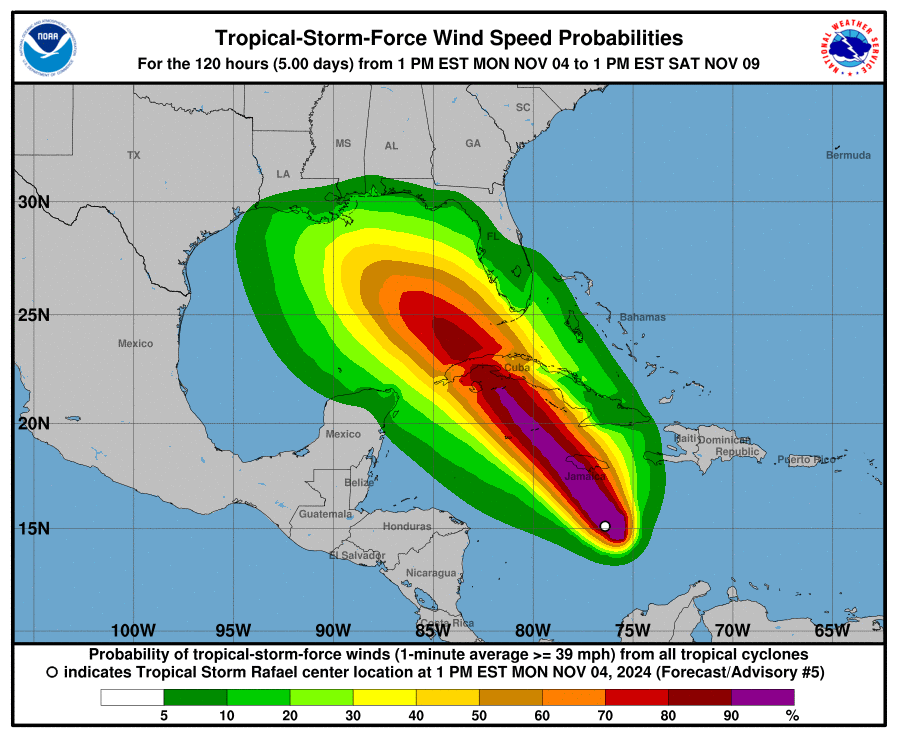
The US National Hurricane Center forecast shows that Tropical Storm Rafael is likely to strengthen and pass just west of Little Cayman on Tuesday evening with hurricane strength.
Citing environmental factors of low wind shear, high moisture, and warm sea surface temperatures, the regional forecasting centre also said in their Monday guidance that “there is a risk of dangerous impacts from hurricane-force winds and storm surge in the Cayman Islands”.
While Rafael is not expected to reach devastating ‘major hurricane’ strength, it is expected to bring to Cayman “damaging hurricane-force winds, a dangerous storm surge, and destructive waves”.
The Cayman Islands National Weather Service and Hazard Management Cayman Islands are reminding residents not to take the threat lightly.
Tropical cyclone activity tends to show a marked decrease in the November, but some of Cayman’s most devastating hurricane impacts have occurred in the last official month of the Atlantic hurricane season.
The warmest water in the Northern Hemisphere above the equator has historically been in the western Caribbean Sea in the month of November.
With warm deep water being the necessary ingredient for cyclones, the late-season systems can spin up from south of the Cayman Islands, as we are seeing with Rafael, or even right over our area. This can result in far less prep time than the storms that occur earlier in the hurricane season, which often begin as tropical waves coming off the west coast of Africa and then track across the Atlantic Ocean and possibly into the Caribbean Sea.
Notable November hurricane impacts for the Cayman Islands include the ’32 Storm, Cayman’s deadliest cyclone on record, taking the lives of 108 Caymanians. On the same anniversary day, Hurricane Paloma struck the Sister Islands with Category 4 winds on 8 Nov. 2008.
Two November hurricanes that show the incredible power of the sea include Hurricane Mitch and Hurricane Michelle.
In November 2001, Michelle passed over 100 miles west of Grand Cayman, bringing huge waves ashore in George Town that damaged buildings in the capital and in West Bay. The waves from Michelle caused over three-quarters of the large breeding sea turtles to be swept out of the Turtle Farm and back out to sea to their freedom.
In 1998, the second deadliest Atlantic hurricane on record, Hurricane Mitch tracked even further away from the Cayman Islands. Despite being nearly 200 miles away, the huge waves generated by this storm inundated large parts of the southern coast of Grand Cayman and resulted in millions of dollars in property damage.
The ’32 Storm that struck the Brac with a surge level of over 24 feet is also the deadliest hurricane to ever strike Cuba. That storm is also known by three other names: ‘The Great Cuba Hurricane of 1932’, the ‘Hurricane of Santa Cruz del Sur’ and the ‘1932 Camagüey Hurricane’. It resulted in over 3,000 fatalities in Cuba, mostly through drowning.
Seventy-six years later to the day, Category 4 Hurricane Paloma made a direct hit on Cayman Brac and subsequently went on to make landfall in exactly the same place in Cuba as the ’32 Storm in Santa Cruz del Sur.
The 2024 hurricane season officially ends at the end of the month.
For the latest information on Tropical Storm Rafael, visit Storm Centre.
Related Videos