

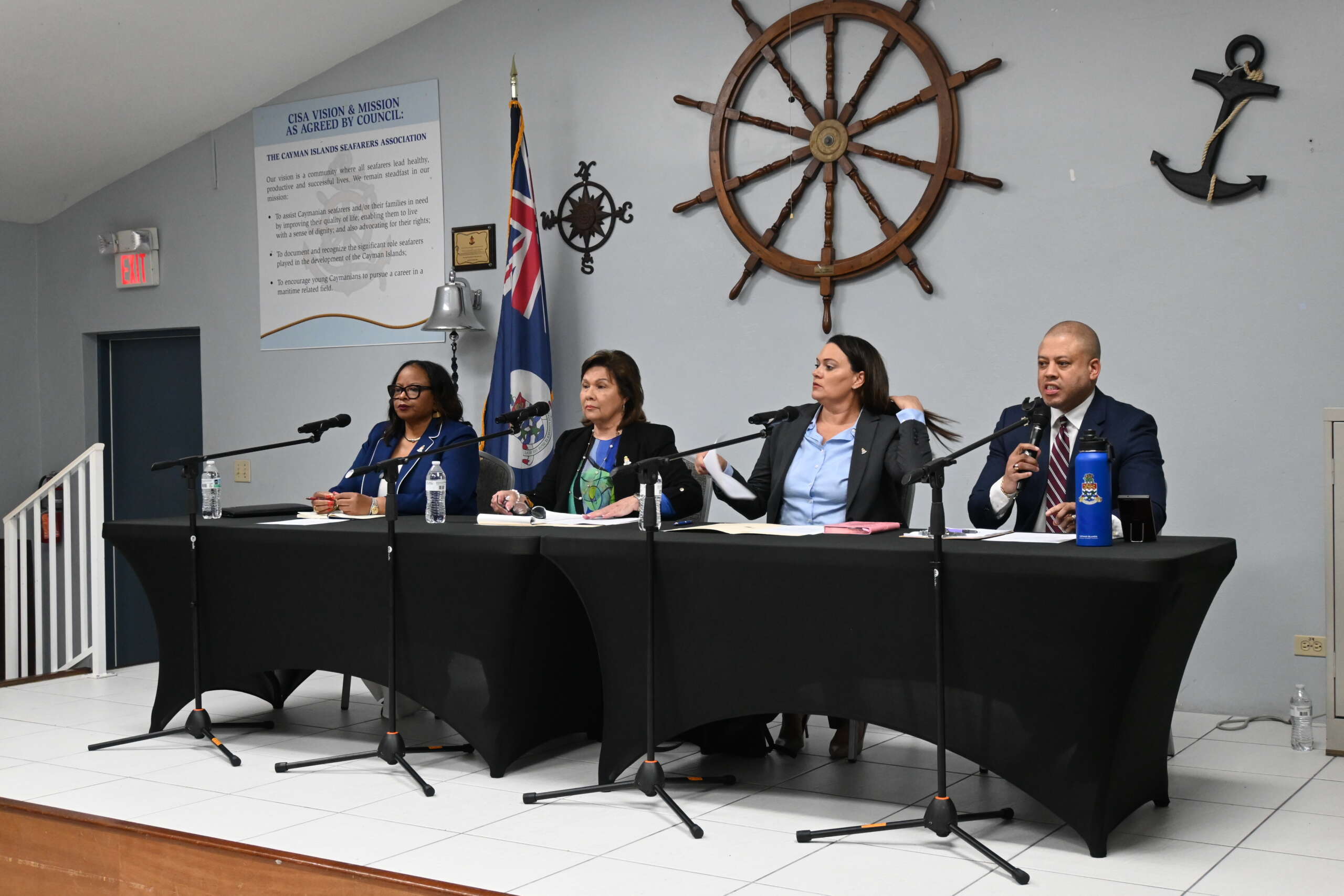
Four MPs who resigned from government launched a blistering attack on the administration on Wednesday night, blasting a “toxic” and “sexist” environment and a Cabinet that failed to act as a cohesive entity.
The former ministers, along with MP Heather Bodden, said at a public meeting that Cabinet members, including the premier, had acted without consultation with colleagues and carried out private negotiations over the failed ReGen landfill deal.
André Ebanks, the former deputy premier in the UPM administration, said the move was the “straw that broke the camel’s back” and sparked the wave of resignations.
Ebanks also confirmed the group would form a new party and issued a clarion call to the audience at the “Enough is Enough” meeting to sign up.
Among the litany of issues within government caucus that the group outlined at the meeting was a row over proposed changes to the National Conservation Act, which they said had played a major part in their decision to break away.
Other concerns included a lack of urgency in dealing with the erosion on Seven Mile Beach, delays in the opening of the Poinciana mental health facility in East End and the escalating costs of a planned new high school in Cayman Brac.
Ebanks said after the meeting, “We are not dealing with a caucus of individuals who come under an umbrella to work to forge an organisation based on a shared vision and values.”
Side talks on ReGen deal
The group said it discovered that, after Cabinet had agreed a termination date on the ReGen deal, separate talks involving Premier Juliana O’Connor-Connolly and minister Dwayne Seymour, with Dart, the private sector partner in the deal, had been held.
They added that O’Connor-Connolly and Seymour, who has now replaced Katherine Ebanks-Wilks as the head of the Ministry of Sustainability and Climate Resiliency, had discussed extending the termination date with Dart beyond the Cabinet-approved 31 Oct. cut-off date.
Ebanks said, “When you take the totality of all the other issues, it’s difficult enough in the face of decisions that aren’t financially prudent, aren’t comprehensive and well thought through.”
He added, “On top of all of that, there is a set of secret dealings outside of the the last mandate issued by the Cabinet without the collective being informed first, which exposed the country to potential liability with the country’s largest investor – that state of affairs is just untenable.”
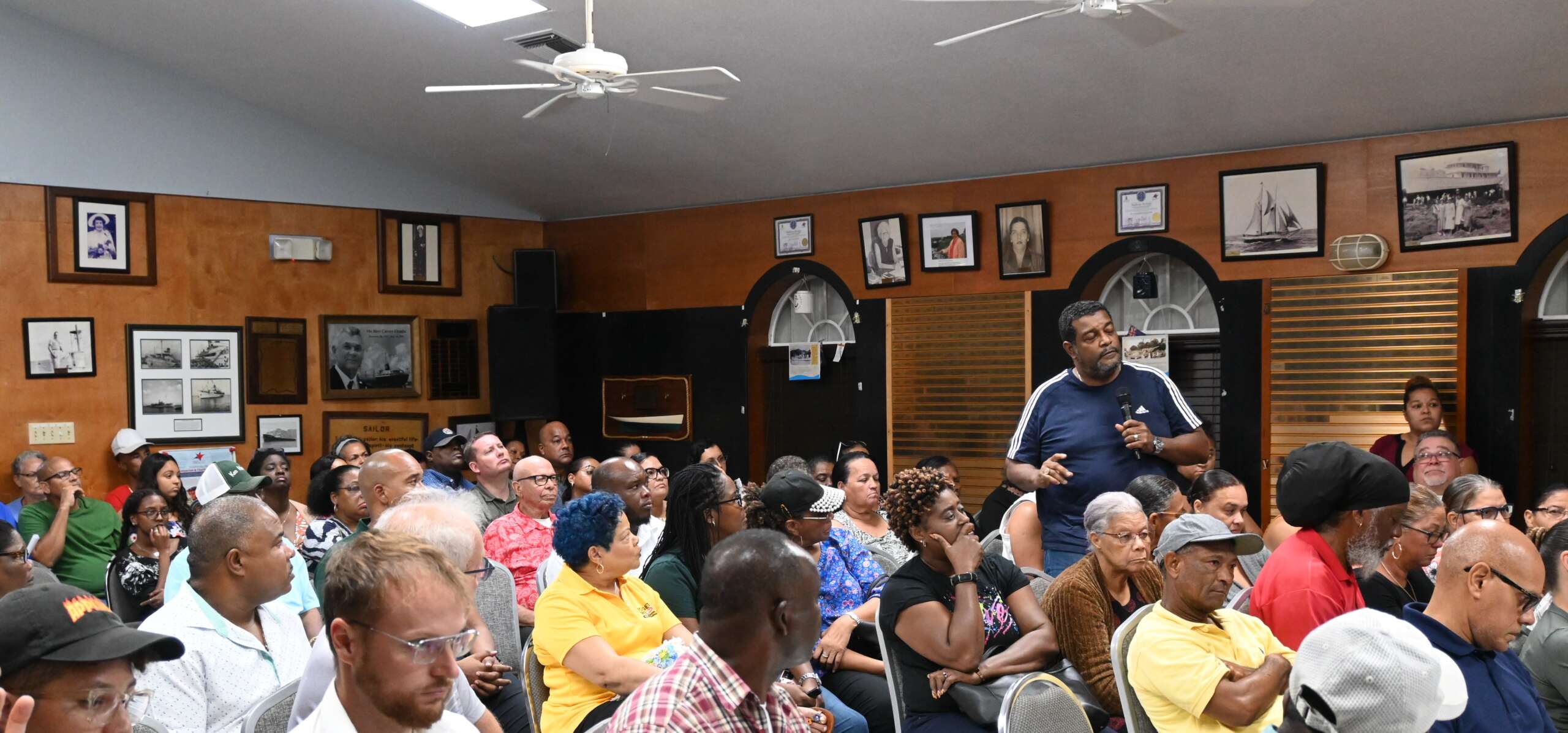
Ebanks-Wilks had earlier told the standing-room-only meeting at the Seafarers Hall in Prospect that Dart executives were given mixed messages.
She said they had been “confused” because the official Cabinet decision ruled the contract would end in October, but that there had been other discussions with the premier about “entering another arrangement”.
“Here, we had members of the same government sending different messages,” she said. “We walked away from that, and the acting premier at the time, Mr. Seymour, circulated instructions to me to communicate to the organisation that the government was agreeable to extending the termination agreement.”
Ebanks-Wilks added that her chief officer also contacted her and said he had “come under pressure” to prepare a document to extend the termination period and that the pressure was coming “from the governor down”.
Ebanks added, “The only body that can approve that is the Cabinet. Chief officers can’t put Cabinet papers forward … no amount of pressure from the governor can cure that.”
The Compass has reached out to the Governor’s Office and to the Office of the Premier for comment.
Sabrina Turner, who had been minister for health and wellness, and home affairs, added, “It was clear that there was a government within a government. You cannot have a government within a government.
“That begs the question ‘where were we headed?'”
National Conservation Act changes promoted ‘unfettered development’
The group said proposed changes to the National Conservation Act had also caused friction among government members.
Ebanks-Wilks said it had been agreed while she was the responsible minister that the conservation council, whose members were mostly public servants, needed to be “reorganised”.
She said a Cabinet paper and a draft amendment to that effect had been drawn up, but those went far further than merely changing the make-up of the council, and were “not in the spirit of conservation”, but designed to promote “unfettered development”.
She added she was given a “thick bundle” of documents in May which made “wholesale amendments” to the legislation.
Ebanks-Wilks said that, in the end, the labour minister – Seymour – was tasked with bringing the amendments to Parliament, rather than her.
Turner added, “It’s almost like sending a plumber to do the electrical work.”
Ebanks questioned why another minister was given the responsibility of steering the amendments through the legislature.
He said, “There is no answer to that question.”
Ebanks said O’Connor-Connolly could have tabled it, but, because it was going to be controversial, she “wouldn’t touch it”.
‘Fumes of alcohol’ in caucus meetings
Turner said there were “times when the fumes of alcohol coming across the table were strong” during caucus meetings.
She added, “We weren’t allowed to speak freely – if we weren’t in line with a particular minister’s paper, they would throw tantrums, storm out of the room and sometimes that meant we lost a quorum.”
Turner said if some ministers tried to contribute to talks on changes to the National Conservation Act, others would close ranks and ensure solidarity by “doing a trade-off”.
She added, despite Cabinet and caucus having a record number of women, “you could see the power of testosterone in there”.
But Turner insisted, “We stood firm for what we had to believe in as women – we had to stand firm to gain the respect we’re due.
“Some were worse than others, but you have to stand up and be firm as females to get your point across.”
She added that O’Connor-Connolly did not see the resignations coming.
“I think she was actually shocked the deputy premier walked,” she said.
She added that the group was aware their resignations might bring the government down, which she said would “have been popular with the people”.
But Turner insisted, “That was not the impetus for why we moved. We also knew [the premier] had that five, so could continue.
“What we are seeing is a rebirth of what the people expect of their elected officials and we have started that. They want respectable people … who treat people with respect,” she added.
Turner told the Compass after the meeting that government caucus operated in a poisonous atmosphere where attempts were made to marginalise women and intrigue and factionalism ran rampant.
Asked by one meeting attendee why the group had risked bringing down the government, Ebanks responded, “The greatest threat to the country isn’t a resignation – it’s a malfunctioning executive.
“From what I have heard, we were on a runaway train and somebody had to pull the emergency brake.”
Another member of the audience asked if the rebels had taken their concerns to Governor Jane Owen, who chairs Cabinet.
Ebanks-Wilks said they had not, because a minority government had been formed and the governor would only intervene if an administration was unable to function.
Ebanks added, “The governor sits in Cabinet and watches the behaviour for herself.”
New party
Ebanks confirmed the group planned “a new party, but I don’t want the emphasis to just be on a party”.
He explained, “It’s time to mature the politics of this country. But it doesn’t just happen because we label something a party.
“Once we have principled leaders with good governance who are willing to take the tough decisions in the overall interests of the country, that’s what will move the country forward.”
- This story has been amended from its original version to reflect some comments that were made in reference to the wider government caucus.
Related Videos












Many times in life we see where justice, principles, and “karma” can bring some people full circle back to their reality. I wonder if my Honourable friends have now reflected on their poor judgement in rushing headlong into the “marriage of convenience” which as retro-fitted after the April 2021 Elections. A couple of unfit MP’s were allowwd to be a part of that coalition, and now the error of that decision has become obvious. The “enablers” have become the “victims”.
Sometimes in life one does not get a second chance to make a good decision, or a second chance to correct a bad decision. Hopefully these 4 MP’s will be given a second chance.
O’Conner-Connelly is so out of touch on how the CIG needs to be for all CAYMAN FIRST citizens and not for her personal interest groups.
1) Especially in regards to the National Conversation Act for oversight on sustainable environmental development projects.
2)Especially, outrageous spending of $60 Million for a high school in the Brac.