


Thousands of people in Cayman are using ‘skinny jabs’ like Ozempic as a weight-loss aid amid an obesity ‘epidemic’ that is stretching the healthcare system to the limit.
One doctor said his practice alone has 1,200 patients using the drugs to fight weight challenges.
Physicians have mixed feelings about the popularity of the drugs, warning that while it can be extremely effective, the long-term side effects are unknown.
Meanwhile, demand for cosmetic treatments like Botox are surging in tandem with the craze for weight-loss injections, according to importers.
Chief Medical Officer Dr. Nick Gent warned that in medicine “nothing is for free” and said he would prefer to prescribe pickleball or pilates for weight loss.
He argues that Cayman, like much of the western world, is facing an epidemic of diabetes and heart disease related to bad eating and exercising habits.
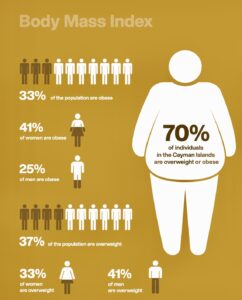
The recent national STEPS health survey showed seven out of 10 people on the islands are overweight.
The healthcare system faces a massive annual bill for treating chronic illnesses that stem from obesity.
And Gent believes a paradigm shift at a community level is needed to help people change their lifestyles. Drugs may have a role to play, he acknowledges, but they come with side effects, both for the patient and society.
“The problem with the Ozempic steamroller is that people are buying in again to an easy fix, as they see it, but it is not.”
As part of a special report today, the Compass spoke to experts in medicine, economics, food, wellness and lifestyle in Cayman to come up with a prescription to shrink the islands’ growing waistlines and annual healthcare costs.
Ideas include:
- Insurers funding more diet and exercise interventions
- Duty cuts to make healthy food cheaper
- ‘Sin taxes’ on fast food
- Calorie counts on menus so people know what they are consuming
- More PE and healthy-eating instruction in schools
- Making drugs like Ozempic available on insurance for obese patients
Skinny-jab craze has exploded in Cayman
No examination of weight loss and health policy in 2025 could begin without addressing injectable drugs, like Mounjaro, Wegovy and Ozempic.
Originally anti-diabetic medications, these drugs have quickly become extremely popular for their weight-loss impact.
In early 2023, NICE, the UK National Institute for Health and Care Excellence, updated its guidance to National Health Service doctors to recommend this type of medication can be prescribed for weight loss alongside ‘lifestyle interventions’ for up to two years for people who are overweight and have co-morbidities that put them at risk of health complications.
Cayman does not have an equivalent body that sets guidelines for doctors, who are free to prescribe as they see fit, though the UK is generally seen as a guide to good practice.
The use of such drugs is skyrocketing.
“It has exploded,” said Jordan Stubblefield, managing director of Blue Water Medical Supplies, which imports medication for various pharmacies on island.
“Thousands and thousands of people per month are on this medication.”

Stubblefield, who says he dropped 45 pounds using Ozempic, said his company alone imports 1,600 ‘pens’ per month of this class of drug.
He said it is not “a get-out-of-jail free card”, and diet, exercise and moderation remain essential. But he believes it will have a growing part to play in public-health interventions on obesity and other challenges for years to come.
The drug has become popular among celebrities, especially in the US and the UK, where it has gained a reputation as a weight-loss cheat code.
Stubblefield believes it is very likely being prescribed by some doctors for people without a high body mass index.
The cosmetic imprint is also seen in a rise in other treatments to deal with the impact of ‘Ozempic face’ – a gaunt look that comes as an unwelcome aesthetic side effect to rapid weight loss.
“Botox and filler and breast implants have exploded on island. We do a lot of that business, as well and the amount of injectors on island compared to 10 years ago? It’s gone up 1,000 percent,” he said.
‘A jump start’ for weight loss
At Total Healthcare, Dr. Rajnish Kumar, a diabetes and weight-loss specialist, sees thousands of patients struggling with weight-related health issues.
He believes most practitioners do follow the NHS guidance and prescribe Ozempic and similar drugs only for people at risk of complications due to their weight.
He currently has around 1,200 patients using Ozempic or Wegovy.
Kumar runs monitored weight-loss protocols for patients – including injectable drugs in some cases – as part of a holistic treatment programme.
He believes the drugs can act as a “jump start” that gives people confidence to make the lifestyle changes needed to maintain a healthy weight.
While longer-term studies of the drugs’ impact are in short supply and patients have been shown to regain weight once they stop using them, Kumar says there is no doubt as to their impact.
They are safer than interventions like bariatric surgery, and when monitored and combined with other lifestyle changes, he believes those drugs will be an increasingly important tool in fighting obesity. They are not for everyone, however.
“If someone is coming in and they want to be a model, we try to motivate them to use other interventions. It is not something we recommend just because you want to look great. This is medication, not a cosmetic drug,” he said.
Price fluctuations
Currently, insurers do not generally fund these types of drugs for weight loss.
Affordability remains a question and there is concern that access to such drugs, as well as more widely accepted lifestyle interventions through nutritionists and personal trainers, could be limited to the wealthy.
Jeanette Verhoeven, of Cayman-based Bogle Insurance Brokers, believes that could soon change as approvals in the UK and US trickle through to Cayman. She expects it will only be covered for people suffering from complications related to obesity rather than as a more general weight-loss aid.
The economics of Ozempic
Economist Simon Cawdery, who has written a column for the Compass arguing for targeted import-duty policy to make healthy food cheaper, believes drugs like Ozempic – from a purely economic standpoint – could be a game changer for public-health systems.
Once proven over the long term, he said prescribing them for weight loss made economic sense, given the enormous public-health bill for treating obesity-related diseases like hypertension, stroke, heart disease and diabetes.
“There’s a good argument to say that if Ozempic or the latest iterations can reduce weight and the implicit consequences, without any side effects, then it’s a magic bullet to save huge sums for healthcare systems,” Cawdery said.

He acknowledged that the scale and acceptability of those ‘side effects’ is a huge caveat and something for medical experts to determine. But given the health and financial consequences of weight-related illnesses, he believes it is something that public-health systems across the globe will treat seriously.
Verhoeven acknowledges this reality, given the prevalence of obesity linked illnesses – from sleep apnea to heart disease – in Cayman.
“A saying in insurance is that 20% of the members use 80% of the benefits and, in my experience, obese, unfit persons fall into that 20% in many cases,” she said.
‘No shortcuts’
For Gent, Ozempic is not a shortcut to avoid the hard work of reforming public-health policy to deal with what he describes as a pandemic of obesity.
He is currently immersed in preparing a discussion paper on the use of the drug for weight loss and believes it can play a role for some patients. But he is not viewing it as a panacea.
His goal as chief medical officer is to drive the mindset change that is needed among families and communities to address the core behaviours – principally poor diet and lack of exercise – that are the root cause of obesity and its attendant conditions.

He worries that the semaglutide “steamroller” derails that process by seeming to offer a quick fix. He points to a 2022 study which showed a lot of patients who stopped taking Ozempic – the active ingredient of which is semaglutide – quickly regained the lost weight.
As someone who lost 100 pounds himself over a “miserable six months” of diet and exercise, Gent believes harder-won gains are more lasting.
Driving island-wide change
Making those type of gains on a national level is an even more difficult problem.
Like an obese individual contemplating a life change, it starts with standing on the scales and identifying that there is an issue.
That is what Cayman did with the STEPS survey. The results were alarming, though not necessarily surprising.
“What we uncovered in terms of the degree of obesity, the degree of untreated hypertension, untreated diabetes [is that] they have become multigenerational epidemics, and I can’t see an end to that. People do not want to change their lifestyle.”
That’s a harsh truth to confront, given the extent to which the debilitating impacts of obesity are costing Cayman in terms of quality of life and cost of healthcare.
“Regrettably, this is an area where the literature is stuffed full of failure and very, very little in the way of success,” he said.
For Gent, an injection purporting to offer an easy solution distracts from the core mission of changing behaviours.
So he is not really joking when he says he would prefer to prescribe pickleball than Ozempic.
Eat less, move more
The sport is the fastest growing in the world and Cayman is no exception.
Cayman will host the Caribbean championships later this year and has thousands of regular players, including Gent himself.
It is easy to learn, anyone can play and it has a heavy social element. It ticks all the boxes for a sustainable form of exercise for people who are not used to working up a sweat.
Pickleball – or other similar activities – is just one example of the types of activities he believes Cayman can encourage to make the population healthier.
Gent is an advocate for more physical education in schools, calories on menus at fast-food restaurants, clearer labelling on produce, and wider availability of cheap and healthy activities for families. The interventions needed to address this epidemic, he says, are not all medical.
Referrals to swim coaching or a dance class could be just as useful as a prescription in fighting obesity.
Driving lifestyle change
Donna Mitchell, a health, wellness and success coach, is on board with that concept.
She devises personal programmes for people trying to lose weight and coaches them through the process.
Mitchell, who started out running the Cayman Islands franchise of Weight Watchers, has tailored her approach to help clients change their lifestyles and, often, their lives.
Sometimes, she says, she is dealing with people suffering from extreme depression as a result of their weight. Being told to eat better is not enough.
“I have so many clients that go to the nutritionist, they get the healthy-eating diet plan, but there’s no implementation. How do you overcome the urge to go to the refrigerator every night and eat the ice cream? Food is a coping mechanism.”
She urges insurers to be more open to the concept of supporting non-medical treatments. Government, too, could make services like hers available to its staff.
There are other ways to incentivise ‘good behaviours’.
Taryn Stein, a dietician and nutrition coach who runs Cayman-based Mind Shift Me, said it was vital that governments don’t use drugs as a cop-out to avoid good public-health policy.
“Prevention is ultimately a cheaper approach than treatment – the more time you spend in an obesity state, the worse your health, so prevention is really key to sustainable long-term and cost-effective management of the obesity crisis,” she says.

She highlights a programme she worked on in South Africa, where members could sign up to a ‘Vitality’ programme run through their insurer and earn points for doing activities like annual health checks; buying healthy, subsidised foods from partner supermarkets; or hitting the gym. The points could eventually be cashed in, with perks such as flight and hotel discounts, and movie tickets.
“Vitality has been a big success in driving healthier behaviours by making those choices easy and rewarding, and it’s been adopted internationally. It’s a smart, practical way to create healthier environments while delivering tangible benefits to members and insurers, with lower healthcare costs,” she says.
Verhoeven says Cayman insurers are starting to offer a greater variety of benefits, but participation levels – particularly among men – are poor.
“There is a trend towards increased wellness benefits being added to plans but, even when added, there is often low take-up by the majority, especially by adult men who typically skip routine preventative [steps] and seek care only when illness strikes.”
Even incentivising exercise and gym can have mixed results, she adds, noting that insurers often see “upticks in musculoskeletal injury claims”.
Change starts at the dinner table
Community-wide change, perhaps, starts around a dinner table.

Chef Maureen Cubbon, who recently ran a successful pilot programme teaching healthy cooking and eating to more than 180 children and parents at Marie Martin Primary School with the YMCA, believes children can be the drivers of good habits in their families.
Working more consistently with that captive audience in after-school programmes and through healthier school lunches could be a route to societal change.
“It’s about showing how easy and tasty eating better can be. It is also about families spending time together and making connections over food,” Cubbon says.
Whether it is using abundant and affordable local produce, like callaloo from the farmers’ market, or devising a simple recipe for a healthier twist on barbecue chicken, she is always mindful of “time, culture and expense” – three of the biggest drivers of eating habits.
Cubbon, who has also worked with the Cayman Heart Foundation and runs Nourish Eatery and Zest – a business that delivers healthy, ready-to-eat meals to clients – said good food can be affordable. Zest charges $150 for two fresh meals a day for five days – a price she believes stacks up well against the average weekly grocery shop.
For those with tighter budgets, she argues the do-it-yourself option can still be affordable. But education is needed on how to shop smart and how to make small changes to meals that can make them healthier.
While she sees a role for drugs and other medical treatments for some people, the chef believes the route to good health is through the stomach.
“Food is at the centre of how you feel,” she says. “Medication can move you in the right direction but no matter how you look at it, no matter what your goals are – food is at the core of your wellness and I don’t think there is any argument about that.”
Related Videos













I’m in America, and my doctor suggested Ozempic, which I refused, since I’ve been losing weight quite well on my own. But I was curious, and looked up the drug. I found this…
Common Ozempic side effects include:
Gastrointestinal upset (upset stomach)
Nausea
Reflux
Vomiting
Diarrhea
Constipation
Stomach pain
Uncommon yet severe side effects also include:
Pancreatitis
Appendicitis
Thyroid cancer
Decreased kidney function
Allergic reactions
Anaphylaxis
Angioedema
Meanwhile, the side effects of – for example – pickleball are that you’ll lose weight, meet people you’re having fun with, and you’ll get in better shape and probably live longer.