

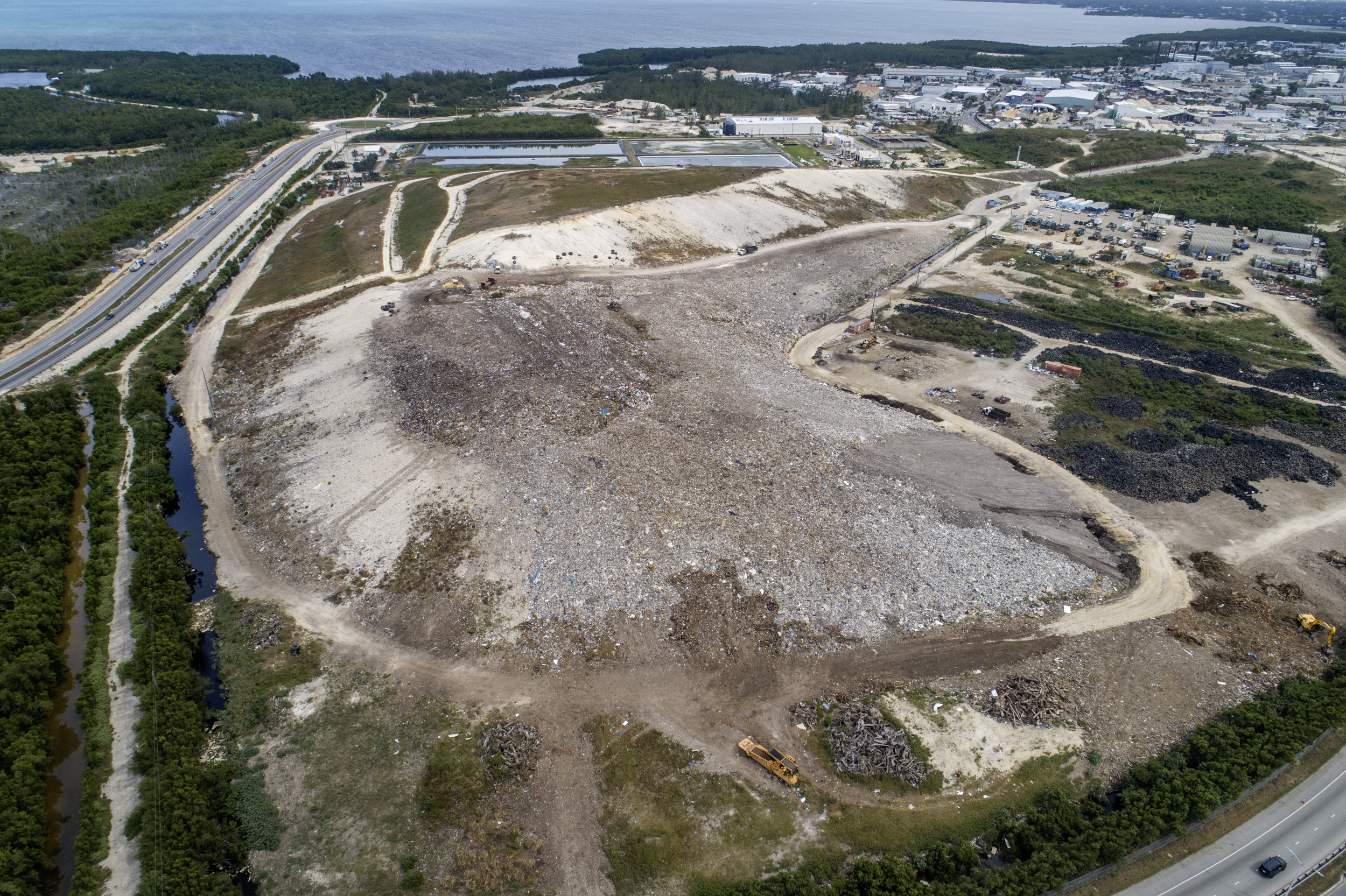
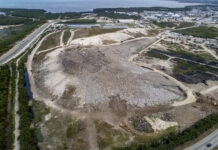
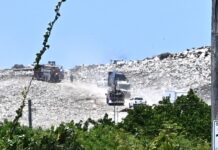
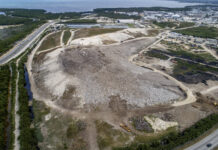
Just over 130,000 tons of trash went into the George Town landfill last year with no plan on the horizon either to replace the rapidly expanding facility or to implement a comprehensive national recycling strategy.
The clock is ticking on the lifespan of the site, though officials say it has been ‘developed’ to the point where it could accommodate waste for another 10-11 years.
But the nixing of the ReGen project – which would have replaced the landfill with a waste-to-energy plant and a suite of recycling and composting facilities – has left government back at square one in its efforts to deal with the long-running problem.
Government has no current alternative plan and the time-consuming job of procuring a new solution will restart with a new business case after the general election in April.
The amount of tonnage that went into the landfill last year – equivalent in mass to 600 blue whales – was revealed following an open-records request from the Compass and has raised concerns that not enough is being done to divert waste from the landfill.
“If a decision was made that waste-to-energy is too expensive … that could make sense. But what happened to reduce, recycle and reuse? There doesn’t seem to be any ambition to implement a proper recycling strategy,” a source close to the moribund deal told the Compass.
The ReGen deal with a Dart-led consortium to implement a national waste management strategy centred around an industrial plant that would incinerate trash to generate electricity was finally abandoned last year, after seven years of negotiations over the public-private partnership ended in failure as costs escalated.
Now the landfill continues to accumulate trash on a site that government leaders accept is not up to modern standards.
“The lifespan of the George Town landfill for the currently developed area is around six years from today. If further areas are developed, this can be extended to 10-11 years,” said Michael Haworth, assistant director for solid waste at the Department of Environmental Health.
There is no timespan on how long procuring a new solution might take.
The business case for this iteration of the project was completed in 2016 and it took almost a decade before the plan was abandoned. In that context, it is conceivable that the George Town site could run out of space before an alternative is found.
Estimates of how long the site has left have been something of a moving target, however.
A policy plan for the national waste management strategy produced in 2016, indicated it would be full by 2021.
“The waste management system cannot continue to rely on the existing landfill facilities for the disposal of solid waste. This is most acute for Grand Cayman, where the landfill site at George Town at current rates of in-fill, will be full in approximately five years,” that report bluntly stated.
Haworth indicated that development of the site was a means that had been used to expand capacity within the footprint. But he acknowledged, “There is finite space at the George Town landfill and landfilling operations cannot continue indefinitely.”
The tonnage of waste going into landfill has increased dramatically, in line with population growth, since that 2016 report was prepared.
At the time, government consultants AMEC Foster Wheeler indicated between 60,000 and 80,000 tons of waste was going into landfill. Even their worst-case scenario projection – highlighted in a graph below – suggested it would be 2030 before the site was handling as much waste as it is today.
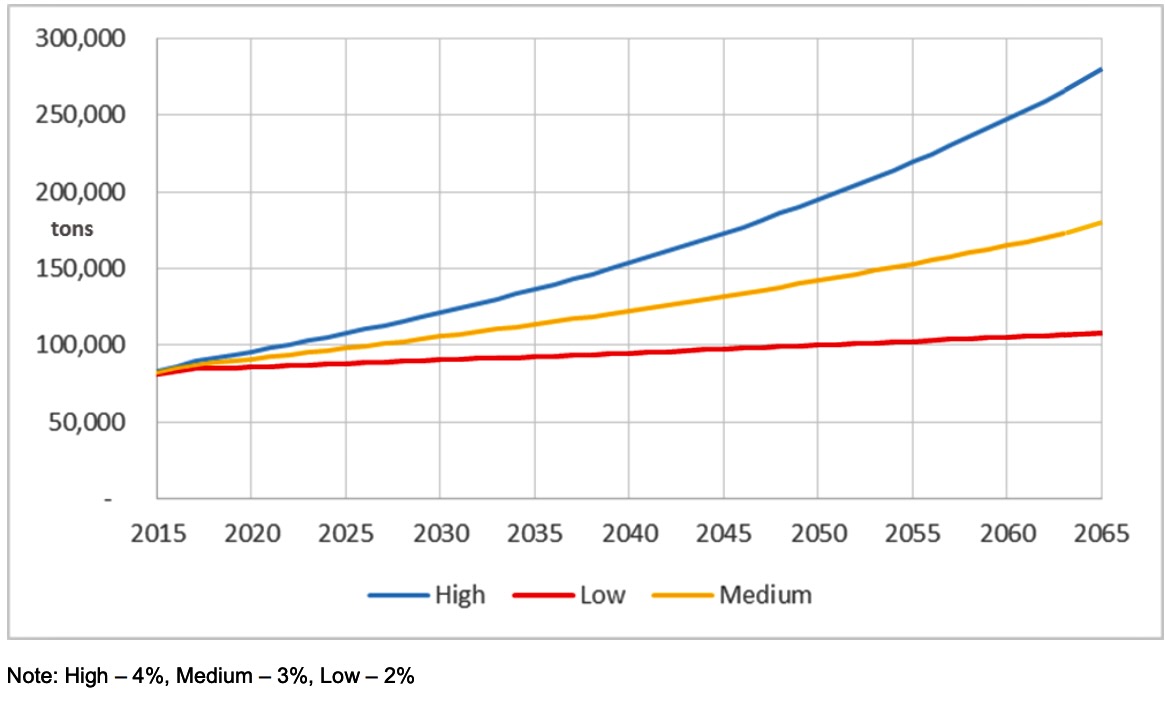
Fluctuations connected to consistency of weighing trash going into the site over the years may have impacted the reliability of those figures.
National recycling strategy was contingent on ReGen
The space pressure at the George Town site could be alleviated with the ‘reduce, reuse, recycle’ method articulated in the original business case for a waste-management strategy
But that, too, is contingent on a new business case and tendering process.
While much of the debate around ReGen, and many of the concerns, focused on the waste-to-energy plant and the costs associated with that element of the project, it was just one part.
The plan also included facilities for green waste processing, construction and demolition waste processing and recycling, scrap metal processing, medical waste, and household recycling.
“The implementation of the integrated solid waste management system project was intended to deliver facilities to divert waste from the landfill to more sustainable solutions. As has been widely reported, this project is no longer going ahead,” Haworth said.
He urged people to take advantage of the options offered through the DEH to drop off mixed paper and cardboard, plastics and metal cans for recycling at depots throughout Grand Cayman.
Currently, recycling is piecemeal and voluntary.
A summary of the ReGen goals articulated in a 2021 analysis as part of an environmental impact assessment, indicated “Through the “reduce, reuse, recycle and recover” key elements of the waste management process, the proposed development has the capacity to divert up to 95 percent of the community’s waste away from the landfill.”
Though some of that was dependent on the waste-to-energy plant, there were high hopes for composting, recycling and diversion of construction waste.
Some districts in the UK have achieved as high as 60% diversion from landfills through a combination of recycling measures and policies designed to incentivise their use. Many local authorities, for example, offer kerbside collections for various recyclable materials and restrict the number of collections for unsorted waste.
Again, implementing that type of coordinated policy in Cayman would be contingent on a government-level planning decision, through the business case procedure.
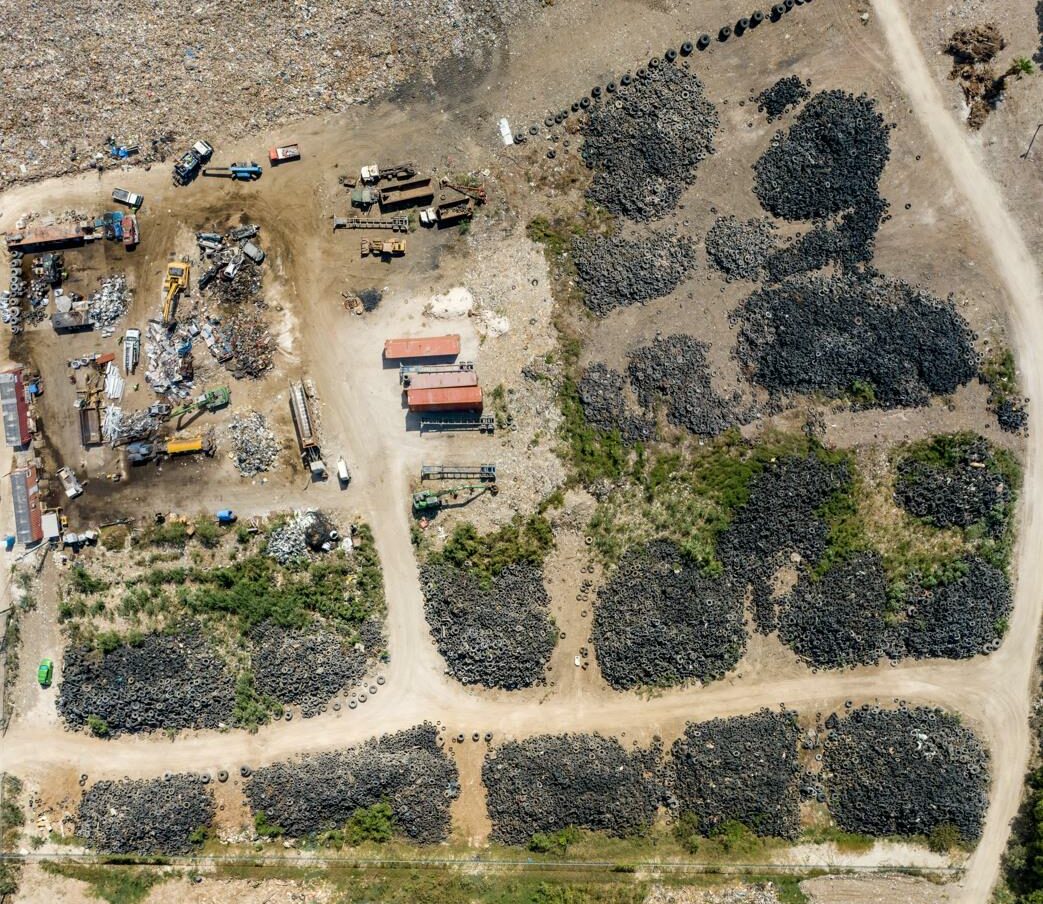
Meanwhile environmental risks remain from the current site, which borders on the North Sound.
The 2016 report indicated that the continued use of “aging, non-engineered and increasingly full landfills” represented a threat.
“The existing solid waste management regime is not sustainable, poses a potential threat to the environment, and does not make best use of potential resources that could benefit the Cayman Islands,” the report said.
Haworth said some improvements have been made since then – particularly through the remediation of the old fill site – one part of the partnership with Dart that did proceed.
“The George Town landfill is unlined; however, the areas of completed landfill have been capped with an impermeable liner and this significantly reduces the production of rainfall- derived leachate. This methodology will continue throughout the life of the landfill.”
He insisted that surface and ground-water monitoring at the site showed “low risk” from contaminants
And he claimed the fire risk had hugely receded thanks to the use of a new compactor which arrived in 2023. Since then he said there had been “no major fires” at the site.
Related Videos








130,000 tons of waste per year. That’s about 1 3/4 tons per man, woman and child.
How much of this is construction debris?
How much is landscaping debris, like tree limbs, leaves, grass etc?
We throw out about 3 trash bags full per week. Say 10 lbs each. That’s 30 lbs per week and 30X52= 1,560 lbs per year. 0.78 US tons per year for our family.
If that reflects average usage then that comes to about 30,000 tons per year of household waste.
I remember reading a university study on trash and trash management. There is a Worldwide accelerative effect on trash output since Internet Ordering started because shipping is easy and packaging became more fulsome to protect the products that get shipped. In the US they don’t even ask you to return broken or incorrect product, they ask you to trash breakage show a picture and they ship you a new thing (even more trash).
Re-orders of products are easy on Amazon which increases velocity of trash even more. Box costs have come down. Metals recycling is interesting because there is recoverable value in metal. Cardboard recycling margins are razor-thin and don’t make sense in small markets like Cayman so we get all the increased trash but none of the recycling ability.
Everybody knows we have to take action and do something about it. Just not in Bodden Town, North Sound, East End, Savanah, West Bay or Georgetown. And there is your problem.
Whoever gets elected next needs to take this bull by the horns and do “something” – even if it’s unpopular. Nobody will fault you if you say, “We have an urgent national need for a new landfill and so while I know it’s not popular, we’re putting it “Here” (wherever ‘here’ is). Choose the spot wisely based on wind direction – shelve the EIA in the name of National Security and pull the trigger. We need some bold executive action to keep the Country progressing forward. Any new landfill will get here just in the nick of time.
“Waste” certainly applies to the ReGen project as tens of millions of dollars have been blown out to sea. It would never have worked anyway as we would never be able to maintain it, just look at the weather radar system. Not a complete solution, but recycling could reduce waste by 50%, we could use the U.K. system which requires each household to use different types of bins/containers for recylable items and have separate collection for these. For the other 50% we should revisit the Bodden Town location which was apparently viable but rejected by politicking. G.T. has borne this burden for decades and now another district should take their turn.
On the issue of leaching, as the GT landfill contains every contaminent there is and as it is decades old and completely unlined, I simply do not believe there is not serious contamination in the surrounding groundwater.
Look to Denmark as an example of smart waste stream management.
Landfills are not allowed within their borders. Their CoGen capacity exceeds their needs and they gladly process their neighbor’s waste streams at a profit. The problem isn’t limited to the Cayman Islands – it is rampant throughout the Caribbean.