

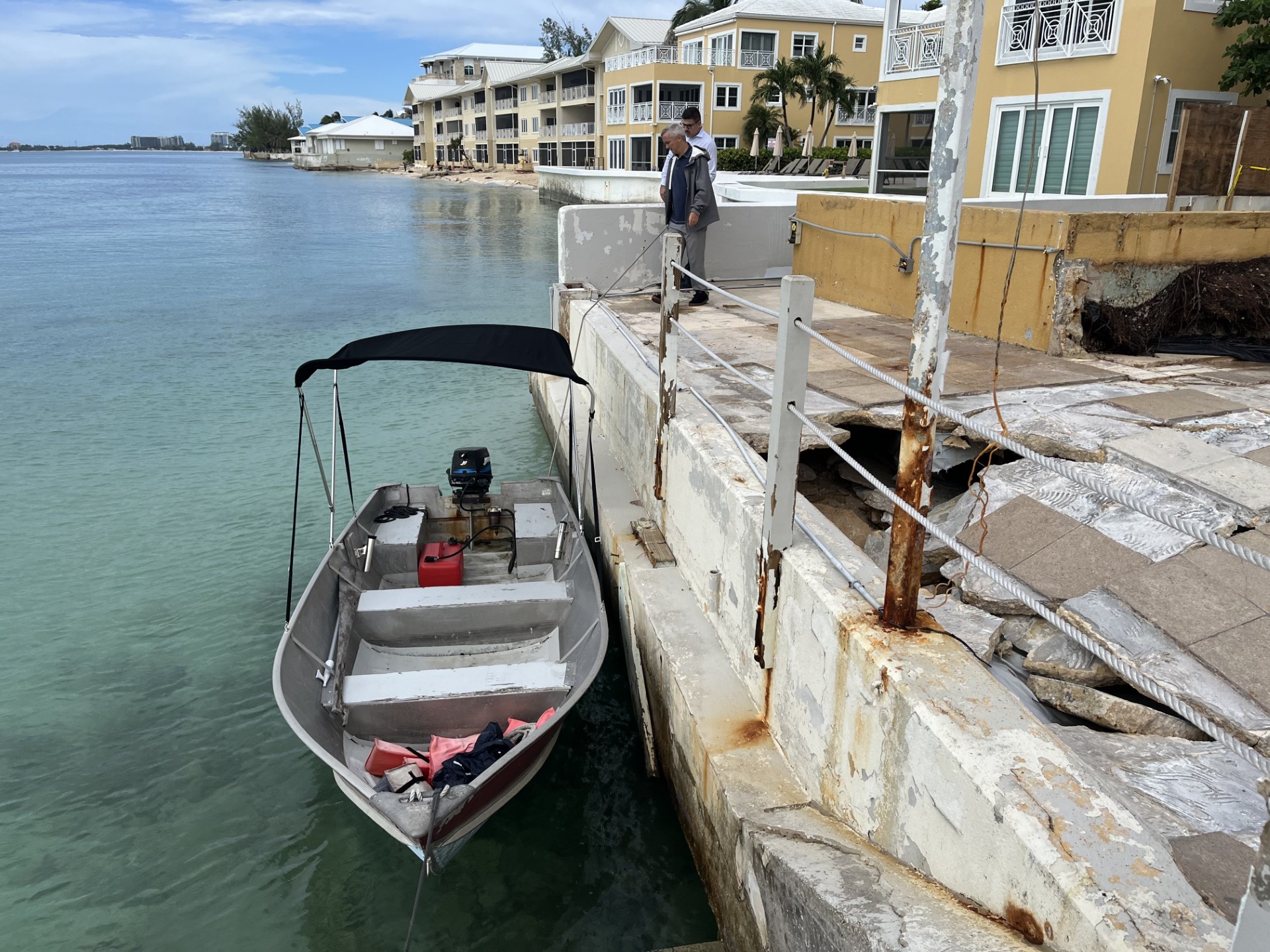
Plans to restore the beach in front of the Grand Cayman Marriott Resort moved a step forward this week.
The National Conservation Council voted that the project will not require an environmental impact assessment because the likely effects of the plans are already well known to the Department of Environment.
The next step is for the DoE, in consultation with the council, to make a recommendation to Cabinet, which has the final decision on whether the project can proceed.
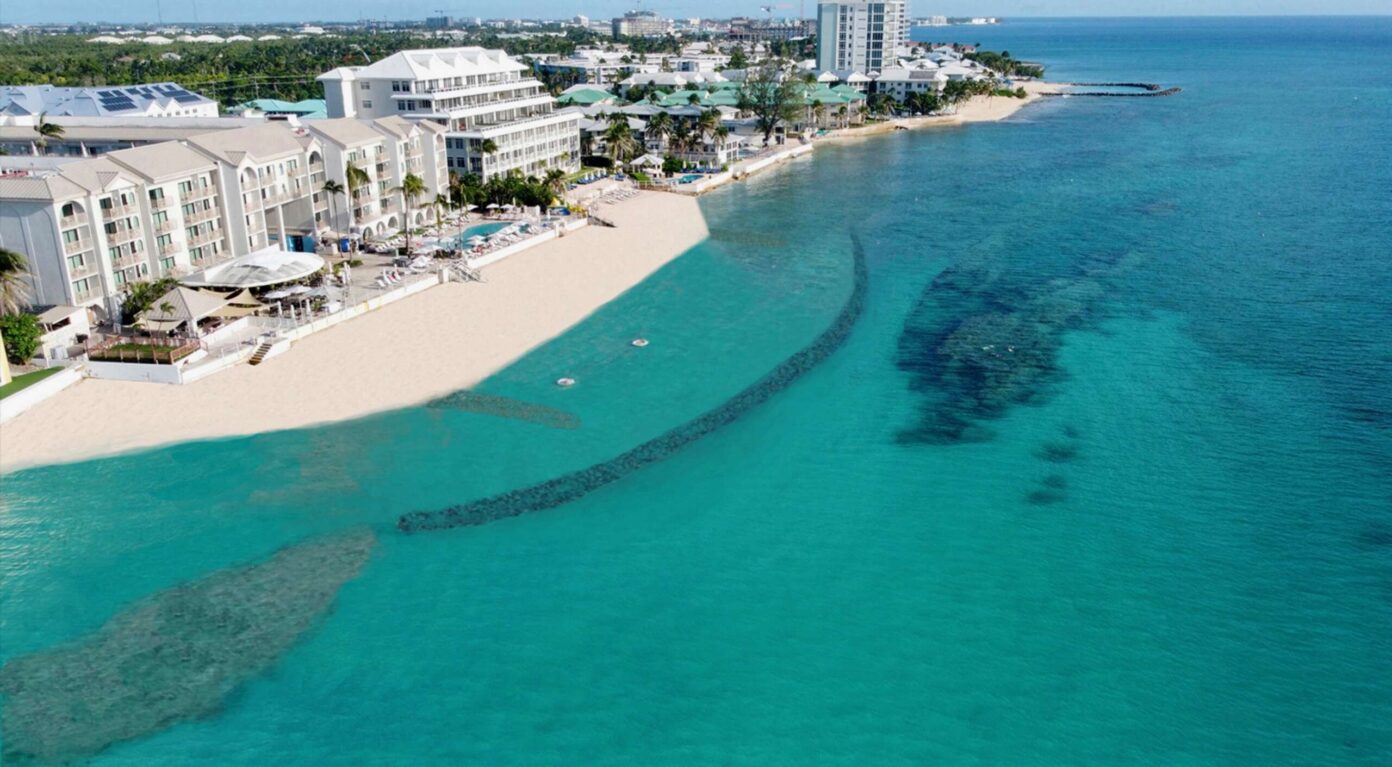
The Marriott ownership submitted an application in January for a “coastal protection and beach enhancement project”.
They propose to deposit up to 8,000 cubic yards of fresh sand on a 60-foot stretch of shoreline in front of the hotel.
Low-profile ‘shoreline stabilisation structures’, buried under the sand and below the mean high water mark, are proposed to help the sand from being swept away in future storms.
The Marriott has become a poster child for the erosion issues on southern Seven Mile. The resort was recently forced to drop ‘beach’ from its name after losing all of its sand in a succession of storms.
During a special meeting of the new National Conservation Council on Wednesday, members were assured the project would not impact broader plans for a wider solution to the loss of almost prime beach front on that stretch of Seven Mile.

DoE Director Gina Ebanks-Petrie’s “strong recommendation” was that the erosion issues be addressed on “the largest scale possible”.
Various possible approaches have been discussed, including a national beach replenishment programme with the aim of restoring sand to the shoreline all the way from the Sovereign condominiums to Tamarind Bay. But the commitment of significant government funds to the issue means a complex and perhaps lengthy procurement process would be required.
Marriott needs a solution
Ebanks-Petrie said the Marriott application was for a smaller project specifically in front of its own property. She said it involved low-profile groyne structures and the project could be “subsumed” into a larger project if and when that happens, she said.
But she acknowledged the Marriott needed a solution quickly.
She re-iterated the DoE’s preference for a “regional” solution for the entire stretch of eroded beach but acknowledged this was a wider government decision and could take some time to come to fruition.
“The issue we’ve got is the timelines for the Marriott, from a commercial perspective, and what the government is able to do in terms of timelines for getting all of the approvals that are needed [for a larger project],” she said.
Council member Walling Whittaker raised concerns that other property owners would want to do similar projects and suggested a “macro solution” rather than a “piecemeal” approach.
Ebanks-Petrie indicated that the Marriott project could actually serve as a useful pilot and provide lessons as government seeks to address the larger issue.
“We are due to brief the current government shortly on the wider project. Our feeling is that standalone project is not incompatible with the wider project,” she said.
It was open to the council to request an environmental impact assessment before making a recommendation on the application. But Lauren Dombowsky, of the DoE’s environmental management unit, said much of the information needed was already in the Marriott’s application or was well known to the department because of its own research on the issue.
The decision does not mean the project is approved as yet, she emphasised, with the final decision lying with Cabinet.
Managed retreat
Ebanks-Petrie said that while the DoE is backing beach replenishment, it also wants to see more considered coastal development and ‘managed retreat’ in future.
She accepted that would be a lengthy process that happens over time as older buildings are replaced. In the case of the Royal Palms beach bar, she said there had been some ‘retreat’ there already with the damaged structures at the water’s edge being demolished.
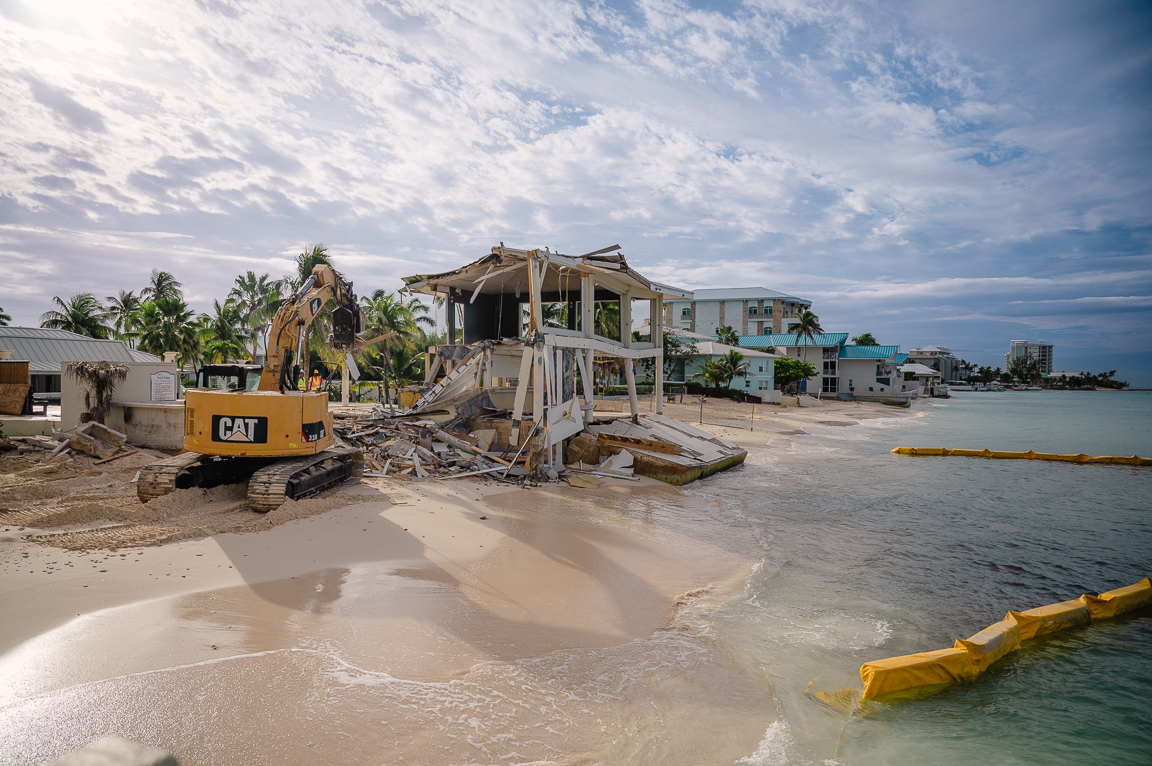
“I don’t think the whole question of managed retreat has gone away. Where people are redeveloping a site, for example, and they have the room to move back, then we strongly recommend that,” she said.
Richard Mileham, the planning department’s co-ordinator on the long-awaited update to the development plan, said a review of coastal setbacks would be part of that process.
Related Videos








I pray for the day that we see a big beautiful sandy Seven Mile Beach again. It’sTHE ignored tourism attraction. It’s a place for locals too. It’s sad to see it not get the treatment it deserves.
I hope that the DOE is taking a hard look at Dr. Tom Goreau’s “Biorock” coral reef growing technology. He showed us convincing evidence from numerous test sites that it could relatively inexpensively help save the expensive replenishment sand while adding a beautiful tourism attraction and fish habitat in about 20′ of water (just outside where the planned low groins would be). It could even take the place of the groins in less urgent areas the north where time permits as it takes about 5 years to mature. He uses a low voltage electric field to energize a grid-worked dome of steel rebar to stimulate fast, healthy coral growth. The steel is protected from corrosion by the electricity and a calcium coating that quickly develops over it, then cultivated corals are attached. The hotels and condos can supply the modest electricity needs, supplemented by solar panels on their roofs. It would certainly be cheaper than replacing the sand after every big storm and might not cost as much as the rocks for a groin. It would also be great for visiting snorkelers. Based on Tom’s experienced confidence in it, I think we should at least give it a good test area just north of the Marriott if the DOE agrees that it has promise.
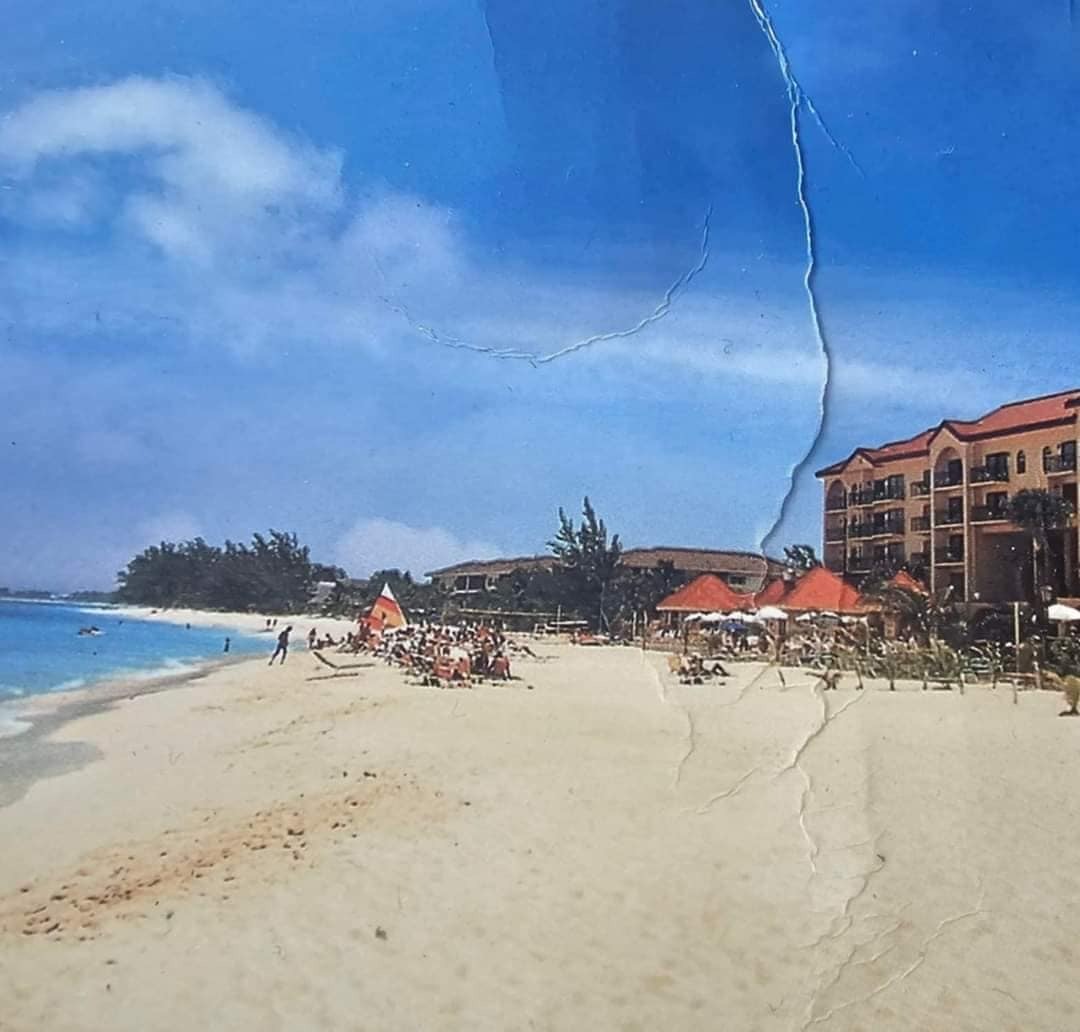
Looking at the size of the beach in the 1990s postcard it’s clear that the property was NOT built too close to the water’s edge but a good way back.
With respect Norman L, a postcard photo isn’t necessarily indicative of your point; it could’ve been taken at low tide. The law’s parameters are based on the high-water mark.
In any case, that area is clear evidence that nature doesn’t abide by man’s laws.
In the late 1960s/early ’70s, Government’s development plans included a dual carriage way set well back from what was West Bay Road then, so as to allow deeper lots on the beach side, with greater setbacks. The 1976 elected Govt scrapped those plans. It’s leader was “national hero” Jim Bodden, owner of JM Bodden Realty, the biggest vendor of SMB in the following decade. The set-back highway eventually came, but too late.
We are only reaping what greed and stupidity sowed decades ago.
I suggest that piecemeal solutions by individual property owners are not the answer and will cause further problems. We have rejected mass cruise ship tourism in favour of stayover visitors and Government needs to take the helm and organise a beach replenishment programme to address all the affected areas. I find it hard to believe that our Governments are still dragging their feet on this vital issue which should have received top priority years ago. How can we attract stayover visitors when nearly half our major beach has disappeared. Miami has had a beach replenishment programme for years has any approach been made to them for advice?. As soon as cabinet approval was given got the $50 million Brac High School the land was being cleared within weeks.
Couldn’t agree more. This is our lifeblood of the island for stay over visitors. So many livelihoods and jobs depend on it but it’s going ignored. It’s like ignoring all the hotel workers, everyone who supports them, everyone is being ignored without the beach being replenished. This is the #1 reason people come to Cayman and why Seven Mile Beach Property is expensive but imagine continued erosion with nothing being addressed. Do they want to see tourism decline? We don’t need people visiting and going home to tell their family and friends, “ Cayman was nice 20 years ago but there is no beach now and they are doing nothing about it, let’s pick another vacation destination.”
Come on, please get something in motion for a beach replenishment ASAP. Please. How hard do we have to beg. We need to keep this a world class tourism destination.
The Crown Jewel of Grand Cayman is Seven Mile Beach. Historically it is also a place where locals gather, and it is the core basis for job creation for many Caymanians.
The government needs to prioritize a beach solution before it is too late and the the character and attractiveness of the island is gone forever.
8000 cu yards of sand and “shoreline stability structures” will certainly fix the problem. Yeah, right!
Groynes actually make sense, though. They worked to create beach in Cayman Kai developments in the ’70s/80s (then were removed), beach at TI grotto, beach at Coral Sands grotto. But the powers that are involved don’t like the aesthetics. Temporary aesthetics which work vs processes which have failed in other places? Hmm?
But I’m no engineer.