Trying to stay upright on a fast-moving board while it is zipping over the water at high speed was a challenge enough in itself, but when the front of my board rose up into the air and took off from the waves altogether, it became an exhilarating, terrifying, gravity-defying moment which will stay with me for some time.
It was my first experience of eFoiling, Cayman’s newest – and possibly one of the most expensive – sport, and it wasn’t like anything I had experienced before.
I had done a small amount of surfing, but that usually involved long periods of waiting for a wave, followed by a frantic minute of paddling, a burst of speed as you try and ride the wave, then either falling off the board or riding it at diminishing speeds into shore before turning round and doing it all over again.
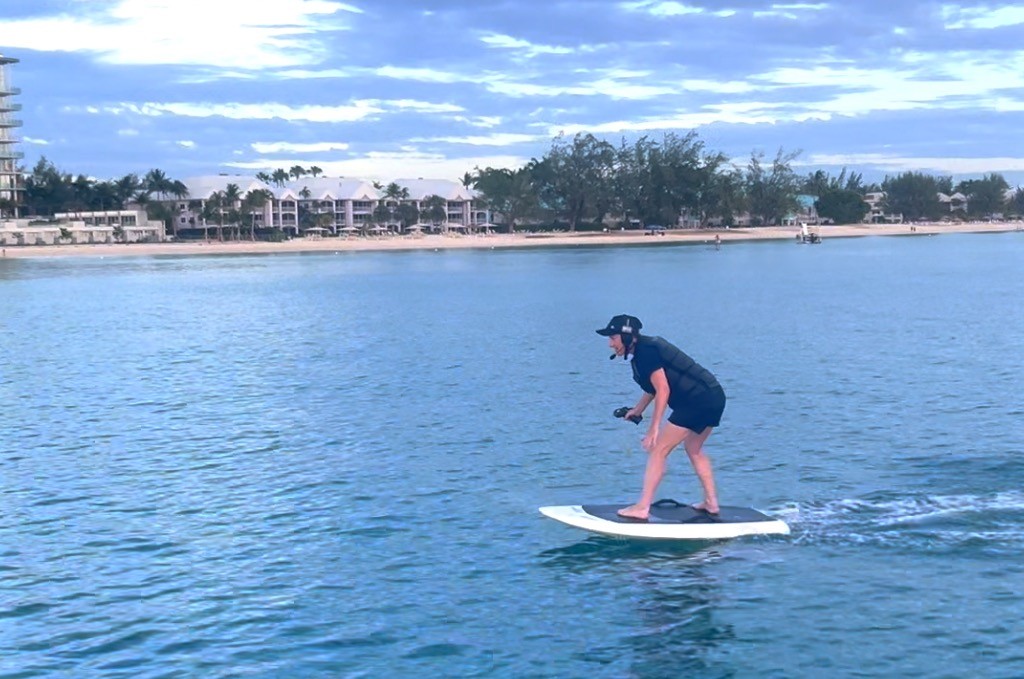
With an eFoil, which is best described as a remote-controlled electric surfboard, you are travelling at speed the moment you climb on board. If you go too slowly, then the front of the board will sink under the waves, taking you with it, and the Wi-Fi connection from the remote-control throttle in your hand will most likely cut out. Squeeze on the throttle though and you will pick up speed and glide effortlessly through the water. That was the idea at least …
Thankfully, I was being introduced to eFoiling under the expert tuition of Riley Grey from Cayman eFoiling, who has done around 3,000 hours of eFoiling and knows how to teach total beginners.
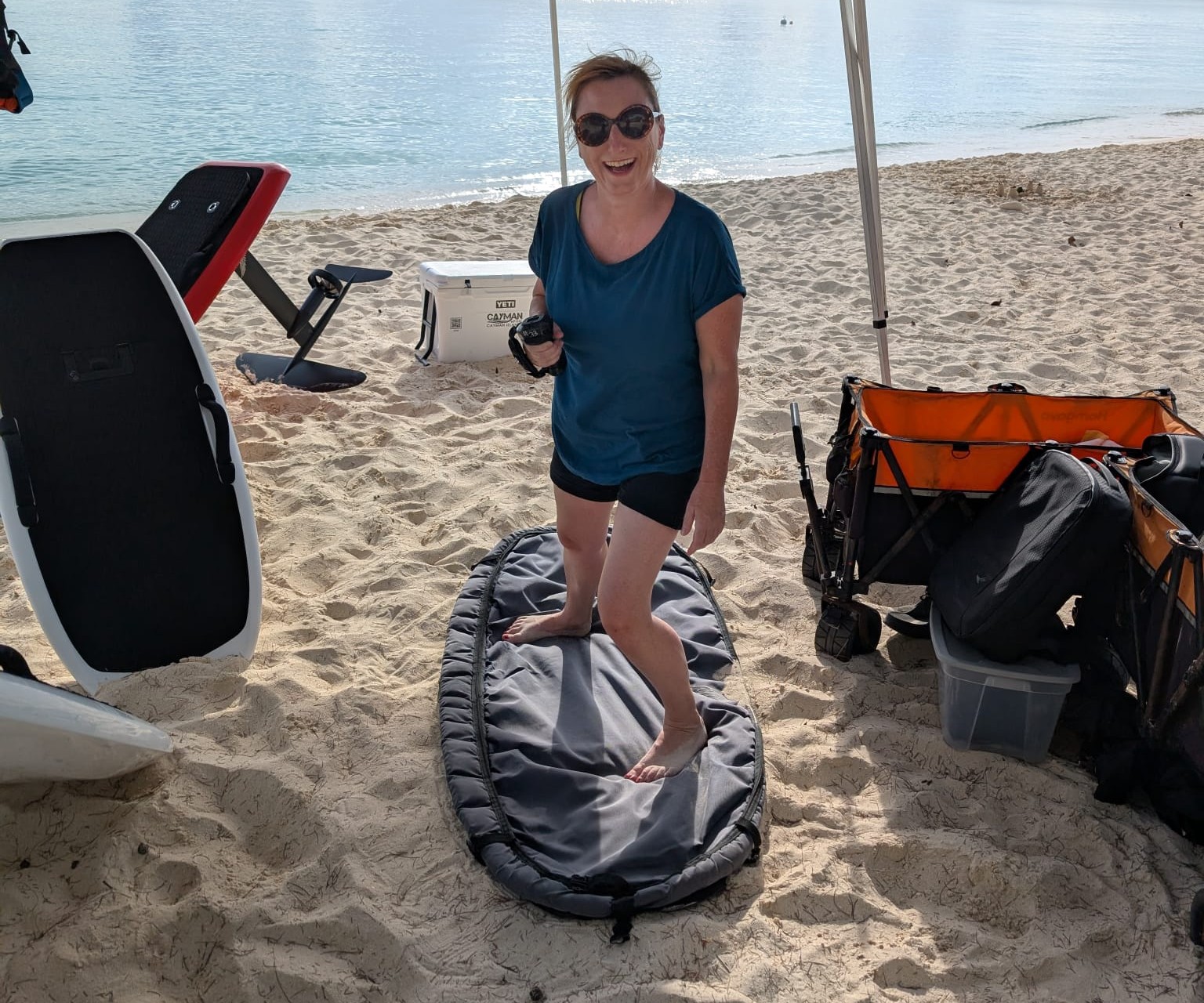
I brought my flatmate David along to share my lesson, which started off with Grey lying down on Seven Mile Beach to demonstrate how to first lie, crawl, kneel and then stand, all while controlling your speed and your weight distribution on the board.
There was a lot to take in, but with an US$18,000 piece of equipment and a powerful outboard motor, it was best we knew exactly what to do in advance.
Trying out my eFoil technique
Having practised on the sand, I was first to head out on the board. With my black shorts, black life jacket and black baseball cap fitted with a headset and microphone, I fancied I looked like an FBI drugs patrol agent, but that illusion soon passed as the board picked up speed and I was flying across the waves. It would have looked pretty impressive but for that fact I was still on all fours – not the most stylish look.
With Grey giving me step-by-step instructions through my headset, I concentrated hard on putting my left foot next to my left hand at the front of the board without nose-diving into the waves, while keeping my right leg straight at the back and also trying to watch where I’m going.
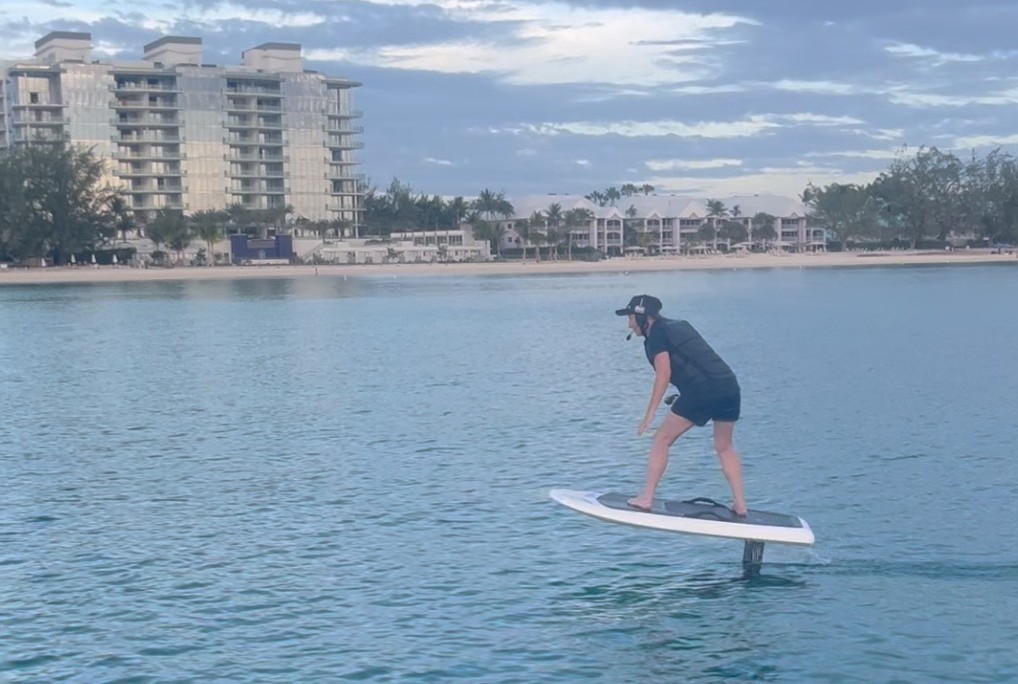
This would be a tricky position anywhere, let alone on a high-speed board, and it was with a sense of disbelief that I managed to rise to a standing position.
“First time up – you’re crashing it!” yelled Grey in my ear, which panicked me until I realised he actually said, “You’re crushing it!”, which I took as a good thing.
Turning was a little tricky, as you have to use your body weight without losing your balance, and at one point it felt like I was heading out to Cuba. After a stern talking to, the board finally co-operated and started to turn in the world’s largest turning circle.
With standing up now achieved, it was time to attempt the crucial ‘touch and go’, which is the skill of flying the eFoil and then bringing it safely into land again.
From eFoiling to eFalling …
Shifting back on the board made the front end soar like an eagle, a fact I hadn’t fully taken in until I looked down at my feet and realised I was flying a clear foot above the water. I instantly fell off in shock.
Thankfully, I remembered to “bail with intent”, which means not crashing into the board or the foil when you fall off, and I also remembered to take my finger off the throttle so the board wouldn’t have an adventure without me.
After hauling myself back on board using the handles, I managed several touch and goes, moving forward on the board every time the board took off and executing some graceful touchdowns. It was then David’s turn to have a go, so I could rest my trembling legs.
Having a break worked really well, as when I went out on the board for a second time, the process felt much more familiar and I stood up straightaway.
It was an incredible couple of hours on the water and a memorable Caribbean experience.
It’s not an inexpensive sport by any measure – it costs $475 for a two-hour introductory lesson with Cayman eFoil, or $550 for two people sharing one board – but if money were no object, I’d be back out there every afternoon for more of this unique sport.
Related Videos