

Markets are hovering near all-time highs at the same time that headlines remain dominated by geopolitical tension, volatile oil prices, and ongoing uncertainty in the Middle East. For many investors, that creates a natural sense of disconnect. If the backdrop feels unsettled, why do markets appear so resilient?
Markets move as expectations shift
Part of the explanation comes down to how markets process information. Prices reflect a constantly changing set of expectations, and even small shifts can have an outsized impact. What tends to matter most is the direction of change. When conditions begin to look less severe than feared, markets can respond quickly, even while the broader situation remains unresolved.
Recent developments in the Middle East offer a good example. A ceasefire, even one that’s temporary or fragile, doesn’t eliminate the underlying risks tied to the conflict or the global energy supply chain. But it can ease concerns around more extreme outcomes, such as prolonged disruption to the Strait of Hormuz. That change alone can influence sentiment and pricing, and it helps explain why markets can move even when the situation itself hasn’t been resolved.
We’ve seen this play out very recently. The S&P 500 declined 5.1% in March as tensions escalated and uncertainty around the conflict increased. Yet in April, the index not only recovered those losses but went on to reach new all-time highs. The underlying issues didn’t disappear over that period, but expectations shifted. As the outlook became less severe than initially feared, markets adjusted accordingly.
This same dynamic has played out repeatedly over the past several years. Since the bull market began in late 2022, investors have navigated a wide range of challenges, including a surge in inflation, rapid interest rate hikes, a regional banking crisis, geopolitical tensions, and ongoing debates around artificial intelligence and global trade. Each of these developments carried real uncertainty, and few were resolved neatly. Even so, markets continued to move forward, steadily incorporating new information along the way.
Cycles don’t wait for comfort
The idea that markets ‘climb a wall of worry’ is often used to describe this pattern, and it ties closely to how market cycles unfold. Bull markets don’t move in a straight line, and they rarely feel fully justified in real time. Instead, they tend to include periods of strong gains alongside frequent pullbacks, shifts in leadership, and changing narratives about what might come next. When you step back and look at market cycles over time, this pattern becomes even clearer. The bigger picture tends to get lost in day-to-day headlines.
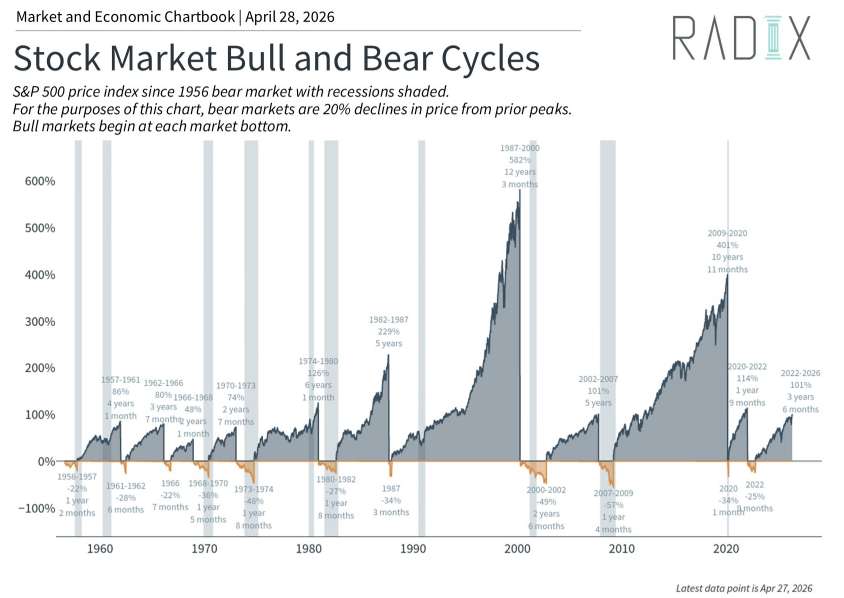
As the chart illustrates, shorter-term declines are a normal part of longer market cycles. Historically, markets have experienced multiple declines of five percent or more in a given year, even during otherwise strong periods. These pullbacks are part of the process, not a signal that the cycle itself is breaking down. What matters more is the broader trend, which is typically driven by earnings growth, economic activity, and liquidity over time.
Looking back, every cycle has come with its own set of concerns. The period following the 2008 financial crisis, for example, was often described as one of the most ‘unloved’ bull markets. Investors questioned the strength of the recovery, worried about debt levels, and debated whether policy support could sustain growth. Those concerns didn’t disappear, but markets advanced anyway.
Today’s cycle is no different in that regard. The specific risks have changed, but the pattern remains. Markets continue to move through uncertainty rather than waiting for it to clear.
What new highs reflect
The presence of new highs can add another layer of confusion. They’re often interpreted as a signal that markets have gone too far or that a reversal is overdue. In practice, markets that trend upward over time will naturally reach new highs on a regular basis. These levels are simply a reflection of long-term growth in earnings, innovation, and economic activity.
At the same time, new highs don’t imply that risks have faded away. The current environment still includes elevated energy prices, ongoing geopolitical tension, and uncertainty around inflation. What markets are reflecting is a broader balance of factors. While some risks remain, other areas of the economy and corporate performance continue to show resilience.
Recent inflation data illustrates this balance. Energy prices have increased meaningfully, but those pressures have not yet spread widely across the broader economy. Core inflation has remained more stable, and corporate earnings have continued to hold up. Different sectors have responded in different ways, with energy-related companies benefiting from higher prices while other areas adjust. This kind of dispersion is one of the reasons diversified portfolios can continue to perform even when specific risks dominate the headlines.
Markets are constantly weighing these crosscurrents. Strength in one area can offset pressure in another, and expectations adjust accordingly. That process doesn’t eliminate uncertainty, but it does help explain why markets can remain resilient in environments that still feel unsettled.
Why it feels out of sync
For investors, the difficulty is that this process unfolds ahead of clarity. There’s a natural inclination to wait for confirmation that risks have passed or that conditions have stabilised before leaning in. Markets, however, tend to move before that confirmation arrives. By the time the outlook feels more certain, prices have often already adjusted to reflect it.
This timing gap is what creates the sense that markets and headlines are telling different stories. In reality, they’re focused on different points in time. News reflects what’s happening now, while markets are continuously adjusting to what may come next.
It’s also worth remembering that cycles don’t end simply because uncertainty is present. They tend to turn when conditions deteriorate more broadly, particularly in areas like earnings, liquidity, or economic growth. While there are always risks to monitor, the current environment still reflects a mix of resilience and pressure rather than a clear break in the cycle.
That difference can make periods like the current one feel disjointed, but it has been a consistent feature of investing over time. Markets don’t wait for a fully clear picture. They move as uncertainty evolves, incorporating new information as it becomes available.
And while that can feel counterintuitive in the moment, it helps explain how long-term returns have been generated across a wide range of environments, including those that, at the time, felt anything but certain.
Jessica Jablonowski, CFA, is the managing director and investment advisor at Radix
Financial Cayman, LLC.
Disclaimer: The views and opinions expressed in this article are my own and do not necessarily reflect those of Radix Financial Cayman, LLC. This article is for informational
purposes only and should not be taken as financial advice. Radix Financial Cayman, LLC accepts no liability for any actions taken based on the information presented here.
Related Videos