By Simon Cawdery

You don’t need to be Judge Dredd to agree that criminals should be punished. Societies across the globe generally accept that persons who cause injury, distress or harm to others should experience some form of punishment. Commonly, this is monetary restitution for harm caused and a loss of personal liberty for a specified period of time. So far so obvious.
But I want to pose a question to readers which is this: If a convicted offender is released after their prison term, and reoffends, was the punishment effective?
I would say no, with a caveat. The caveat is that they may well have been properly punished for the crime they committed and the victims received some form of closure. But if we are honest with ourselves, hasn’t there been a failure if a second crime is then committed?
Surely, one of the purposes of prison is to rehabilitate; not for some soft, woke, leftish agenda, but because crimes have victims, and if we rehabilitate and prevent crimes, then fewer residents or tourists will be future victims of crimes.
The history of prisons is an interesting one since they were once intended purely as a means to an end – a holding place before some other punishment, such as corporal punishment or execution. Then in the 16th to 18th centuries in Europe, prisons evolved to become the form of punishment, the deprivation of liberty being the punishment considered reasonable by society and the punishment considered sufficient to deter.
In Britain in the late 1700s and early 1800s, reforms were introduced with an explicit focus on reform and rehabilitation – the idea being specifically to change the mind and behaviour of the criminal to enable them to become a productive member of society.
It seems clear that if prisons are meant to deter criminal behaviour, then they must be considered a failure. Crime happens in every country and is mostly uncorrelated to the perceived severity of its prison system. If it isn’t the presence of prisons or the conditions of prisons that deters crime, then what does or what might?
Australia may offer an answer. A study from Victoria in 2011 from the Sentencing Advisory Council looked at the question of deterrence and concluded that “The threat of imprisonment generates a small general deterrent effect. However, increases in the severity of penalties, such as increasing the length of imprisonment, do not produce a corresponding increase in deterrence.”
There’s a lot to unpack, not least that deterrence is predicated on ‘rational actors’ … i.e., that the potential criminals sit down calmly before their crime and weigh up the probabilities of being caught and the punishment resulting thereafter. That’s clearly unlikely. The vast majority of criminals in their study were noted as being irrational, in that they are often on substances that distort rational behaviour.
What does this mean?
The first observation is that we should very strongly and aggressively target those on illegal substances and the use thereof. If most criminals are users of illegal drugs which causes irrational behaviour, programmes to eliminate those substances, and programmes to provide counselling to those seeking to reduce their dependency should be encouraged.
More money should be invested in and much more attention paid to some of Cayman’s existing programmes (that often don’t grab the headlines but genuinely improve lives) that steer people to better lives away from the perils of addiction and gangs.
The second observation is an opportunity. The evidence seems to indicate that if the probability of being caught was extremely high, then there would be a reduction in crime. Policing matters, something I will discuss in a moment.
The third observation is a problematic one. Prisons don’t work as a deterrent to crime. It doesn’t matter if the prison is considered nice or nasty; it doesn’t influence potential criminal behaviour. This may run counter to popular culture where Hollywood shows the villains avoiding their crime due to the fear of the supermax prison, but such are the facts.
This doesn’t mean prisons have no purposes; of course they do, but it serves as an extremely useful framework to remember when evaluating what a prison is for.
Policing matters
This hits at a major problem that Cayman faces. The police do an incredibly important role, but are often underfunded and under-resourced relative to the people they are meant to catch. In addition, police officers are often doing jobs that in any other industry would have been replaced by technology. To use one example: Trained officers don’t need to be sitting at the end of a road holding a speed-gun. Technology can deliver better outcomes, more cost effectively, and free up that trained person for more productive means.
Since the evidence indicates that an increase in the probability of being caught reduces criminal activity, then we should be focusing resources and energy on catching criminals. We should be using technology on the roads, in the water and in the air to ensure that trained and skilled officers focus on the human intelligence elements and the in-person elements that only they can do.
We should make far better use of speed cameras, AI cameras for road safety and drones for surveillance and counter-narcotics-operations. We should have a fleet of drones patrolling Cayman’s maritime borders identifying real-time threats so that scarce resources can be sent to where the crimes are happening, not where they are not.
We should, as an aside, also offer all police officers 100% subsidised fitness club memberships so that they have the stamina and fitness if faced with a criminal … it baffles me that we expect our police force to pay for a gym membership.
If we improve our policing systems through better resourcing, better technology, better remuneration and budgets, and therefore make potential criminals realise that they will be caught, perhaps we can reduce crime rates. But that’s only part of the story.
Accountability matters … an aside
We also need a police force that’s accountable. That might seem an odd statement at first glance, so what do I mean? Quite simply, we need a police force that’s accountable to Caymanians and people who live in Cayman. Cayman’s police force is accountable to the British-appointed governor who reports to the British foreign secretary. That’s an anachronism that needs to change. How often do you think the British foreign secretary sits down to review Bodden Town or West Bay crime statistics?
As lovely as any one governor may be, they live in a beachfront house protected by police officers and drive around in cars driven by police officers. If you don’t experience the same daily anxieties as Caymanians, don’t set up roots in Cayman, don’t invest in Cayman, then you shouldn’t have control over the police service of Cayman.
People can have their own views about politicians, but there is no doubt that the one thing politicians can never be faulted for is attention to voters. If voters care about crime, politicians care about crime. Politicians therefore need to have responsibility for the criminal system in the Cayman Islands.
What should prison be for?
Prison should, of course, be a punishment. But it needs to be more than that. This chart shows the extent of the problem:
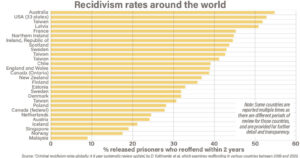
Prisoners, when released, often commit more crimes. That shows that the system doesn’t work as well as it should. Society hasn’t truly benefited if the criminal exits the prison system and reoffends.
Yes, punishment is important, but given the huge cost expended on keeping people incarcerated, surely it would be better if those released didn’t reoffend and re-harm someone else? Surely it would be better for society if those people got jobs, worked and contributed positively rather than ending up back in prison and costing hundreds of thousands of dollars?
The data here is using a study, titled ‘Criminal recidivism rates globally: A 6-year systematic review update’, by Denis Yukhnenko and others, published in the Journal of Criminal Justice (cited by, among others, the US National Institute of Health and Science Direct) which takes data from national reports and databases over the period 2009-2020.
What’s so striking about the data is how varied the numbers are. Why does Norway only have 17% of its released prisoners reoffend versus 38.9% in England and Wales, 45% in France or 52.9% in the United States? Is it because the people are different? That seems possible culturally and sociologically, but remember these are all criminals, so all have some similar psychological traits that nationality can’t alone account for. Something else must logically therefore be at play.
What about Cayman?
The Compass published an article in 2024 which suggested that Cayman’s reoffending rate is in the 80% range. That’s way higher than any of the countries in this global study and a complete embarrassment to our country. How does Cayman benefit if almost everyone who is locked up, then released, then commits another crime?
Some may say, “Well, at least they are locked up again.” Yes, but because they committed another crime and harmed another citizen. Every crime committed means another victim. If we want to reduce the number of victims in Cayman that suffer from the horrible effects of crime, then surely, we should be pulling out all the stops to reduce the number of crimes?
This is an incredibly complex subject with a huge number of unmanageable variables, but it is inescapable (excuse the prison pun) that some countries’ prisons systems are doing something better than others’ and delivering lower levels of reoffending. Surely, any society would want lower reoffending rates? Perhaps its programmes for education. Perhaps its counselling systems. Perhaps it’s the actual facilities.
Whatever it is, it would behoove Cayman to figure it out, figure it out quickly, and spend the money on implementing the necessary changes. Anything that can stop reoffending reduces crimes, reduces the number of victims of crimes, and reduces the cost of treating crimes. Perhaps Cayman needs to study more the ‘Nordic Model’ of re-normalisation rather than the ‘American Model’ of punishment. The point is that whatever we are currently doing isn’t preventing more people becoming victims, so we should be open minded to alternatives.
Back in 2015, the Cayman Compass published an article saying that the cost to house a prisoner was US$78,342. Using data from the government’s 2025 budget, that number has grown to US$113,124. That’s a staggering sum and means that Cayman’s budget for running its prisons is over US$28 million a year. Cayman pays more for every prisoner than it pays any teacher, any nurse, and indeed it’s over five times the cost of educating a child in our school system. Cayman spends all this money and yet we see a perpetuating cycle of re-offending and ever-rising costs. Surely there’s a better way?
A better future?
We should quite properly be spending money on prisons (and likely much more than we currently do). Cutting costs is a complete false economy since we should want our prisons to be places that both punish and rehabilitate. Cutting costs to the bone only for people to reoffend has no long-term benefit.
Unfortunately, conversations involving prisons and prisoners are all too often short term in nature, such as “Lock them up and throw away the key.” But the key is never thrown away. People get released. If they then reoffend, that then costs all of us. More victims of crime, more suffering because of crime, and more costs in dealing with the crime. Investment in prison reform is an investment for the whole community.
Prisons serve a purpose, but the purpose needs to evolve. Cayman needs to do two things much better:
1. It needs much better, firmer, more accountable and more proactive policing; and
2. It needs prisons that punish and rehabilitate.
Stopping crimes happening is one of the best investments any country can make.
I don’t know enough about criminology, psychology or other similar subjects to explain how to make these improvements; all I can do is identify that some countries do things far better than Cayman does and that we should aspire to be the best. Ask yourself a simple question: Do you want to be the victim of crime? If the answer is no, then you should want better, smarter policing, and you should want better smarter prisons.
Simon Cawdery, CFA, is an investment manager and governance professional who lives and works in the Cayman Islands. He writes regularly for the Compass.
Related Videos