

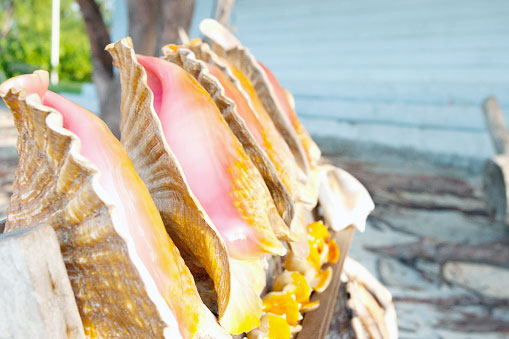
What exactly does a queen conch do all day?
That is the question researchers from the Cayman Islands Department of Environment and Chicago’s Shedd Aquarium hope to answer through a new tracking project that is offering a rare glimpse into the private lives of one of Cayman’s essential marine species.
In May, Department of Environment environmental management officer, Steph Gunby, and research scientist Andy Kough fitted 37 queen conchs with temporary acoustic tags and biologger backpacks at six sites around Grand Cayman.
Over a period of just more than two weeks, researchers tracked the movements of the animals using hydrophones and GPS technology, allowing them to map where the conchs travelled and how active they were.
The results have already revealed some fascinating behaviour.
According to the Department of Environment, tagged conchs were observed burying themselves in the sand, mating and even laying eggs while carrying the monitoring equipment. The observations suggest the tags did not interfere with the animals’ normal behaviour and provided researchers with a front-row seat to activities that are rarely documented in the wild.
The project is designed to improve understanding of conch movement patterns, home ranges and activity levels, while also comparing behaviour inside and outside marine protected areas.
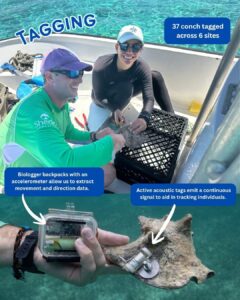
Researchers tracked individual conchs by locating the signal from their acoustic tags, then conducting underwater surveys around each animal. Biologgers equipped with accelerometers recorded movement and direction, providing a detailed picture of how the animals use their habitat.
The queen conch is one of the Caribbean’s most recognisable marine creatures. Growing to more than a foot in length, it spends its life grazing on algae in seagrass beds, sandy flats and shallow lagoons. Caymanians traditionally know a mature conch by its broad flared pink lip.
The study comes at an important time. Conch season closed on 1 May and remains closed until 31 Oct., allowing adults to reproduce and replenish local populations.
Conch have been monitored in Cayman since 1988, with surveys showing long-term declines in density across the islands. Marine replenishment zones have proven important refuges for breeding adults, helping support future generations of this culturally and environmentally important species.
Related Videos








The Observer Effect is the FUNDAMENTAL principle in science that the act of observing or measuring a phenomenon inherently alters its behavior.
The Observer Effect absolutely applies to marine life observed with electronic tags. The very process of capturing, handling, and attaching instruments (like satellite or acoustic tags) can alter an animal’s natural behavior. This introduces potential physical, physiological, and behavioral biases into the research data.
The Observer Effect introduces a paradox for marine biologists: the data collected may reflect a “TAGGED animal’s behavior” rather than WILD, NATURAL behavior.
To attach an electronic tag, scientists must first capture the animal. The acute stress of capture, handling out of water, or undergoing surgery (for internal acoustic tags) CAN INDUCE LONG-TERM PHYSIOLOGICAL CHANGES. This trauma often alters migration timelines or causes temporary erratic swimming behavior immediately post-release.
https://onlinelibrary.wiley.com/doi/10.1111/faf.12861 (Long-term effects of tagging fishes with electronic tracking devices)
The tagging process itself (or the presence of an unnatural external object) can cause short-term erratic behavior, stress, and occasionally minor injuries at the attachment site.
https://pmc.ncbi.nlm.nih.gov/articles/PMC6911844/
Electronic tags and their attachment mechanisms (like harnesses, darts, or glues) increase hydrodynamic drag in the water. This means an animal has to expend more energy to swim, which can reduce its cruising speed, alter migration routes, or hamper its ability to evade predators and catch prey.
https://pmc.ncbi.nlm.nih.gov/articles/PMC12560902/