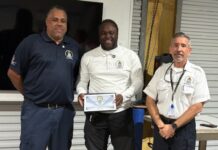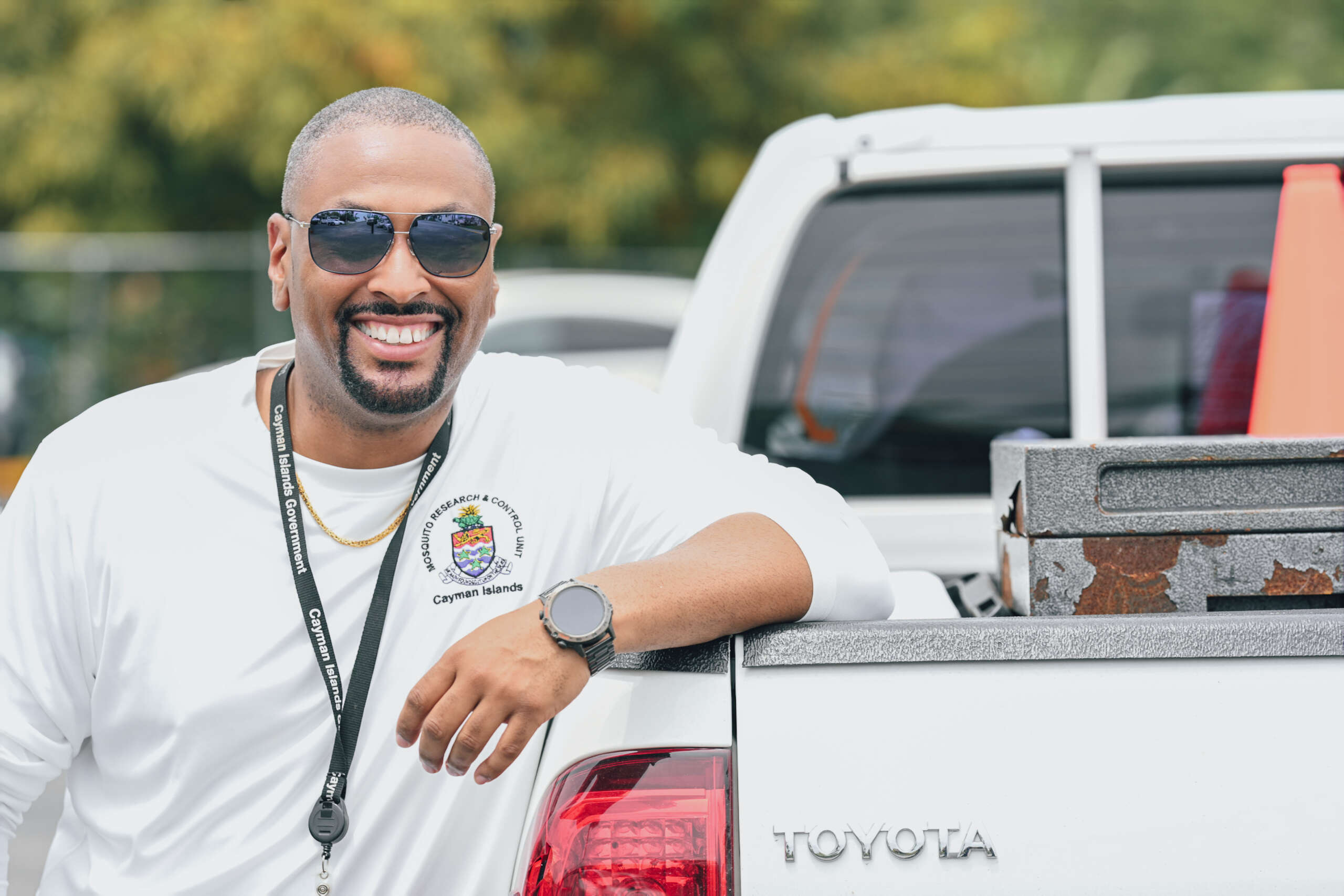
Nearly a decade after leaving the Royal Cayman Islands Police Service, Mosquito Research and Control Unit disease prevention officer Dante Leslie relied on the emergency response skills he developed on the force when a routine property inspection turned into a medical emergency.
During an inspection on 26 May, Leslie, 45, recognised that a resident was in medical distress, called 911 and, following instructions from the emergency dispatcher, stayed by her side, helping care for and reassure her until paramedics arrived – a response she believes might have saved the woman’s life.
“I don’t like to see people hurt. I don’t like to see people struggling,” Leslie said. “If I have the ability to help somebody, I’m going to help.”
A routine inspection turns serious
On what Leslie remembers as an oppressively hot Tuesday afternoon, he arrived at a Bodden Town home as part of MRCU’s routine inspections, expecting nothing more than a standard property check.
The homeowner, who asked to be identified only as Ms. Viv, answered the door as Leslie explained the purpose of his visit. During their conversation, she mentioned that she was not feeling well.
As they continued talking, Leslie became increasingly concerned.
Her stomach appeared severely swollen. She told him she was dizzy. More alarming, he said, was her breathing.
“Every few words that she would say, she would have to take a breath,” he recalled. “You could definitely see that her breathing was getting worse.”
As Ms. Viv’s condition worsened, Leslie urged her to go to hospital. When she explained that she was home alone and too dizzy to drive, he called her husband before contacting 911. The emergency dispatcher guided him on what to do as an ambulance was dispatched.
“I was quite ill, and he noticed that I wasn’t breathing well at all,” Ms. Viv said. “He insisted that he wasn’t going to leave until the ambulance arrived because no one else was there with me.”
As they waited, Leslie relayed instructions from the emergency dispatcher, helped her find a more comfortable position and kept talking to her.
“When people are scared, if you stay calm, they stay calmer,” he said. “If you start to panic, they’re going to panic even more.”
As her breathing became more laboured, Ms. Viv moved inside and sat near the air conditioning while Leslie remained with her. When the ambulance initially drove past the house, he flagged it down and briefed paramedics before they took over.
Ms. Viv was taken to hospital, where she underwent scans and other tests. She declined to disclose her diagnosis but said doctors discovered a condition that, had she not sought medical attention when she did, could have placed her in greater danger.
“Had he not recognised that something was wrong, maybe I wouldn’t have been here,” she said.
Leslie has worked in government on and off for nearly 18 years. Before joining MRCU, he spent more than nine years as a police officer, experience he said taught him how to stay calm and quickly recognise when someone needs help.
With permission from his supervisors, he returned several days later to check on Ms. Viv. She was not home during his first visit, so he came back again.
“I wanted to hear it from her that she was okay,” he said.
For Ms. Viv, his decision to return left a lasting impression.
“It made me feel so proud to be able to speak with him again and tell him how much I appreciated what he did,” she said. “It showed that he genuinely cared.”
Training, instinct and compassion
Although his policing experience helped him recognise the warning signs, Leslie said the first-aid, CPR and automated external defibrillator training all MRCU officers receive also gave him confidence to respond if her condition had suddenly deteriorated while they waited for emergency crews.
He believes those are skills everyone should learn.
“Something can happen to your mother, father, sister, brother, wife, husband or child,” he said. “Having that training could potentially save someone’s life.”
MRCU Director Alan Wheeler said the incident demonstrated that the agency’s role extends beyond mosquito control.
He said Leslie’s response reflected both his professionalism and his character.
“This is a wonderful example of what people-centred public service looks like in practice,” he said. “His actions reflect the values we strive to uphold as public servants and demonstrate how government employees can make a meaningful difference in the lives of the people we serve.”
Leslie, who is married and the father of a 3-year-old son, is uncomfortable being described as a hero.
He said he was raised to look out for others and believes living in a small community comes with a responsibility to help whenever possible.
“We’re a small island,” he said. “There’s too much negativity in the world. Just be kind to one another. If somebody needs help, help them.”
Related Videos