“…….the Battle of France is over. The Battle of Britain is about to begin, upon this battle depends the survival of Christian civilisation, upon it depends our own British life and the long continuity of our institution and our Empire.”
Prime Minister Winston Churchill, 18th June, 1940
Prelude
It is important to understand what led up to the Second World War. Germany had been defeated in 1918 and bitterly resented the conditions imposed upon it by the victors. In the late ’20s a very right wing political party, the National Socialists (Nazis), emerged as the dominant force. This promised to restore Germany’s stature and to improve the poor economic position for most of the middle and working class population. In 1932 they swept to power led by a madman, Adolf Hitler, whose status in the first war was an infantry corporal. Their dogma stood for their hatred of Jews, gypsies and homosexuals. Their target was ethnic cleansing. To achieve their goals they needed more landmass, lebensraum they called it. It was logical then to control all of Europe. Their new army moved into Czechoslovakia, Austria and other neighbouring countries.
When on 1st September, 1939, they moved into Poland the British and French governments said get out in 48 hours or we will declare war. They did not get out, so on 3rd September war was declared. It was a phoney war, with no action until early summer 1940. One great pity was that the Belgians refused to allow the British and French to take up defensive positions in their country hoping that the Nazis would not invade Belgium if they were non-aligned with either side.
On 10th May, 1940, Hitler unleashed the Nazi (German) armies on the countries in western mainland Europe. Within a few weeks Norway, Denmark, France, Belgium and Holland had fallen. Britain managed to rescue its army from Europe with the Royal Navy and hundreds of small ships bringing back 328,000 British and French soldiers from the beaches at Dunkirk.(See note 1). Few people in the world realised it marked not an end but a beginning. Hitler’s ambitions and the stubbornness of Churchill’s defiance had yet to be seen.
Britain stood alone in that dark month. Common sense said that in order for the German armies to be able to take Britain it had first to control the English Channel, 22 miles at its narrowest point. Twenty-two miles that had defied those who tried to conquer Britain in previous centuries.
But to master the English Channel, the Germans also had to control the sky above it. That did not appear to be beyond the ability of the German Air Force, called the Luftwaffe. It outnumbered the Royal Air Force by about three to one. Most of its operational leaders had combat experience in the Spanish Civil War.
Call me Maier
The head of the Luftwaffe was First World War ace Field Marshall Herman Goering. Twenty years after Germany’s defeat in the first war he was a vain, pompous, man addicted to drugs, who could not conceive defeat. The Nazis detested the Jews so his words, ”If a British bomb falls on Germany you can call me Maier,” would come back to haunt him.
Looking at the balance of advantages between the air forces we see that the German pilots generally had much more combat experience; they certainly had many more aircraft. Psychologically they were in good shape, continuing what they thought was a winning roll.
The British pilots and their compatriots from all over the Empire were desperate to save the country from tyranny. They were flying combat missions over home territory. If they were shot down and uninjured they could return to the fight very quickly. Their crashed aircraft could often be salvaged, or at least cannibalised for parts to repair other aircraft.
The biggest advantage for the British was that they had developed the world’s first operational radar stations supported by an excellent control system. Although primitive by today’s standards these at least gave warnings of enemy formations heading in to England enabling ground controllers to direct Fighter Command aircraft on to the enemy.
The battle that was about to start has always been called the Battle of Britain but that does not indicate where the pilots who fought in it came from. Yes, a large proportion of them were British but others hailed from the four corners of what was then the British Empire. In addition there were pilots from many of the occupied European countries who had an absolute loathing of the Nazi swastika symbol. The largest foreign group were the Poles; over 140 of them. Even a few Americans came across to Britain to join in.
The Battle
The Luftwaffe sought to gain domination of the airspace over southeast England by destroying Fighter Commands aircraft and their airfields.
The first concerted attack on 12th August was on the radar installation on the Isle of Wight. Bad weather hampered them the following day, Adler Tag, Eagle Day. On 15th they carried out over 2,000 sorties, but lost 75 aircraft. The Luftwaffe air fleets based in Scandinavia also sent unescorted bombers to attack the airfields in the Northern part of England – a big mistake as many RAF squadrons were in the north on R&R.
They sent bombers to attack airfields closely escorted by their fighters that were supposed to shoot down the British defenders at the same time. The Luftwaffe fighter pilots were dismayed at these enforced tactics as they knew that if they were allowed to fly free range they could ‘get at’ the defending fighters.
The Stuka dive-bombers suffered slaughter whenever these met with RAF fighters. Eventually these had to be withdrawn from the battle.
Each day brought new large formations of aircraft into southeast England, targeting airfields. The overall plan was that Air Marshall Park’s No. 11 Group would tackle the Luftwaffe onslaught in the southeast and Air Marshall Leigh Mallory’s No 12 Group, based in the Midlands, would fly south to protect 11 Groups airfields. Personalities often play a part in warfare. No. 12 Group’s commanders theory was that they should spend time building into large formations before going after the enemy. This took too long and by the time their aircraft had reached the south the Luftwaffe, or what was left of it, had long since returned to their French bases.
By the end of August the Luftwaffe believed it had halved the RAF’s strength to 300. In fact it was still at about 600 as the factories were producing more than twice as many new aircraft as were being lost. On the other hand only three-quarters of Luftwaffe losses were replaced in the same timescale.
In that same period of two weeks, the RAF lost 100 pilots but the Luftwaffe lost well over 600, killed or captured. It must be said that the RAF pilots could do simple arithmetic. They knew the rate of attrition and counted themselves as dead men. One man wrote in his diary that he thought everyone was quite sure they would survive for no more than seven days.
A simple mistake led to a major change in tactics. A Luftwaffe bomber became lost over south London so it dumped its bombs over a built up location. Until that time both sides had refrained from targeting civilian areas. Knowing what Hitler’s reaction would be, Prime Minister Churchill ordered the RAF to send a few aircraft to bomb Berlin. This sent Hitler incandescent and he ordered the Luftwaffe to target London and other cities, giving the British airfields the chance to recover. (The sight of swarms of aircraft high in the sky over Kent and flying along the River Thames towards London is the writer’s earliest living recollection).
September continued with the Luftwaffe having switched to morale damaging attacks on civilian towns and factories. Since the German bombers were relatively light, these did not have the strength to strike fatal blows against major cities and industrial centres. Losses on both sides were still heavy but time was running out for there to be any chance for the Germans to mount a seaborne invasion that year.
The climax came on 15th September with the highest losses for the Luftwaffe. Fighter pilots’ claims on both sides were not deliberately exaggerated but in the turmoil of an air battle more than one pilot could be firing at the same aircraft and both might claim success. The RAF claimed 185 that day but history records 60. But this was enough. The RAF did not destroy the Luftwaffe but it denied the Germans the domination of the English Channel and the skies above it.
Conclusion
The war in the air continued at a fairly desperate level for over a year with nightly bombing raids on the whole of southern England. Civilian casualties were high. It must be remembered that the Luftwaffe invented area bombing, a concept that would be unleashed on German cities mercilessly within two years with four-engine heavy bombers. By 1943, with the US now in the war, their 8th Air Force was also targeting Germany; both air forces laying almost every German city to waste.
No. 11 Group’s New Zealander Air Marshall Park, the saviour of the country, was sidelined. No. 12 Group’s Air Marshall Leigh Mallory went on to serve in the Middle East.
“Never in the field of human conflict was so much owed by so many to so few”. Prime Minister Winston Churchill, 20th August 1940
The Cayman Islands Veterans Association welcomes any individual who has served their country in military uniform. There are presently members from Cayman, the UK, the US, and Canada.
Note 1 – Three quarters of the French soldiers rescued at Dunkirk insisted they be repatriated to France after that country had surrendered rather than fight on alongside the British.
The aircraft
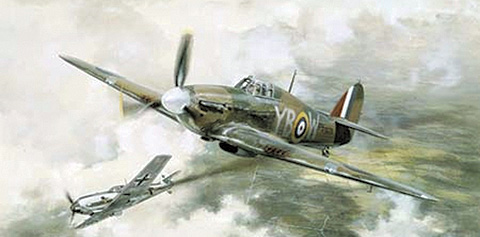
The British had two main fighters: The Hawker Hurricane Mk 1 was more sluggish than the other single-engined aircraft with a top speed of only 329mph. Its armament appeared to be fearsome with eight machine guns but these only fired .303 bullets, the same size as an infantry rifle. The RAF lost 629.
The classic Supermarine Spitfire looked much sleeker and developed an image in the publics eye as the most potent aircraft of the war. Its top speed matched the Me109 but again its armament was poor, matching only its ally, the Hurricane. At least 373 were lost.
Messerschmitt 109E – the mainstay for the Germans. It was better armed than British fighters with two 20mm cannon as well as four machine guns. With a top speed of 354 mph it matched the Spitfire. However, from July to October 1940, 502 were lost.
The Germans had Messerschmitt 110C This was a twin engined aircraft with similar armament to the 109 and almost the same speed. In the same period 223 were lost.
Junkers Ju87 Stuka. This was a very successful dive-bomber when used in the early stages of the war in Europe where there was little opposition. But when it was used against England it was quickly shot out of the sky as the British pilots said, a turkey shoot and withdrawn from combat service.
Junkers Ju88 was a successful twin-engined aircraft, used in the battle as a bomber. It was later used for a variety of combat purposes.
Heinkel 111, another twin-engined bomber.
Dornier Do 17 , yet another twin-engined bomber.
Luftwaffe bomber losses were over 530 aircraft

Related Videos