

Since the Freedom of Information Law came into effect in January 2009, some 2,318 requests for information have been logged by public authorities. Many more have been dealt with outside the Law. After an initial peak of activity in 2009, the average number of requests recorded by Government each year has hovered around 570, or about 48 per month for all of the 92 public authorities combined. These numbers are quite impressive for a small country like the Cayman Islands, but they do not begin to tell the full story of how FOI is impacting society, and how it is being experienced by applicants, public authorities and the Information Commissioner’s Office, the independent body tasked with hearing appeals and monitoring compliance.
The impact of FOI is hard to measure and the available statistics can only begin to scratch the surface. Like Government itself, FOI can touch almost all aspects of an average person’s life, from the water they drink, to the roads they drive on, and the amount of money spent in their name, it is all covered by FOI.
In 2011 alone, there were more than 120 news stories in the written press that mentioned FOI and such topics as finances, discrimination, pensions, prisons, health insurance, police exams, and much more.
Apart from the direct impact of the FOI Law, we also know that since 2009 – most likely because of FOI – public authorities have become better at publishing information proactively, and many now make a point of readily providing information upon request without involving the formal FOI process at all. However, in many cases the FOI Law remains the only way to gain access to Government information, and – more importantly for many applicants – it remains the only place the turn to when information is withheld.
Statistics show that the work public authorities have to put into answering FOI requests is unevenly spread out. The 20 most popular public authorities together receive almost three quarters of all requests. Not surprisingly, at the head of the line are some of the most powerful public sector entities such as the Immigration Department, the Royal Cayman Islands Police Service and the Ministry of Finance, Tourism and Development. At the other extreme, many public authorities are rarely or ever asked any questions under the Law at all.
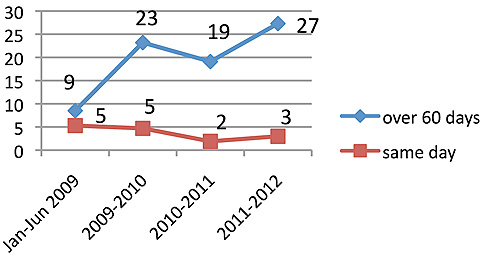
In terms of response times, public authorities are for the most part responding within the statutory period of 30 calendar days, which the Law allows for an initial decision – but only just. It is worrying to note that responses have become significantly slower since 2009, from a median average response time of 21 days in 2009 to 30 days in 2012. It is clear from this result that many requests are not answered within the legal time period. In the same period, the proportion of requests that is fully responded to on the same day has dropped from 5 per cent to 3 per cent, and responses that take longer than 60 days have increased from 8 per cent to 27 per cent. There is no doubt: Government’s responses to FOI requests are slowing down (see figure 1).
But the news is not all bad. In responding to a request, a public authority has a number of options under the Law. In all cases the burden of proof is on the public authority to prove that they have applied the Law correctly. This means that whenever they withhold a record or part of a record from an applicant, they have to show that they have done so within the provisions of the Law, for instance by applying one of the exemptions or exceptions in Part III of the Law.
Between 2009 and June 2011 access was granted to the requested information in 48 per cent of requests, i.e. 36 per cent in full and 12 per cent in part. However over the last year this proportion has increased to 55 per cent, of which 39 per cent were granted in full and 16 per cent in part. This percentage reaches significantly higher when certain irrelevant responses are taken out of the picture: when superfluous requests are removed – i.e. requests for which no records were found, where records were already in the public domain, or where the request was administratively closed because it was a duplicate or was withdrawn by the applicant – the proportion of requests where access was granted reaches 69 per cent in 2011-2012, of which 49 per cent in full and 20 per cent in part. This is an improvement over the preceding years when this proportion was on average just 64 per cent (see figure 2).
This indicates that almost half of FOI applications are granted in full, and over two thirds of FOI applications are granted either in full or in part. It is very hopeful that this proportion is growing over the years, but, of course, there is no guarantee that this trend will continue. Nonetheless, for now, it is a promising sign that Government is on its way of becoming more responsive to applicants, and more transparent in general.
As in previous years, the most often used exemptions (the legal reasons for not disclosing information) in 2011-2012 relate to the protection of personal information (used in 36 per cent of cases where an exemption was claimed), law enforcement (15 per cent), commercial interests (13 per cent) and legal professional privilege (8 per cent). The very broad protection of “the effective conduct of public affairs” is also very popular with public authorities (10 per cent). For clarity, when an exemption is applied by a public authority it has to be shown to relate to the specific circumstances of the case, and cannot apply in a general way only.
The statistical evidence in this article is based on data entered into the Government’s FOI tracking system by information managers. These data are not absolutely reliable, but they do show some interesting trends. The Freedom of Information Law 2007 continues to be a driver for change and its application by Government is itself evolving over time. Some of the statistical trends are positive, such as the apparently increasing openness of public authorities, while others are worrying; for instance the increasingly sluggish response times. While the first observation will not be a surprise for many applicants, the second should give us all hope that FOI is beginning to make a dent in the secretive mindset of Government.
For a full statistical report on the Freedom of Information Law 2009-2012, visit the ICO website www.InfoCOMM.ky


Related Videos













With all the new taxes, adjustment to existing taxes and new laws, would it be nice to know which local companies and associations are exempt of custom duties and for what reasons.