

Plans 29 years in the making
A major rebuilding project has
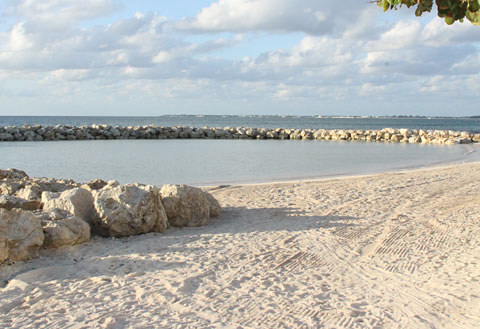
given Treasure Island a brand new lagoon.
The $500,000 project began in May,
said Jim Grainger, board president of the Treasure Island Condos strata. In
fact, he said, the idea to build the beach has been around for decades and the
project in part stabilised previous work at the site.
“This is a project that we’ve been
waiting on for 29 years. It was the original developer’s dream to create a cove
and have a sandy beach where children and families could enjoy. The owners are
excited that it’s finally done,” he said.
The shoreline has been completely
reconstructed and two groynes also constructed in order to create the sheltered
lagoon, which updated upon the plans submitted by the original developer –
which were never realised due to a lack of funds. The beach was designed by
engineer Robert Sorenson and implemented by West Indian Marine, added Mr.
Grainger.
“It took 50 truckloads of sand, which
I believe is 100 tons. There were 1,450 boulders representing 2,900 tons
altogether. It’s great that the Department of the Environment understood the
[eroded] state of the iron shores due to northwest winds and occasional
hurricanes. We had to do something or we would lose all the ironshore
entirely,” he said.
Mr. Grainger said that in addition
to protecting the underlying ironshore, the new lagoon would be of benefit to
owners and guests from a tourism standpoint, and because it is relatively
shallow, it will provide a safe snorkelling experience for children.
Project manager Dale Reichley said
that all the workers were Caymanian and the raw materials were also locally
sourced.
“We dedicate this beach to Cayman
because it’s their beach and they let us use it,” he said.
Coral recruitment
Timothy Austin, assistant director
of research and assessment at the Cayman Islands Department of Environment,
said the project had been discussed for years.
“Treasure Island have been in touch
with us for a long time for advice in how to stabilise their beach situation.
Until recently, we’d had a lot of talks, but nothing had really come of it.
There was a concerted effort around two years ago, and we’ve been working with
them to give them advice ever since. As this required a coastal works
application, we advised them on that process and looking out for the environmental
concerns.
“[We had to make sure that there
was no] impact on the coral reefs from putting a physical structure like this.
One of our biggest concerns was the interruption of the transport of sediment
up and down the beach,” he said, explaining that perpendicular groynes would
disrupt this process but the circular design did not.
The department noted that the
original groynes had been there for three decades and observational data
suggested that this natural movement had not been affected by the structure
that existed.
“As a lagoon, the water is open to
the sea, so we expect fish and so on growing in there. It’s natural limestone
rock, so an ideal habitat for coral recruitment, and there are all the natural
holes created by the rocks where I’m sure we’ll get a lot of wildlife,” said
Mr. Austin.
Related Videos









I used to live at TI and a lot of the original beach seemed to have been washed into the sea, smothering the coral in and just outside the old lagoon.
Let’s hope this one works a bit better.