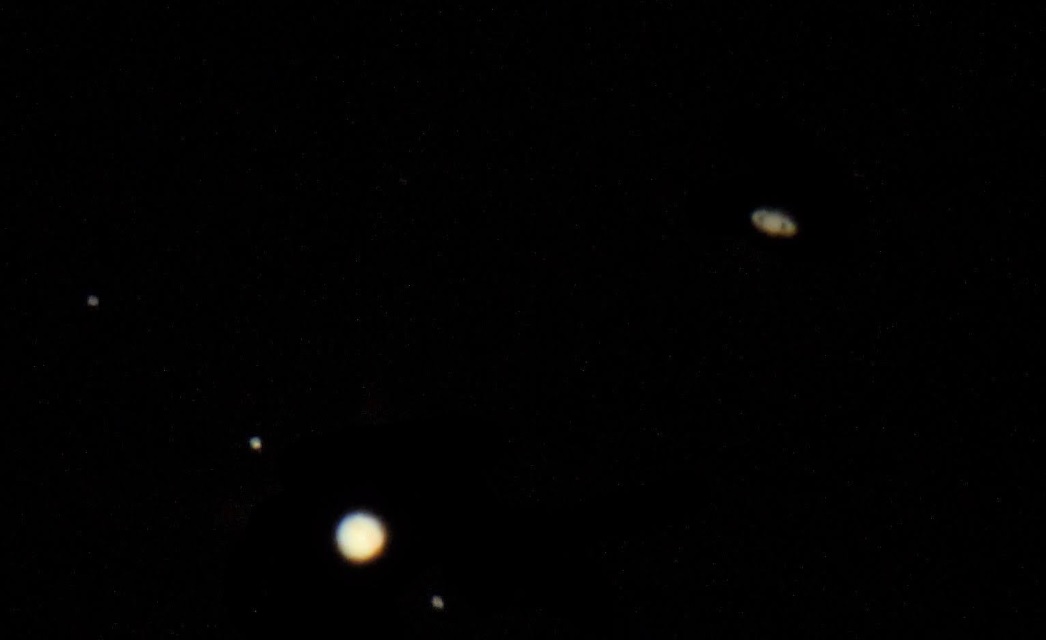
Eyes were aimed skyward in the early hours of Monday evening as the ‘Great Conjunction’ of Jupiter and Saturn, also known as the ‘Christmas Star’, came into view.
Throughout the evening, many skygazers, from toddlers to grandfathers, converged on Pedro St. James, where the Cayman Islands Astronomical Society had set up at least seven telescopes to enable people to watch the once-in-several-lifetimes’ experience.
Long lines formed behind the scopes as the skies darkened and people took their turns to peer into the viewfinders to see the two planets, which came closer to each other – a tenth of a degree apart – on Monday than they had for nearly 400 years. However, the last time the planets could be viewed this close together at night was nearly 800 years ago.
The next time the two giant planets will be this close again will be 15 March 2080.
The Great Conjunction, coincidentally, occurred on the winter solstice, the longest night of the year.
Many families and groups of friends brought blankets and sat on the grass to enjoy the clear night sky at Pedro. Some brought their own personal telescopes or binoculars to view the conjunction.
The Outpost Bar at Pedro opened for the spectacular celestial sight, so people could grab some food and beverages after getting a look at the rings of Saturn and the moons of Jupiter, which were clearly visible through the lenses of the powerful telescopes.
Tiyen Miller, of the Cayman Islands Astronomical Society, said he was glad so many people had an opportunity to view the planets. “It was a wonderful event and it was really nice to see people being very respectful to each other and appreciating the natural beauty of the skies together. … It was especially nice to see so many children and also people from the older generations.”
He added, “We made sure to try to accommodate everyone, having at least one telescope set up to be accessible to wheelchair users and small children.”
For those who missed Monday’s event, the planets will continue to be close together for a little while longer and will be easily visible just after sunset in the west, but Miller said, “Both of the planets are tending closer and closer to where we see the sun, so they will be lost in the glow of the sunset in the weeks to come.”
While these two planets appear to be almost next to each other from the perspective of those on Earth, it is an optical effect, as Jupiter and Saturn are hundreds of millions of miles apart.
Several conjunctions of planets will occur next year, though none will be as close together as Jupiter and Saturn were this week. These include conjunctions of Mercury and Saturn on 9 Jan.; Jupiter and Mercury on 11 Jan.; Mars and Uranus on 21 Jan.; Jupiter and Mercury on 5 March; Mercury and Neptune on 29 March; Venus and Mercury on 29 May; Venus and Mars on 13 July; and Venus and Mercury on 29 Dec.
Related Videos