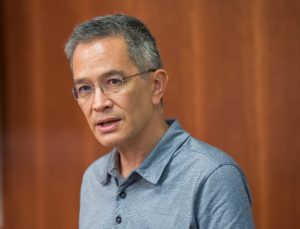
Chief Medical Officer Dr. John Lee has confirmed the new UK COVID-19 variant has been detected in three test samples from the Cayman Islands.
All other variants were ruled out from the samples, Lee said in a statement issued Tuesday morning.
In a brief audio statement, the CMO said, it was “not surprising” that Cayman now has confirmation of the variant in the Cayman Islands.
He stressed that strict protocols are in place to stymie transmission.
“We know it to be virulent and widespread. However, our strict adherence to quarantine protocols is keeping the threat of COVID 19 at bay,” he said.
Last week Lee confirmed to the Cayman Compass that samples were sent to CARPHA (Caribbean Public Health Agency) around two weeks ago for genomic sequencing to determine if the COVID-19 Variant of Concern (UK) – Variant B117 was present.
CARPHA, which is based in Trinidad and Tobago, had assisted Cayman with verifying local PCR test results in the early days of the coronavirus pandemic last year.
According to Tuesday’s statement, the Public Health Department received notice from CARPHA that of a selection of positive COVID-19 samples sent for genomic sequencing, three have come back as the UK variant.
Those three samples were taken from travellers from the United Kingdom and Barbados.
“Of these three people positive for SARS-CoV-2, one traveller group has been discharged from quarantine and the other remains in quarantine,” the statement said.
CARPHA is able to assist with genomic sequencing, at a rate of 10 samples per month, for those cases with high viral loads.
“This new service from CARPHA is much appreciated by the Cayman Islands Ministry of Health, and complements well the PCR testing capabilities at the (Health Services Authority) and Doctors’ Hospital to help monitor and keep our communities free from COVID-19,” Dr. Eryka Simmons, acting medical officer of health, said in the statement.
With this confirmation, Lee reiterated the need for everyone to follow health protocols.
“I strongly encourage everyone dealing with travellers to remain vigilant and adhere to infection prevention and control strategies at all times,” he said in his statement.
The B117 variant was first detected in September last year in the UK and has since been found in more than 50 countries.
The new strain was initially thought to be more infectious.
However, last Friday British Prime Minister Boris Johnson announced that the new variant may now also be more deadly.
“In addition to spreading more quickly, it also now appears that there is some evidence that the new variant – the variant that was first identified in London and the south east – may be associated with a higher degree of mortality,” Johnson said in a statement at a COVID-19 briefing.
Governor Martyn Roper, in a post on his social media pages responding to the announcement, said it is “understandably causing concern in our community”.
However, he said, as Lee indicated, “we have robust quarantine procedures in place to keep COVID at bay.
“These policies are working. Anyone dealing with incoming travellers needs to exercise care, be vigilant and follow our protocols closely. That will enable us to maintain the excellent progress we have made responding to the pandemic,” Roper said in his post.
Trinidad and Tobago’s Health Ministry also confirmed last week that it had detected the variant in recent cases in that country.
In addition to the UK variant of the COVID-19 virus, other variants have been found in South Africa and Brazil.
A BBC report published over the weekend stated that the UK has identified 77 cases of the coronavirus variant first detected in South Africa in cases linked to travellers arriving in the UK, rather than through community transmission.
The South Africa variant has been found in at least 20 other countries.
Scientists have indicated that the current vaccines are effective against the new variants.
US pharmaceutical company Moderna announced that its vaccine appears to work against new, more infectious variants of the pandemic virus found in the UK and South Africa, according to the BBC.
Related Videos