Nearly 80% of baby green sea turtles hatched on beaches on Little Cayman and just over 90% on Grand Cayman are related to turtles from the Cayman Turtle Farm, according to a new study.
Researchers from the University of Barcelona, University of Exeter and the Cayman Islands Department of Environment, in a three-year study of nests of green sea turtles on Grand Cayman and Little Cayman, have confirmed that the farm’s turtle-release programme has been instrumental in rebuilding the turtle population locally.
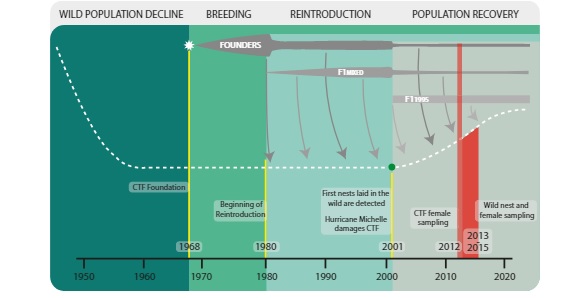
From near extinction in the mid-20th century, the population of adult breeding females in the Cayman Islands has grown back to between 100 and 150, the study found.
Concerns that disease or in-breeding among captive turtles may have impacted the reproductive fitness of the released turtles or their offspring have not materialised, at least not among this first generation of turtles, the researchers found.
The study, led by Marta Pascual and Carlos Carreras, members of the Laboratory of Evolutionary Genetics of the Faculty of Biology and the Biodiversity Research Institute of the University of Barcelona, analysed the impact of the farm’s green turtle reintroduction programme, which began more than 50 years ago.
Many of the captive turtles at the West Bay facility (called the Cayman Turtle Farm at the time of the study and now known as the Cayman Turtle Centre) originated from adult and juvenile samples, and eggs collected from different populations in the Atlantic.
“Therefore, the first breeding individuals of the farm have genetically diverse origins, which is seen in the study,” Carreras stated in an article on the University of Barcelona website.
Pascual, in the article, said it was important “to consider the genetic origins of the samples used for captive breeding in any species in order to avoid associated negative effects. Luckily, these negative phenomena were not seen in the first generations, but we cannot rule out the option of them appearing in upcoming generations.”
The results of the study were published recently in the Nature Communications journal.
Clutches related to Turtle Farm
In their report, the authors stated, “Overall, we found 79.4% of Little Cayman clutches and 90.3% of Grand Cayman clutches were related to the adults in the CTF… These results confirm that the nesting populations of these two islands are mainly the result of an assisted colonisation through individuals from the captive breeding program.”
Another aspect of the study involved looking at the potential impact of climate change, as increased temperatures have been seen to lead to a greater proportion of female hatchlings. In Cayman, however, among wild breeding adult turtles, the researchers said they did not detect female-skewed sex ratios.
While the study found that the turtles released from the farm were not affecting the fitness of the new population, “these results only refer to the first generation of wild hatchlings, due to the long generation time of the species”.
The researchers advised that population fitness analyses “should be repeated in the future to monitor potential drops in fitness due to outbreeding, since their deleterious effects can appear in later generations”.
They added, “Our study sets the baseline to evaluate these components in future generations, but also provides the analytical framework to pursue these type of studies in other endangered species for which ex-situ conservation programs are envisaged.”
While the study shows that the Cayman Turtle Farm’s assisted colonisation programme appears to have been successful so far, the researchers stated that “a careful study of the species and the colonisation area prior to the reintroduction is necessary to ensure the survival of translocated individuals but also to determine the potential impacts that the colonisation may have on the host ecosystem”.
They added, “In the case of the Cayman Islands, this aspect was not considered and individuals from distant populations were incorporated to the breeding stock. The scientific study and ongoing monitoring of conservation actions is just as important as their initial implementation and, in the case of the Cayman Islands, the impact of the captive breeding program on other Caribbean populations should be assessed in the future.”
The authors of the report acknowledged that concerns had been raised over the economic costs and effectiveness of the Cayman Turtle Farm’s reintroduction programme, and its suitability to recover the green turtle population.
‘Fit to survive’
But, they stated, “Despite controversies surrounding the Cayman Turtle Farm outcome, detailed analyses have shown how this attempt started almost 50 years ago was successful in contributing captive-raised individuals to the wild and that the first wild generations are fit to survive in their natural habitat.”
They added, “We show how the study of the foundation of new populations in vertebrates with complex life histories, such as marine turtles, can also provide relevant information on the generations required to establish a genetically differentiated new population or potential alterations of fitness. Assisted colonisation has shown potential in protecting a complex and highly migratory species in response to a critical population decline.”
The study authors, however, noted that “ex-situ strategies” – which involve the transfer of a certain species away from its native habitat – “should not replace, but aid in-situ conservation, and the latter should be considered as a conservation management priority before resorting to complicated, costly and controversial ex-situ conservation strategies”.
The study involved samples collected from 320 nests laid in Grand Cayman and Little Cayman during the 2013, 2014 and 2015 nesting seasons, from May to November. DNA testing was done on one hatchling per nest, and compared to genetic data from a previous study that included genotypes from 57 wild green turtle females nesting on Grand Cayman in 2013 and 2014, as well as 257 females breeding in the Cayman Turtle Farm.
Related Videos