


By Patrick Brendel, Cayman Current

How well did Cayman Islands students perform on their end-of-year exams? Which schools had the highest pass rates – and which had the lowest? How do Cayman’s schools stack up to regional peers in the Caribbean?
The Ministry of Education’s annual Data Report contains the answers to those questions, and many more. Along with budget documents and publications from Office of Education Standards’ school inspectors, the Data Report is a key source of information about the Cayman Islands education system.
In terms of student performance, however, the Data Report contains information only about Cayman’s public schools. The figures for Cayman’s private schools are not publicly available, which collectively serve 45% of the country’s total school-age population of more than 8,500 students.
In the two months since the Data Report for the 2020-2021 academic year was published in April, the Cayman Current produced a series of analyses on the 43-page document.
Here is a summary of our key observations gleaned from the series:
Year 11 exam scores regress to previous levels
After a spike in test scores in 2020, Year 11 exam results for Cayman Islands public secondary school students in 2021 regressed to levels on par with previous years.
In total, 40% of Cayman’s Year 11 students met the ‘national expectation’ on exams, meaning they achieved five or more Level 2 passes – equivalent to grade C or better, including in English and mathematics.
In 2020, test administrators in the UK and Caribbean adjusted their exams in response to the COVID-19 pandemic. The decline in Cayman’s scores in Spring 2021 coincided with the Caribbean Examination Council’s decision to return to its usual practices.
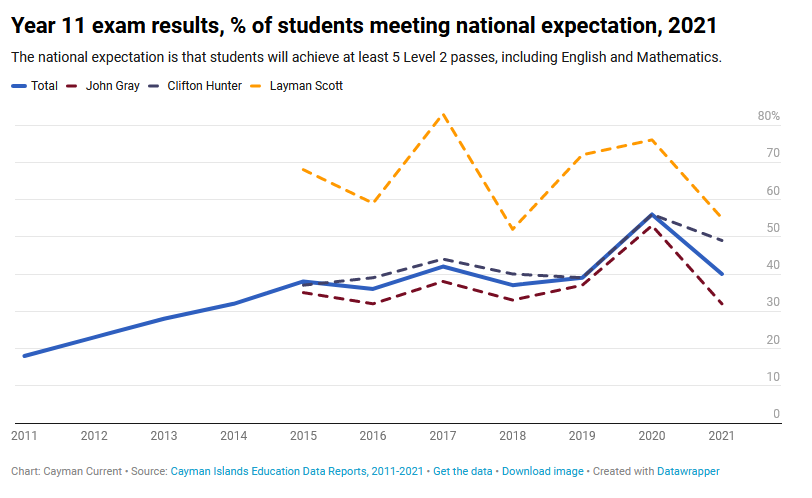
The 40% pass rate dropped sharply from the 56% pass rate in 2020 and is a slight increase from the 39% pass rate in 2019.
However, only one of Cayman’s three public high schools posted better results in 2021 than 2019 – Clifton Hunter High School.
Once again, the top performing school was Layman E. Scott Sr. High School on Cayman Brac, where 55% of Year 11 students met national expectations. However, that was a decline from 76% in 2020 and 72% in 2019.
At Clifton Hunter, 49% of Year 11 students met national expectations in 2021. That was a 10-point improvement over the 39% pass rate in 2019, and a decline of ‘only’ seven points from the 56% mark in 2020.
John Gray High School posted a Year 11 pass rate of 32% in 2021, down from 53% in 2020 and 37% in 2019.
The Spring 2021 exams took place at the conclusion of the 2020-2021 school year, during which time Cayman remained in a ‘COVID-free bubble’ and there were no pandemic-related disruptions to secondary schools, unlike in the current 2021-2022 school year.
Commenting on the release of the 2021 Data Report, Department of Education Services Director Mark Ray said 2021 results should be compared to scores from 2019 rather than 2020.
“In 2021, [the Caribbean Examinations Council] reintroduced the full suite of examinations in line with previous years and for this reason, we believe that the 2021 results are more comparable to those obtained in 2019,” he said.
Girls outperform boys again
According to the Data Report, “girls are outperforming boys in all metrics” in Year 11, including English, maths, science and in terms of meeting the ‘national expectation’ of achieving five or more Level 2 passes (including English and maths) on standardised exams.
However, the ‘achievement gap’ between Year 11 girls and boys in Cayman public schools shrank to its smallest margin on record in 2021.
In the Spring 2021 external exams, 79% of girls passed English, compared to 55% of boys, while 45% of girls passed maths, compared to 42% of boys.
Overall, 43% of girls met the national expectations, compared to 38% of boys.
The five-point achievement gap between girls and boys is the smallest on record since data became available in 2016. The closing of the gap can be attributed to boys improving their scores in maths while girls’ scores in maths have declined or stagnated.
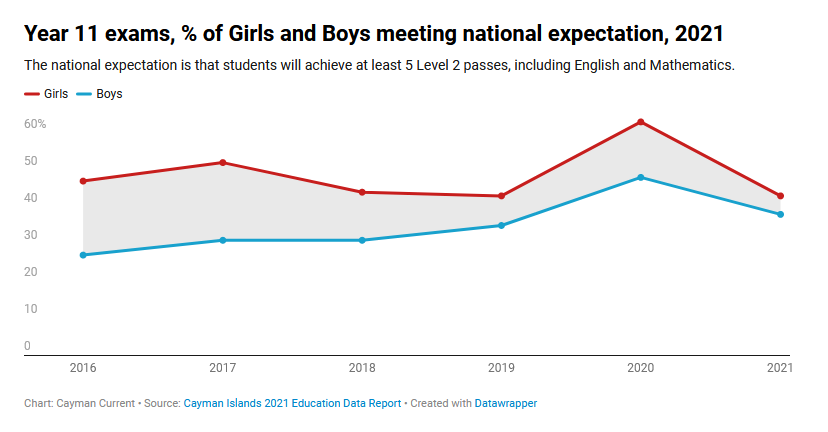
Since 2016, the boys’ pass rate in maths has increased from 33% to 42%. Meanwhile, the girls’ pass rate in maths declined from 48% to 45%.
Poor maths results hold scores down
Relatively poor performance on Year 11 maths exams is the primary reason why most Cayman public high school graduates fail to meet the ‘national expected standard’.
Since 2015, the overall pass rate for Year 11 public school students has ranged between 36% and 42%. In 2021, the overall pass rate was 40%.
Similarly, during that time, the pass rate for maths has ranged from 40% to 47% (including 43% in 2021).
Meanwhile, the pass rate in English is much higher, ranging from 59% to 75% (including 67% in 2021).
Put another way, many more students pass English than maths – and those students who do pass maths are extremely likely to meet the national standard.
The number of students who meet the “national expectation is closely aligned with … achievement in mathematics”, according to the Data Report.
Clifton Hunter significantly outperformed John Gray
Following a period of two years where John Gray had nearly closed the gap in test scores, Clifton Hunter posted an overall pass rate that was 17 percentage points greater than John Gray, the largest margin since records became available in 2015.
Overall, 49% of Clifton Hunter students achieved the ‘national expected standard’ compared to 32% of John Gray students, a difference of 17 percentage points.
In 2019 and 2020, the overall pass rate between Clifton Hunter and John Gray differed by only 2 or 3 percentage points.
From 2015-2020, Clifton Hunter has had a greater pass rate than John Gray each year, with the margin ranging from 2 to 7 percentage points.
Layman E. Scott continues to have a significantly higher Year 11 pass rate than either public secondary school on Grand Cayman. From 2015-2020, the overall pass rate at Layman Scott was between 12-39 percentage points greater than Clifton Hunter.
In 2021, however, Clifton Hunter closed the overall gap to 6 percentage points. The gap between Layman Scott and Clifton Hunter in maths – which is the primary factor for students in Cayman to achieve the national standard – was only 3 percentage points.
Cayman on par with Caribbean
Cayman’s Year 11 public school students scored higher than the regional average on CSECs in maths but lower than the regional average in English.
Typically, CSEC scores are released in the fall after the spring exams are taken. However, 2021 scores were delayed due to COVID, so the Data Report provided the first opportunity to examine Cayman’s scores in the context of Caribbean peers and compare them to prior years.
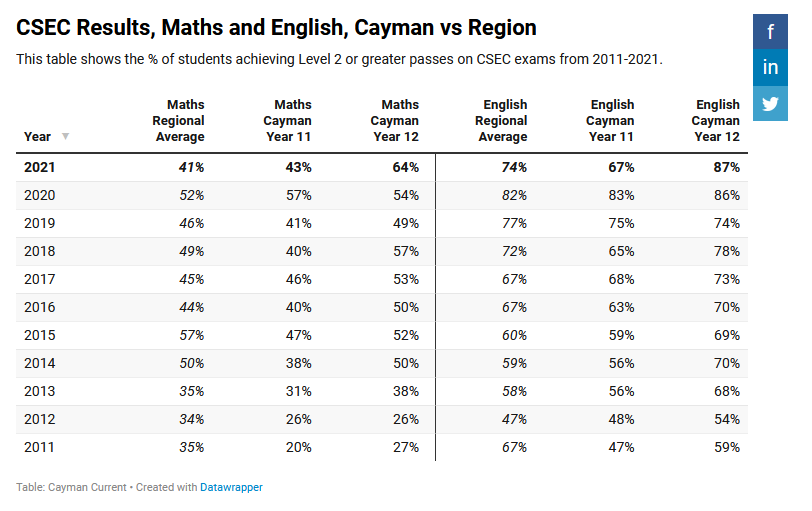
For the third time in 11 years, Cayman’s Year 11 students beat the regional average in maths. For the eighth time in 11 years, they scored lower than the regional average in English.
In Cayman, 43% of students passed maths compared to 41% regionally. Meanwhile, 67% of Cayman students passed English compared to 74% regionally.
Cayman’s results improve significantly when Year 12 examinations, which allow for retakes of key subjects at the Cayman Islands Further Education Centre, are considered.
Related Videos













In the 25 years I have been reading this paper on all kinds of topics this is the most depressing upsetting article I ever read. It seems like the kids on Cayman are not getting a good education and almost half or more fall below what it called the “national average”. I assume this means that most of the kids do not go to collage and therefore can not get advanced jobs. More money should be put into education these children from early ages
Bruce is completely correct. Take the budget used to employ people now unnecessary at Travel Cayman and use it to improve teaching standards.
It’s probably more complicated, because clearly all students are different and not every one may be able to achieve great hights, no matter the expenditure. In fact the expenditure goes up while the results are falling down everywhere in the world, so that’s a paradox that is yet to find a solution.