According to Cayman’s official statistics, there have been about 30,000 cases of COVID-19 locally.
But when you factor in undetected asymptomatic infections and the growing number of people who don’t report their COVID status, the actual figure is likely far higher. In fact, public health chiefs acknowledge they are no longer trying to keep count.
Every day there are fewer and fewer left who are yet to be infected.
The shrinking membership of the “no-corona club” includes people who have been vaccinated and boosted and those who have developed an obsessive-compulsive approach to hygiene.
But it also features some who haven’t been jabbed at all, workers who have been exposed day-after-day for almost three years and carefree socialites who have continued to party like it’s 1999.
As a dentist, Dr. Jennifer Mountjoy has come as close to the front lines as it gets, but she has remained virus-free. So have Tracey Ebanks-Gordon, who works at the Foster’s deli counter, and hair stylist Paige Gallagher.
Is it vaccines, genetics, luck, or is there something else that connects them all?
Important area of research
Scientists are beginning to explore this subset of ‘super dodgers’ as a possible clue to unlocking some of the remaining mysteries of the pandemic.
Dr. Amesh Adalja, at the Center for Health Security at Johns Hopkins University in Baltimore – one of the leading global authorities on the pandemic – told the Compass that studying people who, like Mountjoy, Ebanks-Gordon and Gallagher, have stayed COVID-free, could provide valuable information.
“It’s an important avenue to research, especially as there may be ways to use the underlying explanation of their fortune to develop new medical countermeasures,” he said.
Right now, exposure to earlier coronaviruses or “idiosyncrasies in the immune system” is the simplest explanation, though the science is in its early stages, Adalja said.
What is certain is that the official figures, in every country, are a massive undercount. The UK data records 23.5 million cases – less than half the population. Yet preliminary genetic studies detected evidence of infection in 75% of those tested.
Cayman’s health chiefs have stopped publishing a running ticker of weekly figures because they accept their statistics are no longer likely to be accurate.
Andrew Vincent, a director of Integra Healthcare on West Bay Road, which carries out ‘immunity testing’ for patients, said the numbers are increasing of those showing antibodies that are produced as a result of having a COVID-19 infection.
“Within these, there are patients saying they never knew they had COVID, and some who had COVID whilst travelling, so it doesn’t figure in our Cayman Islands data,” Vincent said.
Perhaps the best evidence we have is anecdotal.
At the clinic, he said, “we escaped the first waves of COVID with virtually no COVID infections in staff but more recently, like many organisations we speak to as well, it has been more like ‘whack-a-mole’ and just a matter of who is off next. Between our own immunity testing and regular LFT testing, we know that more than half our staff have had COVID. That creates a massive challenge for any organisation trying to run smoothly.”
Vincent fears waning immunity and the increase in new variants in Cayman as travel increases could lead to a fresh surge this winter, a common concern arising across the globe.
He said the current infection rate was likely far higher than official figures indicate, something few now disagree with based on real-life experiences.
The super-resistors
At the Foster’s deli counter, Tracy Ebanks-Gordon patrols the aisles of the busy airport store. As a Muslim, who wears a hijab and burka, she is used to covering up – a behaviour that she believes may have protected her and her family.
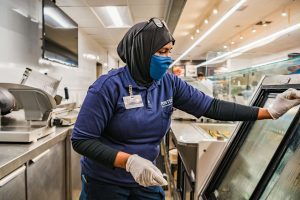
Having worked on the shop floor at both the Savannah and George Town supermarkets over the past two years and with seven children, aged between 12 and 23, she has likely been a primary contact of almost everyone on the island at some point.
And while colleagues, school friends, even the woman with whom she shared a ride to work, have all contracted the virus, she and her entire family have stayed healthy.
“I guess we have been lucky,” she says, the trace of a question-mark in her tone.
Is it nature or nurture that has kept nine members of the same family COVID-free?
“Well, I haven’t missed a single day of work in 12 years at Foster’s,” she says.
“I don’t get the cold, I don’t get the flu and I haven’t had the virus.”
Whenever a colleague or friend comes down with COVID, she says, she takes a test and then “I wash my hands and get back to work.”
Don’t stop the boogie
Paige Gallagher is similarly puzzled by her ability, thus far, to steer clear of infection.
When the island started to open up for business after the “Stay home Cayman” period in 2020, she donned a visor and mask and got back to work. As a hair stylist, she comes into close physical contact with her clients and would be considered relatively high-risk, despite being vaccinated and boosted.
As the fear of COVID has reduced, she’s dropped the mask and has taken full advantage of the revived opportunity to travel and socialise.
“I don’t know how I managed to avoid it,” she said.
“I’ve been to ‘Boogie Nights’ so many times sweating on the dance floor with everybody. I’ve been to see bands. I have been to Europe. I was even at that big event for the hospice where everyone got it.”
She has friends who have “never left the house” and yet still caught COVID.
“I am a social person; I am always hugging up on somebody. I am really surprised I didn’t get it,” she added.
Gallagher is not worried about getting the virus at this point. She recognises the damage it has done globally but is keen to ‘get on with life’.
For others, the explanations are more obvious.
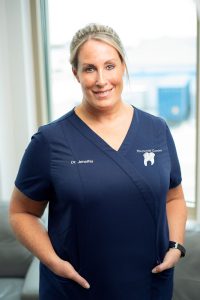
As a dentist, Dr. Jennifer Mountjoy was determined to protect her most vulnerable patients and prevent her and her colleagues from becoming vectors for the infection.
Examining people’s mouths all day every day, there was an obvious risk that they would catch, carry and spread the virus. So the Dental Centre, on West Bay Road, invested heavily in creating as safe an environment as possible.
The surgery put in place hi-tech preventative measures, including a medical grade air-filtration system.
A professional obsession with hygiene has helped keep the surgery virus-free. Even now staff wear personal protective equipment and P100 masks.
“We did a lot of research when we reopened the clinic after being shut down for three months,” she said.
“The good thing about working in a dental surgery is you already have good infection control because you are dealing with bodily fluids non-stop.”
Hidden cases
The lingering question for anyone who can count themselves one of the super-dodgers is ‘How do you know?’
And it’s true that anyone could have had an asymptomatic infection at some point.
But the three women featured in this article have also been tested multiple times for their jobs.
Does this make them and other super-resistors special or genetically ‘fit’?
Probably not, says Dr. Frank Koentgen, the Enterprise City-based scientist who helped develop Doctors Hospital’s testing regime.
“Science is statistically simple in that there is always some individuals in a diverse genetic population that will be less prone to any given viral infection,” he added.
Integra Healthcare’s data may also provide some clues as to why some people are seemingly able to evade variants of the virus while others seem to catch them all.
Professor Andrew Shaw, CEO and chief scientist of Attomarker Ltd, which designed the COVID-19 Antibody Immunity Test, said the results, both in Cayman and the UK, showed that some patients respond better to vaccines than others.
So, the same jab might provide stronger, longer lasting immunity to some than others. Additionally, different variants are clearly requiring different levels of antibodies to ensure reasonable protection from infection.
While there is intriguing research potential into super resistors, he believes better-targeted vaccines, hygiene, social distancing and masks remain the most reliable methods of avoiding infection and serious illness.
“Everything else strikes me as more risky,” he said.
Related Videos