


Industry and government representatives have once again put the spotlight on the lack of options for air travel within the Caribbean region.
Air travel in the Caribbean in terms of passenger numbers is at 81% of the pre-pandemic volume. This performance is better than the global figure, which stands at 74.3% of the pre-crisis level.
But intra-Caribbean travel is still trailing 2019 activity significantly – down 21% for available routes and down 40% in flight frequencies, according to International Air Transport Association (IATA) statistics.
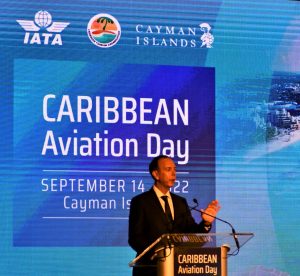
Peter Cerda, regional vice president of IATA in the Americas, criticised the missing connectivity at IATA’s Caribbean Aviation conference in the Cayman Islands.
Cerda said it was “worrying” that in many cases regional travellers have to fly via Miami or Panama City to reach other destinations in the Caribbean.
Even though the intra-Caribbean market does not have the size of other regional markets in the world, he said, it does need to be served not only for the good of local residents and businesses but also to facilitate multi-destination tourism.
Cerda argued multi-destination tourism and the ability to offer a range of experiences was becoming even more important in the current inflationary environment that will have an adverse impact on disposable incomes in North America and Europe.
“The industry is not looking for handouts. The industry understands that we have to pay for those services. We understand that the provision of adequate infrastructure for aviation comes at a cost.”
But very often it was difficult to see a correlation between the level of cost and charges of the actual service provided.
Caribbean’s high taxes, fees and charges
Globally, charges average about 15% of the ticket price; in the Caribbean it is 30% and, in some markets, taxes, fees and charges make up half of the ticket price.
Quoting ticket prices from London or Miami, he pointed out that air fares to the Caribbean were higher than to Dubai or Cancun.
“Caribbean destinations are running the risk of pricing themselves out of the global travel market,” Cerda said.
At the same time the Caribbean is more reliant on international spending than any other region.
Before the pandemic in 2019, tourism represented 13.9% of GDP and 15.2% of all jobs in the region.
Last year this had dropped to 9.1% of GDP and 13.4% of jobs according to data from the World Travel and Tourism Council (WTTC).
$100 billion industry by 2032
Julia Simpson, president and CEO of the WTTC said in a message to delegates that her organisation estimates Caribbean tourism could grow 6.7% each year over the next decade, far outpacing GDP growth.
This would turn regional tourism into a $100 billion industry by 2032.
That would require investments into infrastructure, in addition to lower taxes which would create more business and induce investments, she said. “We know that this stimulates customer demand while making it more viable for airlines to operate.”
Simpson cited Antigua and Barbuda’s 50% reduction in government taxes for flights to certain Caribbean community countries as a positive example.
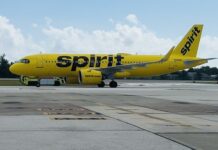
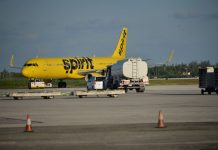
Matthew Klein, EVP and chief commercial officer of Spirit Airlines, a budget carrier, said many governments in the region were “making it difficult for us to grow in the way that we feel we could grow and bring more economic development and tourism to your destinations.”
“At Spirit Airlines our ability to grow revolves around being able to make money and being profitable,” he said. “We have 33 airplanes coming next year and I’d love to deploy more of them into the Caribbean.”
He said Puerto Rico is, for his airlines, a much larger market than before COVID and one reason is that the US territory has low taxes of $60 per roundtrip.
Lower taxes in central America and South America had also translated into more flights by the airline there. There were examples like Costa Rica, where fees came down and load factors went up, he said.
Klein said he believes the pie can grow for everyone.
“Airlines out of the United States will do more, if there is more money and profits to be made.”
Even though there were some opportunities in intra-regional travel, high fees and not knowing the exact size of market were the main challenge for his airline.
Competing for customers
Felipe Bonifatti, Lufthansa Group’s director general in South America and the Caribbean, said higher fees can make a difference for travellers from Europe. For a legacy long-haul carrier from Europe, passengers have many other options outside of the Caribbean at a similar travel distance around the Indian Ocean, from Zanzibar to Thailand.
“If airlines think about expanding into niche markets, there are so many regions in the world that are fighting for the very same profile of customer,” he said.
Aside from cost, reducing complexity was another factor, he said, with some countries in the Caribbean region having as many as ten different tax codes for each air fare.
From an operational standpoint, Bonifatti said, growth in the region faces problems caused by insufficient connectivity. If there is a problem with a grounded plane, for example, there is no easy way, nor sufficient connectivity to send 200 or 300 passengers to the next islands through partners, so that they can take another plane home.
Related Videos











If Cayman Airways operated a route to an Eastern Caribbean hub like St Martin or Puerto Rico, that would be used by those who frequently travel between Cayman and the BVI on business -cutting travel time in half. It would open up the Eastern Caribbean as either a vacation option to those living in Cayman or nationals of those islands returning home. Flights on Thursdays and Mondays would be optimal. The business travellers can go out on Mondays back on Thursdays, and those who just want a long weekend mini-break to experience another Caribbean Island (St Barts for example) could leave on Thursdays and back on Mondays. Not everyone wants to (or can) travel through the USA to reach other Caribbean destinations. Connecting Cayman directly by air with the Eastern Caribbean would support regional tourism!
High prices, by definition, dissuade customers. Cayman has a unique and uniquely desirable tourism product. If even to get recovery kick started, considering lower fees for bringing in tourists, even temporarily, should be on the table. Being frank, Spirit airline and its passengers, who are always looking to save literally a nickel or a dime but are nickeled and dimed relentlessly in return, might not be the airline Cayman Tourism would want to call the shots on this subject. A thoughtful comprehensive [e.g. longer runways, infrastructure improvements, etc] approach will go a long way to brining back this sector of the economy.
What happened to LIAT? If all of the island’s governments subsidized the now bankrupt regional airline there would be an inter island carrier. Give a little, get a little.
I agree. It is the long-term best interests of all islands to support intra-Caribbean air travel. This would encourage longer stays in the region by tourists with money to spend. It would also open up economic development and potentially lead to stronger Caribbean economic partnerships.