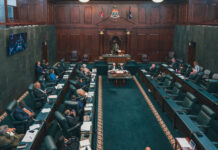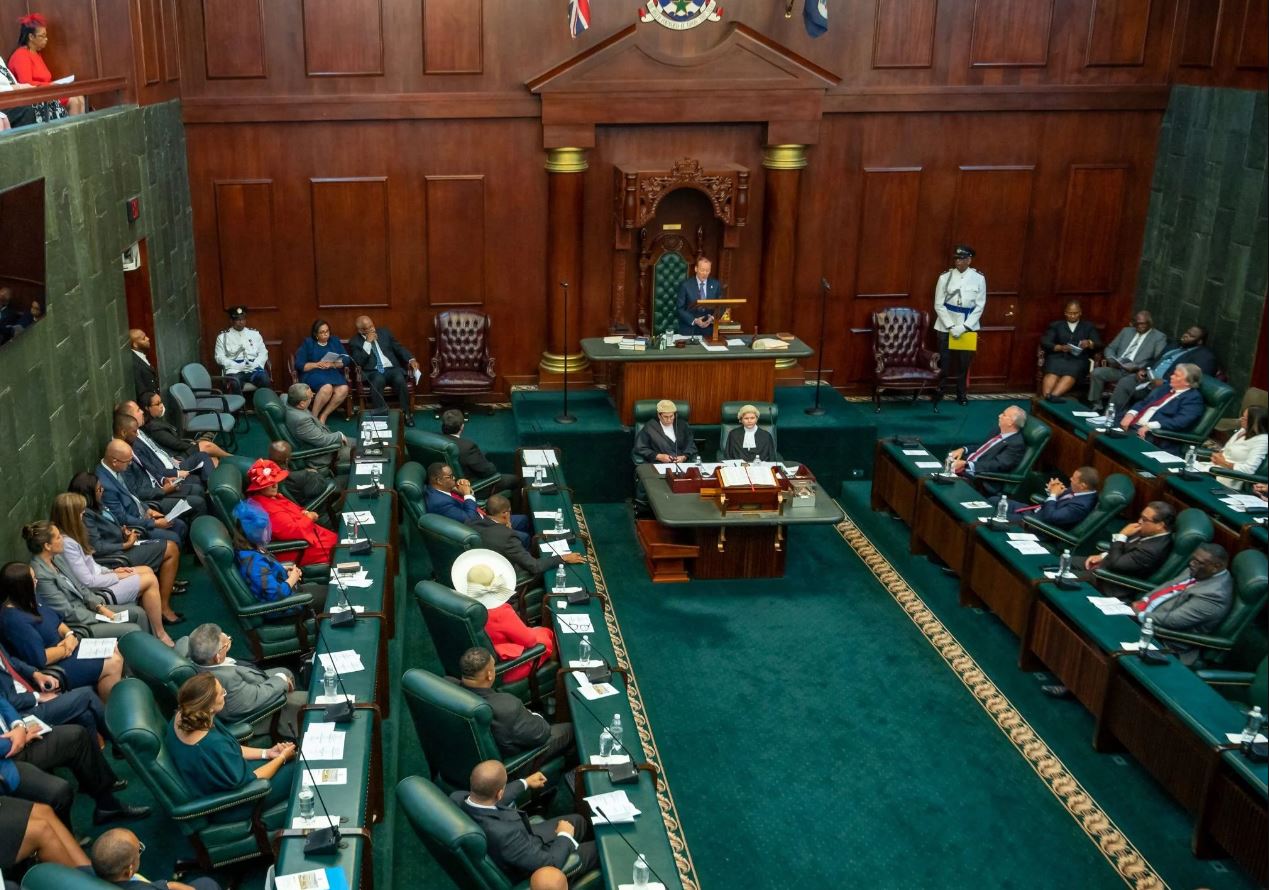
Neither of two versions of Cayman’s first parliamentary code of conduct, presented to the House by then-Speaker McKeeva Bush, on 7 Oct., have yet been signed off by lawmakers.
Premier Wayne Panton, in response to queries from the Cayman Compass Friday, 14 Oct., on the two codes, said the only code of record for consideration would be the one he circulated.
“Any other draft code which may have been tabled by the former Speaker at the start of Parliament was never accepted and circulated on behalf of the Parliament Management Council,” he explained.
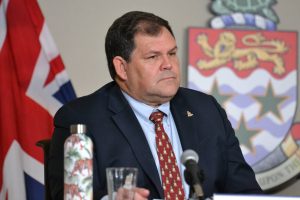
The code, though laid before the House, was not voted on nor was it approved.
As for adopting the code, Panton reiterated his position that the “preferred approach” is for all MPs to sign the code and “thereafter it would be tabled in Parliament and voted on”.
“That last action would formally adopt it as binding on all future Members of Parliament,” he said.
However, Opposition Leader Roy McTaggart maintained his objection to the two drafts, one by now-former House Speaker McKeeva Bush and the other by Panton.
Speaking with the Cayman Compass last week, McTaggart stressed the need “for a fully independent body such as the Commission for Standards in Public Life being responsible for investigating allegations and determining appropriate disciplinary measures if warranted”.
However, Panton, in response to McTaggart’s position, said he was not aware of the Opposition’s suggestion.
“I am satisfied that does not have to be in the Code of Conduct. A mechanism such as this needs to be set out in the Parliamentary Standing Orders (which are currently under review) and not in the Code. It also certainly does not need to be a commission. It would more likely be a Disciplinary Committee,” Panton explained.
Copy and paste?
The Code of Conduct tabled in the House on 7 Oct. and issued to the media, included a label that made the document appear to be copied and pasted.
Written into the footer of the document was Cayman Islands Ministerial Code of Conduct version 1 adopted by the Cabinet on 27 July 2021.
That 14-page ministerial code outlined how members of the executive branch should conduct themselves when it comes to ministers’ interests, conflicts of interest, gifts, travel and accommodations, favours and more.
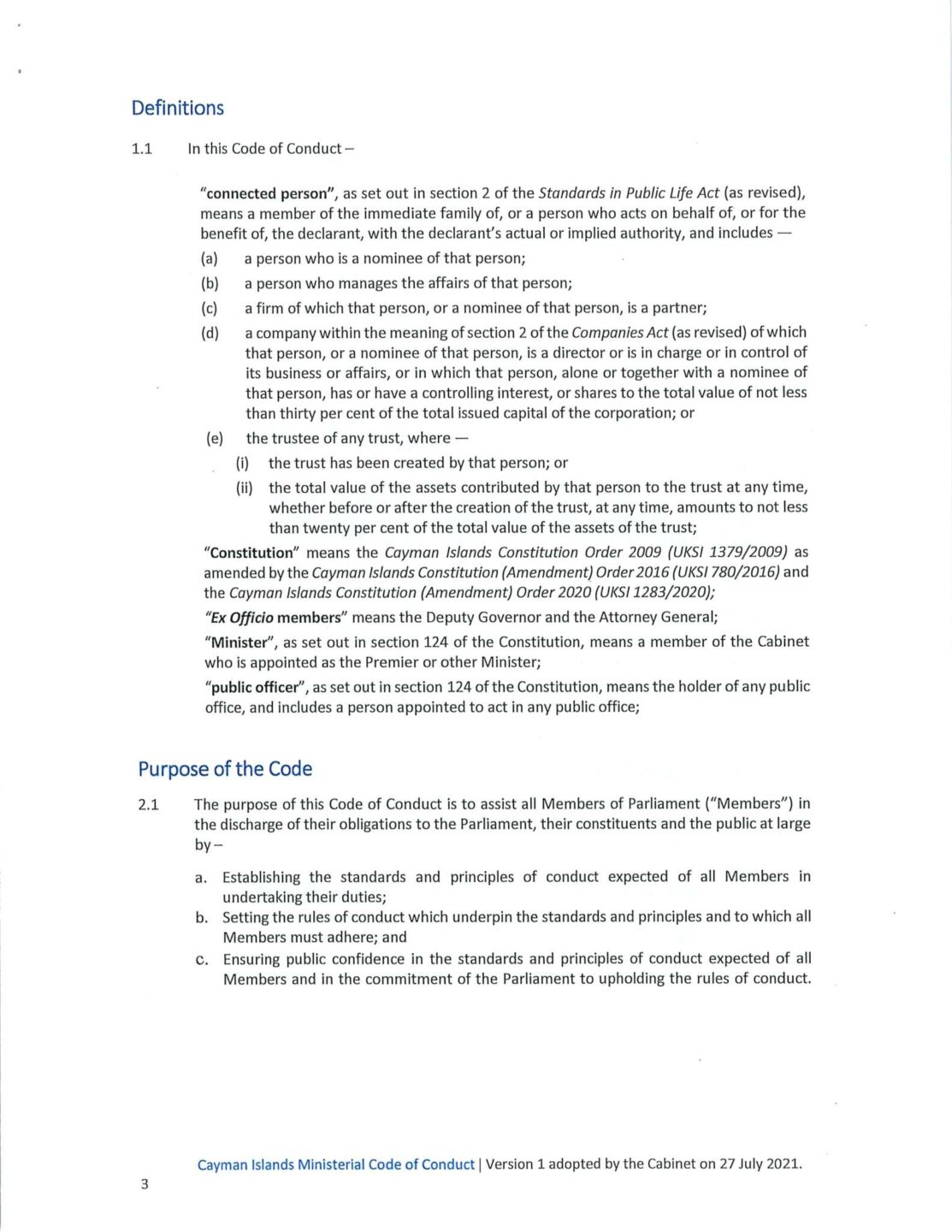
Panton, who was asked about this, defended the document.
“This is not a cut and paste of the Ministerial Code. There are, however, similarities as it is desirable to have consistency where possible and the underlying principles of the Standards in Public Life (Nolan Principles), for example, are certainly equally relevant in either Code,” he said.
He said the draft code of conduct, which had been circulated by the Clerk of Parliament to all Members of Parliament on 18 March “did inadvertently have a minimised footer referring to the Ministerial Code of Conduct”.
However, he said, “That was a result of the template for the Ministerial Code of Conduct being used and populated with the content of the draft Parliamentary Code. Effectively, that reference is irrelevant.”
But, the definition used in the code doesn’t mention members; instead it notes ‘Minister’ “as set out in Section 124 of the Constitution, means a member of Cabinet who is appointed as the Premier or other Minister”.
PACT pledge
Creating a code of conduct for parliamentarians was a pledge of the PACT administration.
The “immediate” implementation of the code for parliamentarians was part of PACT’s deal with Bush to return as Speaker to secure a government, following the April 2021 general election. Bush had been convicted of common assault on a female bar manager in December 2020.
However, Panton acknowledged that “there was an unfortunate period of delay”.
He said, as a result of that delay, “I personally took control of developing the Code and shortly thereafter took the draft to the PMC (Parliament Management Council) from which it was circulated.”
He maintained that the only comments he has “ever received on the draft Code circulated by the Clerk have come from the Government bench”.
Panton said he was not aware of any response or comments from the Opposition.
“I am aware that the Opposition have claimed that they did not receive the draft but I find that difficult to believe given that the email addresses used are the same on which all Members receive communications from Parliament,” he added.
What the code says
As it stands, according to both codes, the application of the provisions falls under the remit of Parliament and any action or investigation falls to existing members.
According to the proposed codes, any allegation against an MP or ex-officio member of the House (the deputy governor or the attorney general) is to be dealt with by a disciplinary committee for the purpose of investigation and reporting to Parliament for action.
Under the premier’s version of the code, the disciplinary committee will comprise three members – one nominated by the Speaker, one by the premier and one by the leader of the Opposition. At least one of the three must be a retired judge or an attorney-at-law who is no longer practising.
However, McTaggart did not accept that MPs should be involved in that process and contended that producing a code has taken far too long.
“It is well past time for the Premier to give this matter the due attention it deserves. I would add that it’s not lost on the public that it has taken so very long for the Premier to do anything about this matter,” he said.
Bush, in presenting the two codes on 7 Oct., clarified that all MPs have had a draft for “a long time now” as he sought to dismiss previous Opposition claims that no code had been completed.
He urged all representatives to work together to produce “a fair and reasonable Code of Conduct that all Members are content with and that the public would believe that we are trying to conduct ourselves according to those rules”.
Bush said the code of conduct is not a partisan issue, but rather for the entire House.
Related Videos