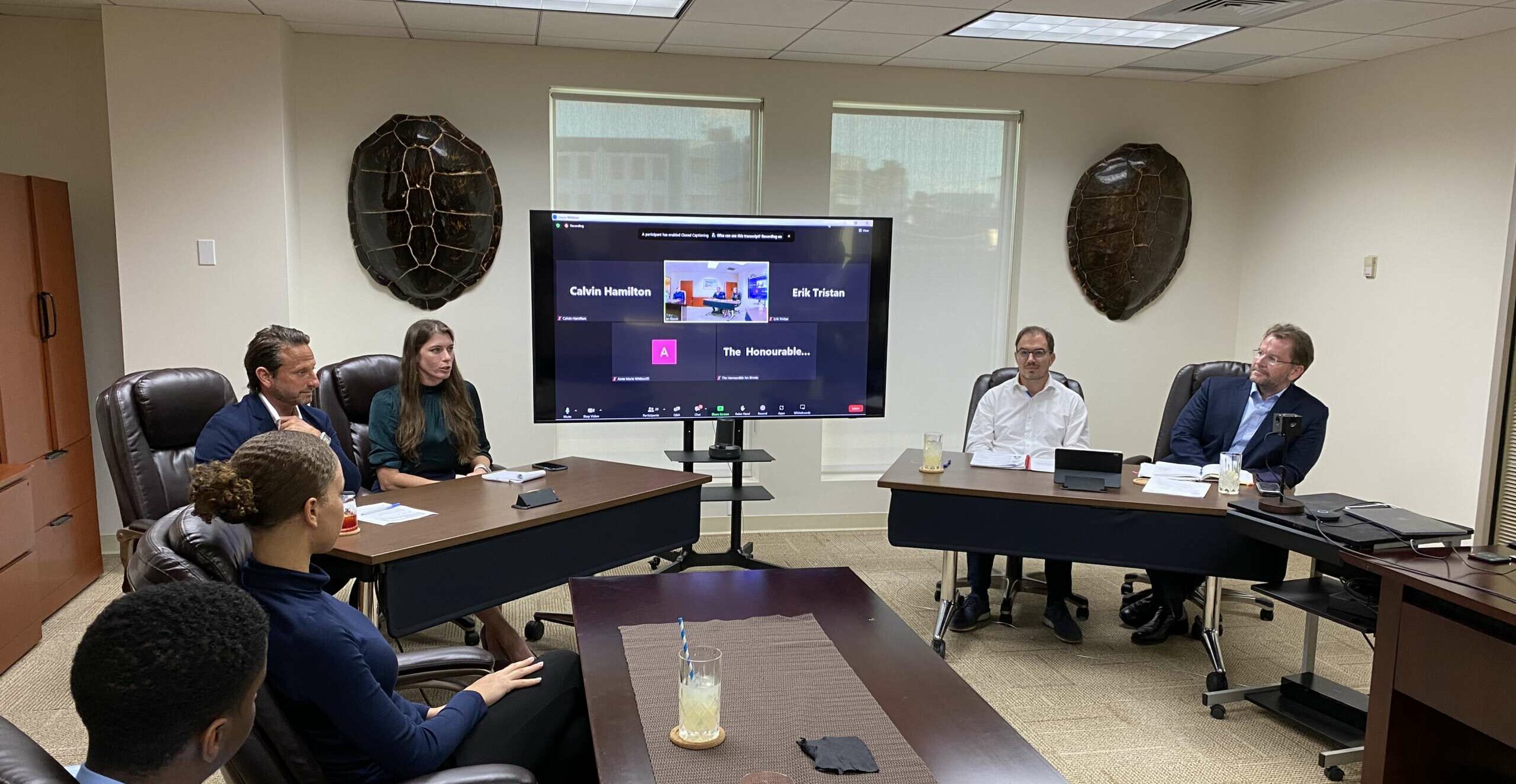
The Cayman International Arbitration and Mediation Centre (CI-MAC) celebrated its launch on 12 Jan. with a panel discussion on the opportunities for arbitration in the Cayman Islands and the importance of regional arbitration centres.
The first arbitration centre in Cayman, located at 90 North Church Street in George Town, was founded by CEO Megan Paget-Brown and her father, local lawyer Ian Paget-Brown. It provides the technological infrastructure, facilities, services and staff to conduct arbitration hearings.
“We hope that by having the centre here we can help raise awareness of arbitration, mediation and other dispute resolution mechanisms in the jurisdiction and also raise awareness for the jurisdiction in the region and internationally as a location for dispute resolution, whether it is in person, hybrid or virtual,” Megan Paget-Brown said.
Generally, arbitration offers a much quicker, less costly and confidential resolution to disputes than the public court process. In contrast to litigation, the parties have a say in selecting the judges, called arbitrators, by, for example, subject matter experience or their country of origin.
There is limited opportunity to appeal an arbitration award ensuring that parties will get a final answer to their dispute. Compared to court judgments, it is also typically much easier have arbitration awards recognised and enforced in foreign courts.
CI-MAC is a joint venture with Canada’s Arbitration Place, a leader in the industry for virtual and hybrid hearings, which provides the technology platform and court reporting, case management, virtual secretary and other services.
Paget-Brown said Cayman is a perfect location for a regional arbitration centre as its arbitration law is relatively modern and has been brought in line with the leading jurisdictions for arbitration, for example by ensuring privacy.
In addition to Cayman’s excellent reputation as a financial centre and its sophisticated judiciary, it has an advantageous geographical location between North and South America and the wider Caribbean, with direct flight connections Europe, the US and Canada, she added.
Paget-Brown expects CI-MAC first to focus on financial services and commercial disputes based on the experience that already exists on island, before widening to disputes from other industries.
The centre will soon publish its rules and a roster of both local and international mediators and arbitrators. The CI-MAC CEO said she expects “a list that everyone will find to be very exciting” with a wealth of international and regional experience.
Shaun Tracey, counsel in Campbells’ Litigation, Insolvency and Restructuring Group, said “it’s a great development to have a facility like CI-MAC locally in Cayman”.
Having once conducted an arbitration in Cayman, Tracey said it was difficult to find a suitable venue at short notice and having to fit it out with all the necessary technology to allow for a hybrid virtual hearing.
And although it all worked out in the end with the help of various service providers, he said, “it was nothing like what I imagine would be the case here, going forward, where you have a ready-made facility” dedicated to arbitration.
Tracey said the local chapter of the Chartered Institute of Arbitrators and now the arbitration centre “are both a reflection and also a part of a trend towards alternative dispute resolution” in what has so far been a litigation-focused jurisdiction.
Quentin Cregan, a partner in Maples and Calder’s Dispute Resolution & Insolvency team, said more clients are asking to include arbitration clauses in agreements or fund documents and there are more Grand Court judgments in relation to arbitration.
Cregan said he believes that having a facility in Cayman like CI-MAC is going to make it much easier to conduct arbitration locally to the point where, once there is a certain familiarisation with the process, “it could become self-fulfilling” with clients more inclined to use alternative dispute resolution.
In larger cross-border disputes, the counterparties and their legal advisors tend to look for a neutral venue for such proceedings and the Cayman centre is ideally placed to fill that gap, he added.
Related Videos