

Negligible renewable energy, lack of recycling facilities and very high carbon dioxide emissions are just some of Cayman’s environmental failures, a report revealed this week.
The Office of the Auditor General – the watchdog of public spending – released a 63-page account on Monday, 20 March, detailing how the government fared against sustainability targets.
It looked at the eight most environmentally focused of the United Nations’ 17 Sustainable Development Goals, which were adopted by member nations in 2015.
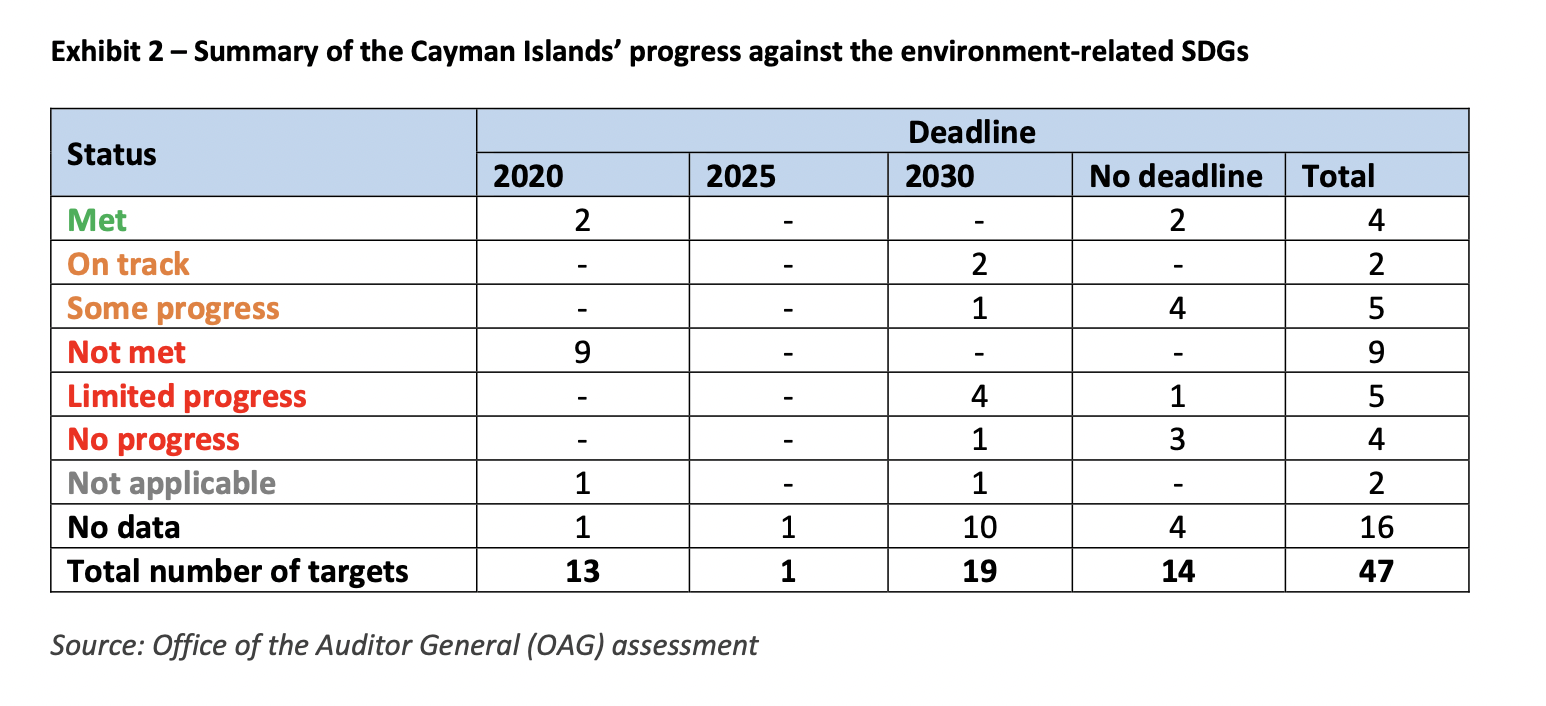
These goals contain 47 specific targets.
During the review, Auditor General Sue Winspear found that locally there was no data to determine if 16 of the targets had been reached, and two were irrelevant to Cayman.
Of the remaining 29 targets, 11 had a deadline of 2020, and only two of those targets had been met up until 2022. The report can be viewed at the website of the auditor general.
3% of energy renewable
Among the most significant issues highlighted in the report was the lack of investment in renewable energy.
Goal seven is to ensure access to affordable, reliable, sustainable and modern energy for all, with a target to increase substantially the share of renewable energy by 2030.
The government’s National Energy Policy 2017-2037 also set a target of 70% of energy to be renewable by 2037.
However, as of February 2023, only 3% of Grand Cayman’s energy was renewable, and there is no publicly available data for the Sister Islands.
“Access to electricity is almost universal, but electricity costs are high, largely due to the reliance on generating electricity from diesel,” Auditor General Sue Winspear said.
“Renewable energy is environmentally-friendly and may be cheaper for residents in the longer term.”
Excessive waste
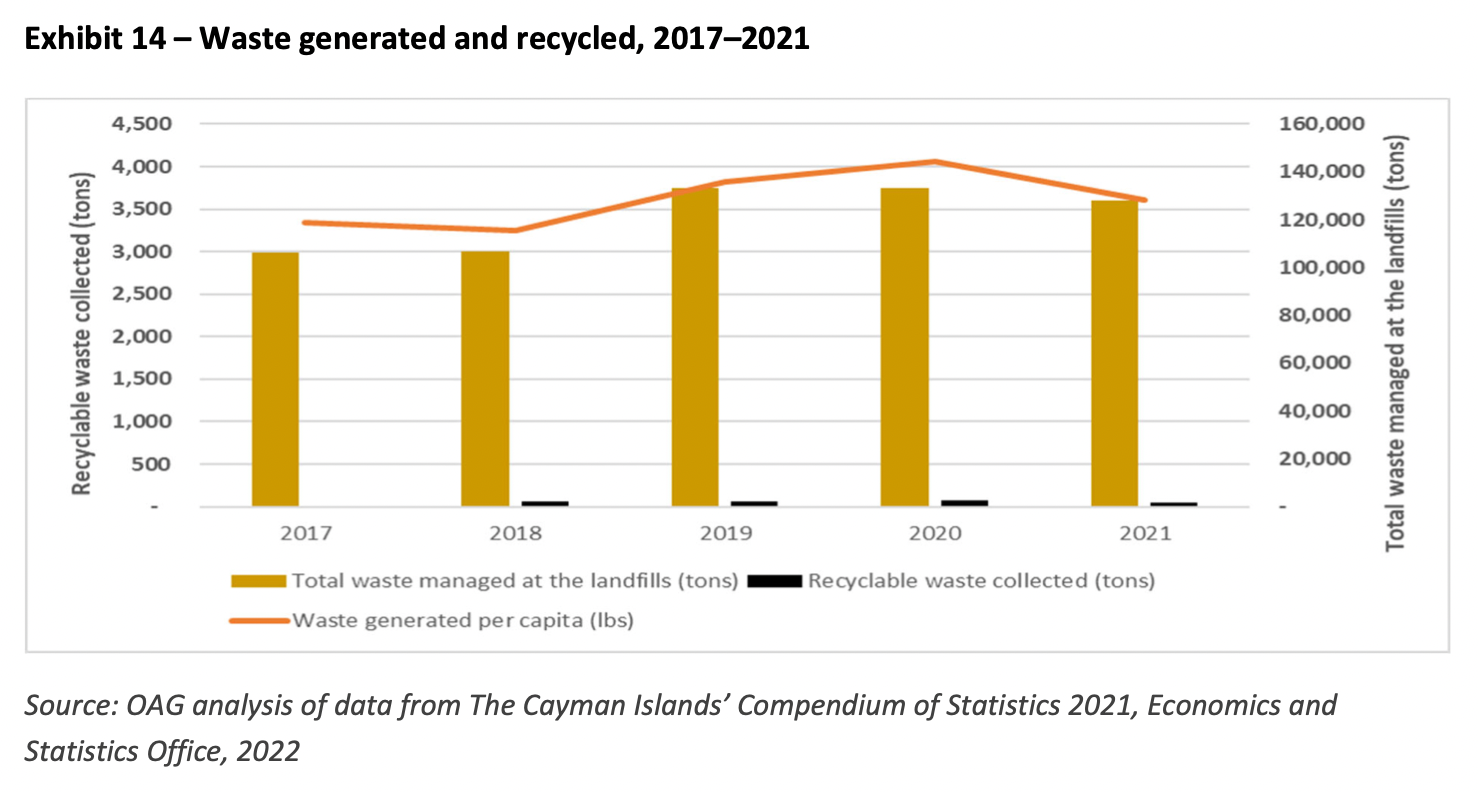
Goal 12 is to ensure sustainable consumption and production patterns; however, waste generated per capita is vastly higher than the global average, and there is limited recycling.
The report revealed that each person generates about 11 pounds of waste daily – more than five times the global average. Less than 3% of waste is recycled.
“The Cayman Islands welcomes significant numbers of tourists relative to its population annually,” the auditor general said, “but we found no correlation between the tourist numbers and the waste generated per capita.”
The government is currently negotiating a public–private partnership for ReGen, the integrated solid waste management system for the George Town landfill.
“I hope the final contract delivers a project that will improve the islands’ waste management and provide value for money,” Winspear said.
High CO2 emissions
Goal 13 is to take urgent action to combat climate change and its impacts, with a target to integrate climate-change measures into national strategies, policies and planning.
Carbon dioxide emissions, at 15 metric tonnes per capita, are more than three times the global average and 68% higher than the government’s 2030 target.

They contribute to global warming, which has key consequences for small islands, like rising sea levels, more intense tropical storms and coastal flooding, the auditor general said.
“I acknowledge that carbon dioxide emissions are high primarily due to the islands’ reliance on diesel for electricity generation and private motor vehicles for transport, but action is needed to reduce these and their impact.”
She noted that the government has recently completed a climate-change risk assessment and is drafting a climate-change policy.
Some success
The “mixed picture” report also highlighted some successes, Winspear said.
She explained that in March 2022, Cabinet approved 865 acres across five locations for formal risk protection.
“These areas are home to mangroves and other threatened habitats and are in addition to the 3,739 acres already protected.”
Also, about 55% of near-shore waters are under some form of area-based management.
Of the 18 future targets set for 2025 and 2030, two have been met, two are on track and some progress has been made with five. There has been limited or no progress with nine.
Winspear encouraged the government to start collecting the data needed to measure progress against all relevant targets.
“We plan to do further performance audits focusing on specific environmental issues in the future. We will use the data in this report as a baseline for those performance audits,” she said.
Government response
Responding to the report, a Ministry of Sustainability and Climate Resiliency spokesperson said it supports the aims, noting, “Independent analysis of public sector efforts play an important role in promoting accountability, transparency and achieving best value for public money.”
Just last week, the ministry announced it had awarded $87,000 to accounting firm PwC to find out which of the UN’s sustainability goals are most relevant to the Cayman Islands.
This project will formalise existing government sustainability initiatives in the context of a globally recognised framework, the spokesperson said.
Related Videos












There should be more solar an CUC being the ONLY electric company should be required to work with any solar company or home owner. There use to be recycling bins at various places around the island. Most are not there anymore. Everyone should be required to separate their recycling
Investing in solar just isn’t worth it under the current scheme. Unless you are staying in your property for 10 years + it’s hard to justify retro fitting an older property.
While I am not a promotor of Climate Change, I do believe that we need to better protect and maintain our islands.
Renewable Energy is great for those who should be able to select those energy sources, and some alternatives provided for the less financial capable. Reducing the use of polluting fuels such as diesel certainly is desirable, and CUC should be supporting the no cost (to CUC) addition of private solar/wind home and commercial energy production. Remember, as the island’s population expands, there will be need for more generation by CUC unless private business and individuals share in adding to the over all production.
Programs to improve the Quality of Life should be spearheaded by Government. Anti-liter, recycling and trash collection programs should be supplemented by greening of the island projects such as maintaining public gardens, water features and others to bring a true paradise look to the three islands. And not just lip service!