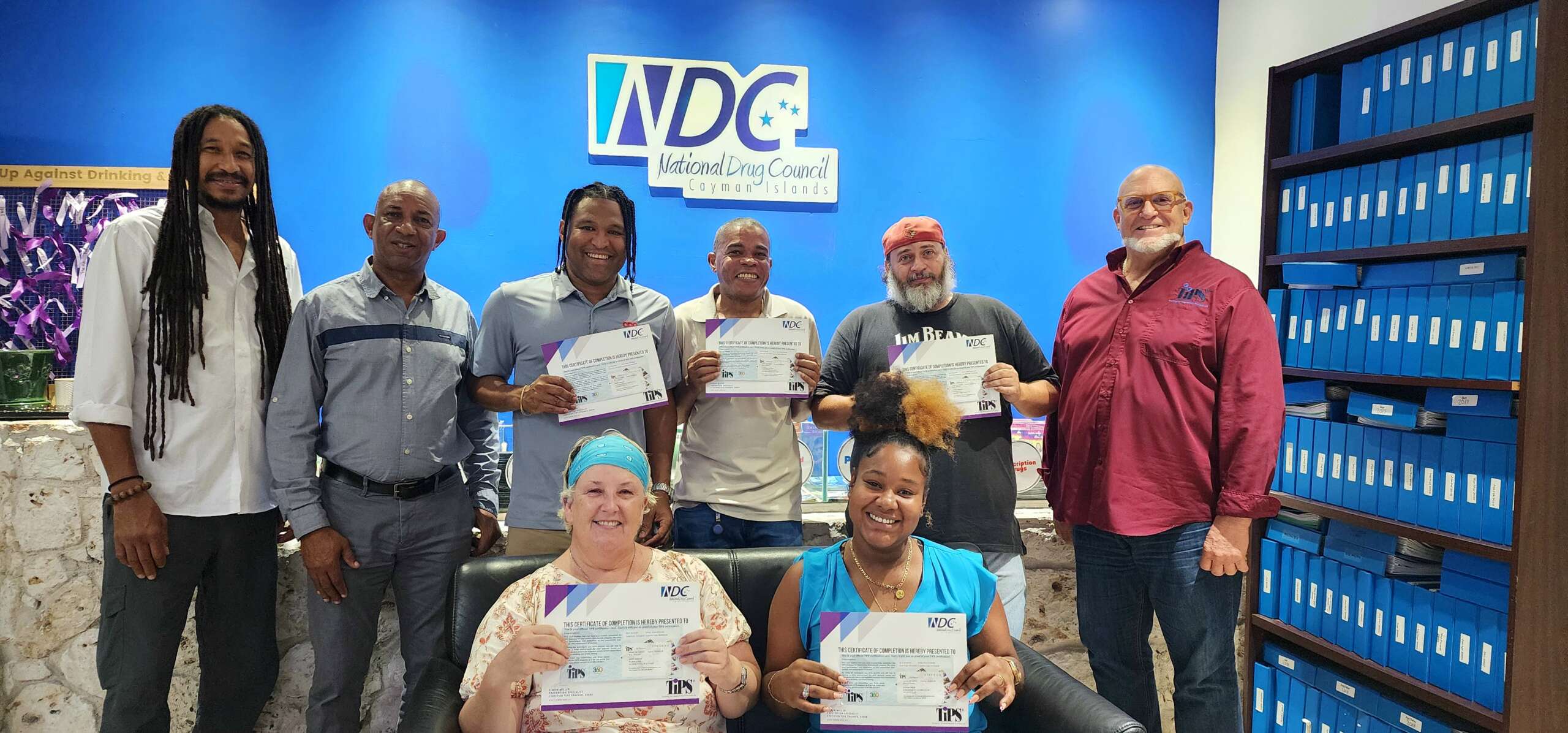
The National Drug Council has reiterated its call to make ‘Training for Intervention Procedures’, or TIPS, mandatory for all hospitality-industry workers serving alcoholic beverages.
TIPS, which is a globally recognised programme, has certified more than 5.5 million servers worldwide, according to its website, and has been offered in Cayman for the past 16 years through the National Drug Council.
“This is a wonderful programme that can truly help to save lives,” the council’s prevention and information officer Ivan McLean told the Cayman Compass. “It teaches servers the warning signs to look out for when deciding whether their customer has had enough, or if they need to space out the drinks, or if they need to engage in conversation to help give that person some extra time to sober up, among several other skills.”
TIPS is provided free to all members of the public, but only on a voluntary basis, which the council’s prevention specialist Simon Miller believes needs to be changed.
“We have said it before, and that is this programme should be mandatory before a person can be hired to serve alcoholic beverages,” said Miller. “The fact is that a significant percentage of our workforce is foreign labour, and this is particularly true in the bars and nightclubs where the servers are, more often than not, on a work permit.”
He added, “There are some people who come to Cayman who are already trained, and so they brush up on their skills and get re-certified. Then there are others who come… and when they realise it is free they quickly jump at the chance to get certified.”
Miller told the Compass that his office has trained hundreds of persons over the years but due to high turnover in the service industry, he continues to witness a revolving door with trained workers departing Cayman and new untrained workers arriving to take up their jobs.
“Imagine how much easier and better it would be if it was mandatory for you to get TIPS trained before you could get a work permit to work as a server in a bar or restaurant,” said Miller. “This way we could ensure that all the servers are properly trained and, in turn, this could go a long way to save lives.”
A review of the past decade’s worth of the Royal Cayman Islands Police Service annual crime and traffic statistical report reveals that between January 2013 and December 2022, 81 people died as a result of injuries sustained in motor vehicle collisions. During that same time, there were 2,419 prosecutions for DUI.
While drink-driving has been an obvious factor in some of the fatal collisions, as a number of coroner’s court hearings have shown over the years, there is no way of knowing the exact number of crashes in which DUIs played a role.

“I’ve heard it said that ‘A car in the hands of an intoxicated driver becomes a deadly weapon’, and it is so true,” said McLean, pointing to the numerous fatal accidents that have been recorded on Cayman’s roads.
Miller pointed to other jurisdictions which require TIPS training or a functioning equivalent as a prerequisite for all alcohol servers.
Australia has made it mandatory for all alcohol servers to be trained through its Responsible Service of Alcohol programme. In the US, there is a mix of mandatory and voluntary training programmes that vary from state to state. In the Caribbean, Barbados has also taken a similar stance, requiring a functioning equivalent to TIPS for all alcohol servers.
While there has been some support for TIPS from local companies and event promoters, the reach of the programme remains limited.
“We have been calling for years for a similar programme to be implemented, but successive governments have yet to introduce it,” Miller said.
He believes that this reach could be expanded if the TIPS certificate was viewed like the mandatory food handler’s course administered by the Department of Environmental Health.
“If this does become a reality, we will at that stage have to consider charging a fee to help offset the expenses of such a large endeavour,” said Miller. “But for now, it’s in the hands of the legislators, but really this is for the greater good.”
Related Videos