

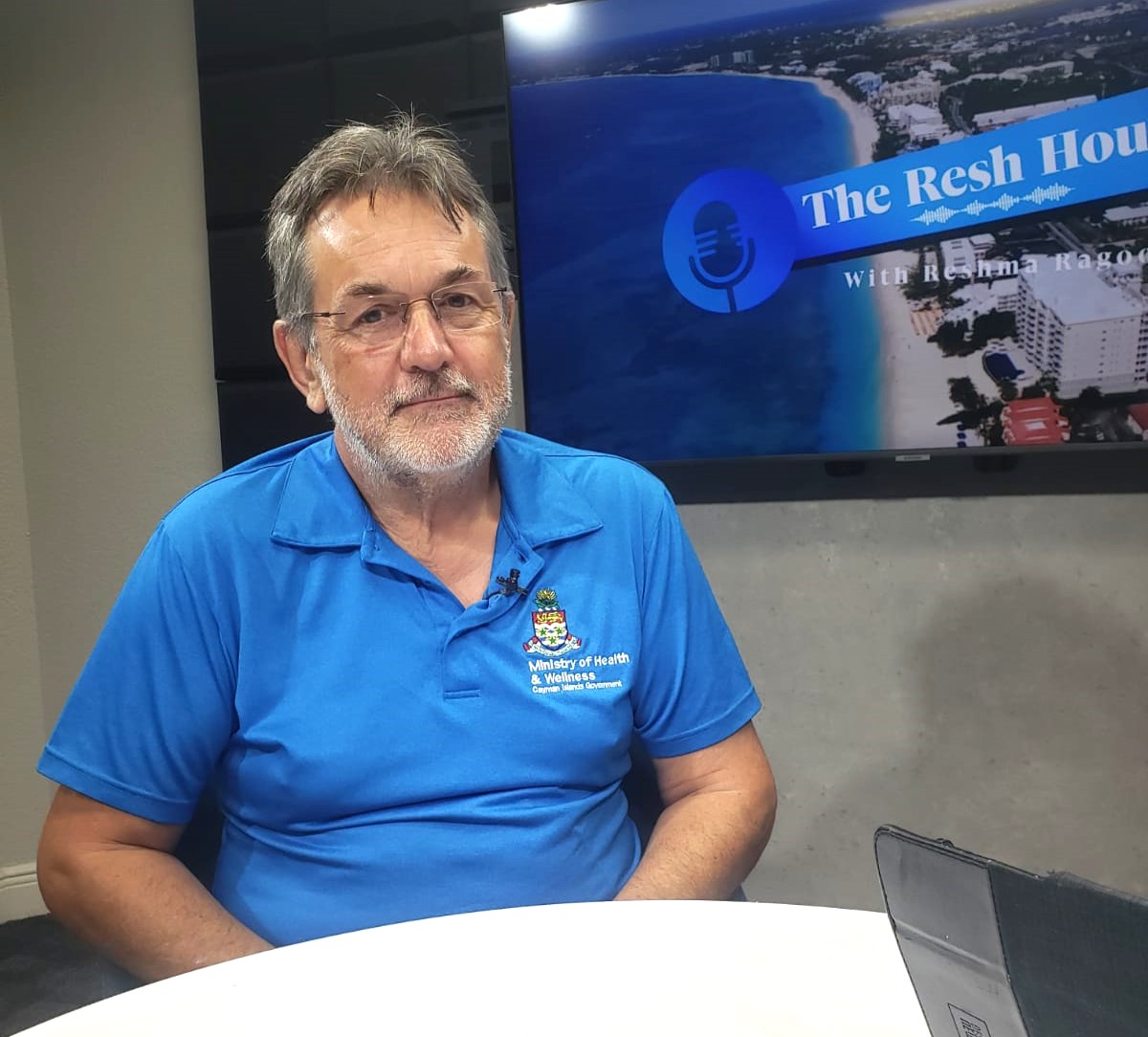
Chief Medical Officer Dr. Nick Gent says his decision to implement stringent rules and guidance for prescribing controlled drugs in Cayman was a necessary safeguard for patients and clinicians alike.
Cayman, he said, cannot continue with the unchecked use of addictive medications like oxycodone and others.
“We’ve already got big problems, but if we don’t take control of these [drugs] the problems we’ve got now, they’re only going to get worse,” Gent said on Wednesday’s episode of the Cayman Compass weekly talkshow ‘The Resh Hour’.
‘I can’t account for them’
Earlier this month, Gent, using his powers under the Misuse of Drugs Act, introduced new regulations, with immediate effect, banning refills on a suite of controlled drugs such as highly abused painkillers like OxyContin (a brand name for oxycodone).
Though some within the pharmaceutical and medical fields believe the strict approach has brought additional strain, financial and otherwise, on those needing the medications, Gent remained firm.
“The cost of care is not primarily what is in my mind here. It is the cost to the people of unrestricted prescribing of controlled drugs… They’re controlled because they are dangerous and almost all of them have strongly addictive properties,” Gent said.
As chief medical officer, he said he has responsibility for issuing licences to import controlled drugs and, in the absence of this regulation, he could not say where the drugs are going.
“I’m personally responsible for the scale of use of these medicines in the Cayman Islands and at the present time I can’t account for them. I’ve spent my first year here looking at and watching those [trends] and I know that we have got a degree of misuse of those [drugs],” Gent said.
He said he knows how much material is being imported into Cayman and it’s not what he thinks would be “rational clinical use”.
Gent said what he has implemented is not “novel”, but standard practice, and Cayman should not be an exception.
“If the medical world is driving a problem of addiction, it’s also the medical world that is responsible for managing those addiction problems. We’ve got to be able to understand what’s coming in, who’s getting it, where it’s going, why it’s going there so that we can drive out bad practice and we can increasingly drive in best practice,” Gent said.
These drugs, he said, are making their way into the black market in Cayman and his actions are not as simplistic as trying to stop criminal trade.
“I’m also trying to introduce quality systems which say that if you are using and prescribing a medicine which has potentially dangerous properties then that has to be done in a structured way,” he said.
The rules, he said, are entirely consistent with those that are in other places like the UK.
“These [rules] are about medicines which should only be used where there is regular supervision. It’s a patient’s interest and it’s a patient’s safeguard here that we’re talking about,” Gent said.
Very high degree of use
Gent also restricted a host of other medications commonly used to treat conditions ranging from anxiety and depression to insomnia and attention deficit disorder.
Cayman, he said, has “very high degrees of usage which don’t seem to be in keeping with our population size for a number of other medicines including things like the anxiolytics [to treat anxiety] and the amphetamines”.
He pointed out that the only information he has is how much of these medicines in total he has allowed into Cayman “but after that there is no information”.
“There’s no standardised pharmacist system. There’s no reconciliation of prescription items. It’s a mystery who’s using them, why they’re being used, what the purpose is, and whether or not they are being used to treat appropriate conditions,” Gent said.
The rules, he said, are now in place to gather that information.
He said what exists now is “complicated” and the problem is officials cannot trace in the system what is happening or who is taking advantage of it.
“I think there are people who are using the system and the system is constructed in a way in Cayman where people can be accessing multiple doctors. There is the potential for doctors and others, in good faith, to be providing prescriptions, but in practice people are gathering prescriptions together and claiming medicines from pharmacies that they don’t need for themselves,” he said.
Gent stressed that it is not a matter of assigning blame or prosecuting anyone, but the drugs in question have serious medical and societal implications when abused or are not monitored well.
“If things like these are not closely monitored and used for the period that they need to [be] and [are on] repeat and repeat and repeat, and suddenly you find ‘Oh, that person maybe hasn’t needed that medicine for the last two or three months but they’ve carried on taking it’ – what’s happened is they’ve been left with a problem of withdrawal if we stop that medicine, and so we’ve accidentally created an addiction,” he said.
Related Videos











So we, the patients, who need medicine regularly need to suffer because others chose to abuse? Cayman is an Island of three. How does he expect those on the other Islands, to see their doctors once a month? How does he expect the elderly, the disabled to get to their doctors once a month? like seriously? This puts tremendous pressure on both the doctors and staff who now have to do even more work, when they could and should be helping people. Let the specialized doctors who have trained in their field and know what is best for their patients, do so. We are NOT the UK. Stop treating us as if we are. Also, listen to those who are SPECIALISTS to find answers to alleviate what you say is being abused. Just don’t go painting everyone with the same brush, making finite decisions that are actually causing more harm than good.
I agree, it’s the medical guild’s self-interest at work.
An unnecessary burden and substantial expense for people already suffering from severe, ongoing pain. A minimum doctor’s appointment just to get a refill is how much? Say $100. That’s an extra $1,200 out of the patients’ pockets. Not to mention travel to the doctor, waiting time, time off work etc.
All that is needed is for a regulation that prescriptions for this class of drug can only be filled at ONE designated pharmacy. The prescription can be electronically sent directly from the doctor to that pharmacy.
That eliminates any potential to fill the prescription at multiple pharmacies.
It seems that the Chief Medical Officer has a low opinion of the competence of our outstanding medical professionals. Yes, controls are needed to prevent abuse and ‘street drugs’ but why does this have to be at the expense of genuine patients with a thinly veiled insult lobbed at our doctors and pharmacists? Not impressed.