


A ‘beach bond’ has been proposed as a possible solution to help fund a major sand replenishment project on Seven Mile Beach.
With government dropping funding for its own project to restore the eroded beach, hoteliers and condo owners are investigating alternate solutions.
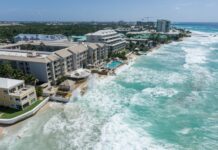
The owners of the Marriott Resort – one of the worst-hit properties – and Dart Enterprises, which owns the derelict Royal Palms a short walk away as well as the Kimpton Seafire and The Ritz-Carlton at the other end of the beach – are pushing for action.
They say Seven Mile Beach is both an asset for tourism and the main recreational space for residents. Hermes Cuello, general manager of the Marriott, said enhancing, protecting and preserving Seven Mile would likely have a positive economic impact on Cayman – even if it costs in excess of $20 million.
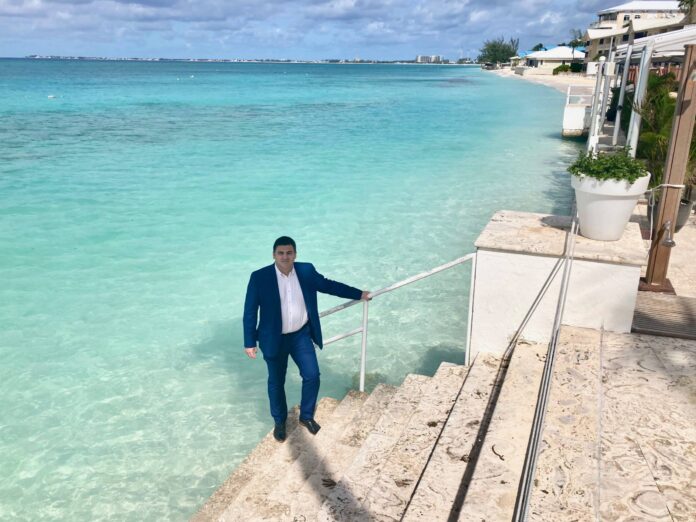
He said the hotel has suffered lower occupancy and lower room rates as a result of losing its beach. That has meant a proportional decline in government revenues, through the tourism and accommodations tax, charged at 13.5% per room.
Collectively, the Seven Mile Beach hotels and condos account for the lion’s share of the approximately $30 million government brings in through this tax annually.
Cuello said hoteliers would likely support a small increase if it could be directed towards a ring-fenced fund to replenish the beach.
“What we would like to discuss with government in future is the possibility of creating a beach fund, coming from the tourism sector,” he said, noting this could be saved each year and dedicated to protecting and preserving the beach.
“That way, any time there is a crisis like there is now, we have the money to deal with it.”
Public funds needed too
At current room occupancy and revenue rates, an extra percentage point on the tourism tax would bring in around $2 million each year. Therefore, any replenishment project on the scale envisaged would likely still involve a significant up-front investment in the first instance.
Cuello emphasised that government, the public and the economy at large would derive multiple benefits from investing in the beach.
He believes a replenishment project would help raise property values – and thus revenue from stamp duty – make coastal infrastructure safer and improve access for everyone, restoring the ability for residents and visitors to walk the length of the beach.
“The beach is public. Anyone can use it, so the investment would be for everyone,” he said.
“I think the replenishment would represent a positive return on investment for the government.
“The private and public sector has to sit down and work out a solution.”
Dart has shared the findings of a comprehensive scientific study on Seven Mile erosion issues with landowners along the beach and with government.
That report by the Danish Hydraulic Institute recommended a large-scale renourishment project to restore the beach.
And it warned that, without intervention, the entirety of the beach would start to be impacted in the coming decades.
Robert Weekley, Dart’s senior vice president of development and planning, said the issue would not be resolved with one replenishment project and that Cayman would continue to be impacted by the changed weather and wave patterns that had caused the loss of sand in the first place.
But, he said, “a wider replenished beach and a holistic beach management programme” will make Cayman better able to cope with these changes and maintain its top attraction.
“The development of a proactive Seven Mile Beach management plan that involves periodic maintenance nourishment is something that is urgently needed to address any future erosion events.”
He said, in other jurisdictions, such projects were typically government funded.
But he did not rule out support from private businesses, potentially through a targeted tax.
“The funds for replenishment programmes can be generated via specific taxes on tourist accommodations and or beachfront properties.
“A review of publicly available information shows that there are instances where replenishment has been funded by private parties or bonds. These options are currently being reviewed.”
Related Videos









These older resorts need to “bite the bullet” now. Get rid of the seawalls and concrete pool decks and any seaside swimming pool. The horse shoe sea wall at Sunset Cove, needs to be removed. When the shoreline of West Bay Beachfront is restored to what it looked like in the 1970s then I am sure there will be amazing results.
The sea wall at Sunset Cove is the only thing keeping the beach there When no-one on SMB can go in the water because of high waves you can go in the water in the cove. Not only should the cove not be removed but the wall should be extended to preserve the rest of SMB. The most famous beach in the world Copa Cabana is q man made beach
This is a bad situation Read “Beach Replenishments Kill Coral Reefs!”
There are other solutions.
I grew up in Fort Lauderdale and 50 years ago they used to catch tons of Lobster on the first reef that was just 200′ off the beach. Then the government started beach replenishments, as Cayman is proposing and the reef was buried in sand, then later the second reef was too. Now you need to go 1/4 mile offshore before you find a reef.
“Florida is taking a giant step backward in terms of maintaining healthy reefs and essential fish habitats, we must learn from the mistakes and destruction of past beach projects,” said Dan Clark of Cry of the Water, pointing out that a recently constructed US Army Corps Civil Works project placed 120,000 cubic yards of sand on the beaches of Pompano and Lauderdale-by-the-Sea, and that local divers are now reporting the burial of nearshore reefs and hardbottom in Pompano Beach. This Army Corps project used the same sand source as Broward County proposes to use. This is particularly alarming since the Broward project would place 1.2 million cubic yards of sand, 10 times the amount as the Army Corps placed.”
The solution might be a combination of things.
We can build groins before any replenishment is done, instead of burying our reefs in sand after the next big storm.
“Groins are shore perpendicular structures, used to maintain updrift beaches or to restrict longshore sediment transport. By design, these structures are meant to capture sand transported by the longshore current”
But they must be properly engineered.
“The negative impact of groins on downdrift shorelines is well understood. When a groin works as intended, sand moving along the beach in the so-called downdrift direction is trapped on the updrift side of the groin, causing a sand deficit and increasing erosion rates on the downdrift side. This well-documented and unquestioned impact is widely cited in the engineering and geologic literature.”
But that doesn’t mean they can’t be used, it means that they must be carefully engineered. Don’t do it without proper design.
The other thing is the the University of Florida has done a lot of research on the addition of underwater artificial reefs nearshore to prevent beach erosion which creates habitats that would be fun for tourist to snorkel on. These should not just be considered for 7 mile beach but off the iron shore around South Church Street where I own a condo at Windsor Village.
Year after year the iron shore get eroded at places like Smith’s Cove. Us older folk will remember how much more iron shore there used to be there. The addition of artificial reefs is an environmentally friendly reduce waves energy before they hit the beach or Ironshore.
UF research is published online and they would consult if asked for a reasonable fee. Please do!
Finally from the cost side. It should not just be the people of Cayman paying for this. To be fair private and commercial owners of oceanfront properties should pay for a significant portion of the solution, they are the most impacted. I am one, I bought my property knowing that the ocean proposed a risk to my property. It’s not like I was surprised when waves crashed over my sea wall.
It is reasonable that i pay my fair share and hope that the solution is more environmentally friendly that a simple replenishment.
There never was a Cove at Sunset Cove. The “Ironshore” ocean front was blasted with Government permission, to create the cove.
I would like to see the costal work approval and license application. SMB started to disappear after that cove came about.
Agreed. I’ve been watching the sand shift for 20 years and I can confirm categorically that we never experienced the loss like we have now until that artificial cove was built. After that no sand came back to that stretch past it to the Marriott. The sand would go and come back (it went away totally after Ivan) but it would come back in full force after storms, and we had over 100 feet of sand in front of Laguna/Regal Beach.